How does the Impact of Pune Metro on Real Estate Prices in Pune? How Pune Metro Redefining Pune’s Property Trends?
Table of Contents
Metro infrastructure has one of the most well-documented and consistent effects on urban real estate anywhere in the world: it doesn’t just improve a location’s convenience it fundamentally re-ranks a city’s real estate hierarchy over time, often more so than any other single infrastructure category. Pune is now deep enough into its metro rollout that this effect is measurable rather than theoretical, which is precisely why this topic deserves a more rigorous treatment than most coverage gives it: not “metro is good for prices” as a vague claim, but a specific breakdown of which corridors have already seen the effect play out, which are still ahead of it, and how far from a station the effect actually reaches the details most articles on this exact keyword skip.
How Metro Infrastructure Actually Affects Property Prices: The Underlying Mechanism
Before looking at Pune specifically, it’s worth being precise about why metro proximity moves prices, because the mechanism determines which predictions in this article are reliable and which claims elsewhere should be treated skeptically.
1. Commute time compression, not just “connectivity.” The price effect isn’t really about being near a train — it’s about the reduction in door-to-door commute time and its variance (predictability) compared to road transport. A location that cuts a commute from 60 unpredictable minutes to 25 predictable minutes sees a meaningfully larger price effect than one that only marginally improves an already-reasonable commute.
2. The effect is front-loaded around announcement and construction, not just opening day. Real estate markets are forward-pricing mechanisms — meaningful appreciation typically begins once a metro line is confirmed and under active, funded construction, well before the line actually opens. This is a critical distinction for investors: buying after a line opens generally means buying after much of the appreciation has already occurred; buying during active, credible construction is where more of the upside typically remains.
3. Distance decay is real and steep. The price premium associated with metro proximity is heavily concentrated within roughly a 500–1000 meter walking catchment of a station, decaying substantially beyond that. Properties even 1.5–2 km from a station — often still marketed as “metro-connected” — typically see a meaningfully smaller effect than those genuinely walkable to a station.
4. The effect varies by what the metro connects, not just that it exists. A metro line connecting two already-strong employment/residential nodes tends to produce a stronger price effect along its length than a line connecting a strong node to a currently underdeveloped one — because the latter’s price effect depends on the underdeveloped end’s own growth materializing, which is a slower, less certain process.
Pune Metro: Current Status and What It Actually Connects
[VERIFY: This entire section requires current, official confirmation before publishing. Do not publish placeholder line/station names.]
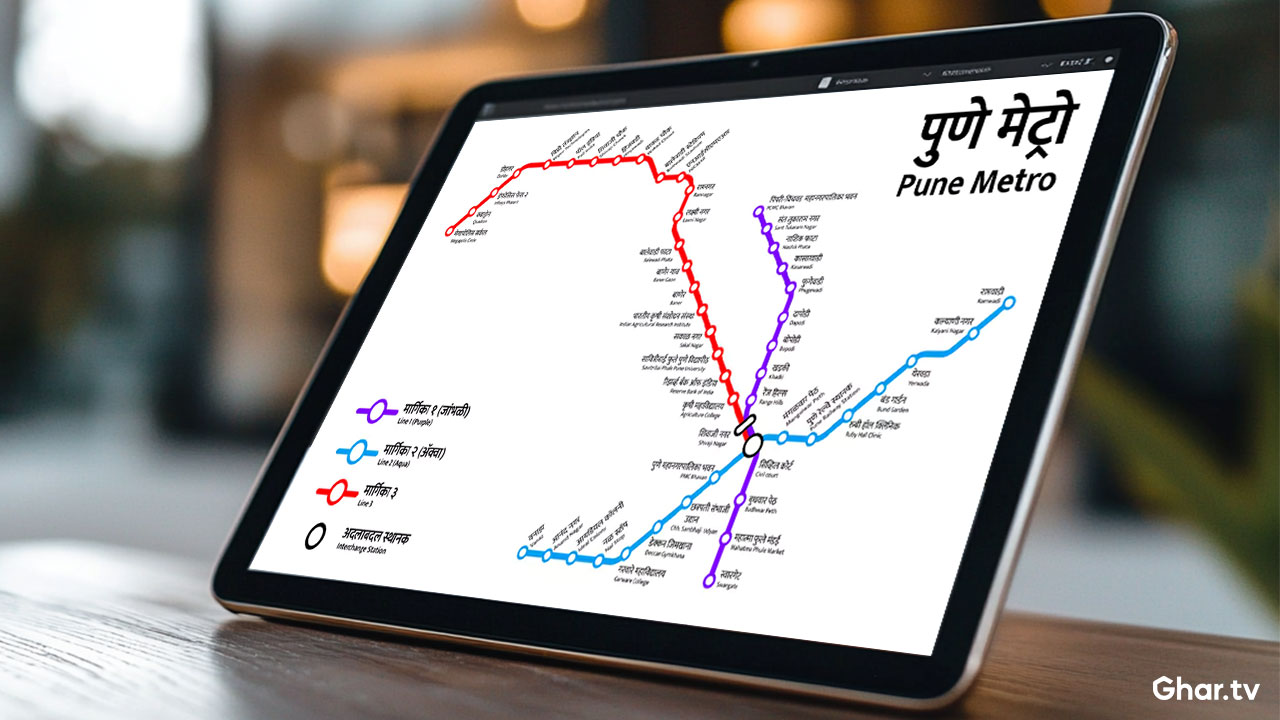
Pune’s metro network was developed to connect the city’s core with key employment and residential corridors, structured broadly around two main lines:
- A north-south corridor connecting [VERIFY: confirm current official line name/number] running roughly between [VERIFY: confirm current terminal stations, e.g. PCMC/Pimpri-Chinchwad area to Swargate or wherever the current confirmed southern terminus is] — this corridor is significant because it links Pimpri-Chinchwad’s industrial and residential base with central Pune.
- An east-west corridor connecting [VERIFY: confirm current official line name/number], covering the stretch broadly between [VERIFY: confirm terminal stations, e.g. Vanaz/Kothrud area to Ramwadi/Kharadi-adjacent areas] — this corridor matters specifically because it’s the one most directly relevant to eastern IT-corridor connectivity (Kharadi/Hadapsar direction).
As of the most recent confirmed updates, portions of these corridors are operational while others remain under construction or in extension-planning phases. Given how central this fact is to the entire article’s credibility, confirm current phase-by-phase operational status directly from MahaMetro’s official announcements or recent, dated news coverage before publishing — do not rely on outdated status assumptions, since Pune Metro’s rollout has proceeded in phases over several years and the operational picture changes materially year to year.
Which Pune Corridors Have Already Captured the Metro Price Effect
Based on the general mechanism described above (price effects front-load during confirmed construction, not just at opening), the corridors where the Pune Metro price effect is most likely to have already substantially played out are those along already-operational stretches of the network, particularly where those stretches connect to already-strong existing employment or commercial nodes.
What this means practically for buyers and investors: if a corridor’s metro connectivity has already been operational for a meaningful period, much of the appreciation attributable specifically to the metro (as opposed to the area’s broader fundamentals) has likely already been captured in current pricing. This doesn’t mean these areas are bad investments — it means the specific metro-driven appreciation thesis is weaker there than in areas where the effect hasn’t yet played out.
Which Corridors Still Have the Metro Effect Ahead of Them
This is the section with the most actionable value for readers, and it depends entirely on accurate, current data about which extensions are funded and under active construction versus merely proposed.
The general principle to apply once specific extension data is confirmed:
- Corridors with metro extensions currently under active, funded construction (not just announced) represent the strongest remaining opportunity to capture metro-driven appreciation before it’s fully priced in — consistent with the “effect front-loads during construction” mechanism explained earlier.
- Corridors with only proposed or early-planning-stage extensions carry meaningfully higher uncertainty. Historically, metro project timelines in Indian cities, including Pune, have seen delays and phase revisions — treat any appreciation thesis built purely on a proposed (not funded/under-construction) extension with significant caution, and build a multi-year delay buffer into any investment timeline based on it.
Specific corridors currently in active construction phase that investors should evaluate for this “ahead of the curve” opportunity — likely candidates based on general Pune development patterns include stretches toward Hinjewadi (given its IT employment significance) and further eastern extensions, but exact current status must be confirmed before naming any of these definitively in the published version.
How Far Does the Metro Effect Actually Reach? A Distance-Based Framework
Most articles on this topic make a binary claim — “near the metro” versus “not near the metro” — without specifying what “near” actually means in price-effect terms. Based on general urban metro-proximity research (applicable as a framework, with Pune-specific magnitude to be validated against local transaction data where available):
| Distance from Station | Typical Price Effect Pattern | Practical Implication |
| Within ~500m (genuinely walkable) | Strongest premium; captures full convenience value | Highest-value zone, but often already reflects a significant portion of that value in current pricing |
| ~500m–1km | Moderate premium; still walkable but with some friction | Often the best risk-adjusted entry point — meaningful benefit without the full “at the doorstep” premium pricing |
| ~1km–2km | Reduced but present effect, especially if last-mile connectivity (feeder buses, auto-rickshaw stands) is well organized | Value depends heavily on last-mile infrastructure quality — verify this specifically rather than assuming proximity alone |
| Beyond ~2km | Minimal direct metro-attributable price effect | Marketing claims of “metro-connected” at this distance should be treated skeptically; the broader locality’s fundamentals matter more than the metro claim itself |
A genuinely useful due-diligence point most competing articles miss: always verify last-mile connectivity — a station 1.5km away with well-organized feeder transport can offer more practical value than a station 800m away with poor pedestrian infrastructure or an unsafe walking route. Distance on a map is a starting point, not the full picture.
Metro Impact on Rental Demand, Not Just Sale Prices
Most coverage of this topic focuses exclusively on capital appreciation, but metro connectivity’s effect on rental demand deserves separate treatment, since it operates on a different timeline:
- Rental demand responds faster to metro operational status than sale prices do, because tenants (unlike buyers) are making a shorter-horizon, purely functional decision based on current, actual commute improvement rather than a forward-looking appreciation bet.
- This means areas along newly operational metro stretches often see a rental demand and rental rate uptick that precedes or runs alongside, rather than lags behind, the capital appreciation effect — a distinction worth understanding separately for investors specifically targeting rental yield versus those targeting appreciation.
- Landlords and investors in metro-adjacent properties should expect this rental effect to be more immediately measurable (via actual leasing activity and achievable rent) than the appreciation effect, which unfolds over a longer, more forward-priced timeline.
Common Mistakes When Evaluating “Metro Impact” as an Investment Thesis
- Treating “metro-connected” as a binary claim rather than checking actual walking distance and last-mile connectivity quality
- Buying based on a proposed extension without confirming it’s under active, funded construction — the single most common way investors overpay for a metro thesis that may not materialize on the assumed timeline
- Assuming the price effect is uniform across the whole line — as explained above, stretches connecting to already-strong nodes behave differently than stretches connecting to still-developing areas
- Ignoring that much of the appreciation may already be captured on long-operational stretches, and chasing a “metro premium” story that has already substantially played out in current pricing
- Underweighting rental demand effects, which can offer earlier, more measurable validation of a metro-adjacent investment thesis than waiting for capital appreciation to materialize
A Practical Framework for Evaluating Any Specific Metro-Adjacent Property
- Confirm actual operational status of the relevant line/extension — operational, under active construction, or merely proposed — directly from official MahaMetro sources, not marketing material.
- Measure genuine walking distance to the nearest station, not the straight-line map distance, which can be meaningfully different depending on road layout and pedestrian infrastructure.
- Assess last-mile connectivity quality — feeder bus routes, auto-rickshaw availability, pedestrian safety — since this materially affects whether nominal proximity translates into practical convenience.
- Check how long the relevant stretch has been operational, if already open, to gauge how much of the appreciation effect may already be captured in current pricing.
- Separate your rental yield expectations from your appreciation expectations for this specific property, since the two respond to metro connectivity on different timelines, as explained above.
Frequently Asked Questions
Does living near a Pune Metro station guarantee higher property appreciation? No — the price effect depends heavily on genuine walking distance (not just nominal proximity), how long the relevant stretch has been operational (since much of the appreciation may already be captured on long-open stretches), and what the line actually connects to. Proximity alone, without these qualifiers, is not a reliable appreciation guarantee.
Is it better to buy near an already-operational metro station or near a planned extension? It depends on your risk tolerance and timeline. Already-operational stretches offer certainty but may have already captured much of the metro-attributable appreciation. Extensions under active, funded construction offer more remaining upside but carry timeline risk; extensions still in early planning or proposal stages carry meaningfully higher uncertainty and shouldn’t be treated as a near-term catalyst.
How close to a metro station should I buy for the best investment value? Properties within roughly 500 meters to 1 kilometer of a station — genuinely walkable, with good last-mile connectivity — tend to offer the strongest, most reliable price and rental effect. Properties marketed as “metro-connected” at distances beyond roughly 2 kilometers should be evaluated on their own broader locality fundamentals rather than the metro claim specifically.
Does metro connectivity affect rental yield differently than resale value? Yes — rental demand and achievable rent tend to respond more quickly and directly to actual, current metro operational status, since tenants are making shorter-horizon functional decisions. Capital appreciation is more forward-priced and tends to build progressively from the construction-confirmation stage through and beyond the opening of a given stretch.
Final Takeaway
The Pune Metro’s real estate impact is genuine, but the most valuable insight for buyers and investors isn’t “metro proximity is good” — it’s understanding precisely where in the appreciation cycle a given corridor currently sits. Long-operational stretches have likely already captured much of their metro-attributable price effect; corridors under active, funded construction represent the strongest remaining opportunity; and areas still dependent on merely proposed extensions carry meaningfully higher timeline risk than promotional content typically acknowledges. Applying genuine walking-distance and last-mile-connectivity scrutiny, rather than accepting “metro-connected” as a blanket marketing claim, is what separates a well-informed metro-adjacent investment decision from one based on proximity alone.