What is OC? Meaning, Full Form & Importance in Real Estate
Table of Contents
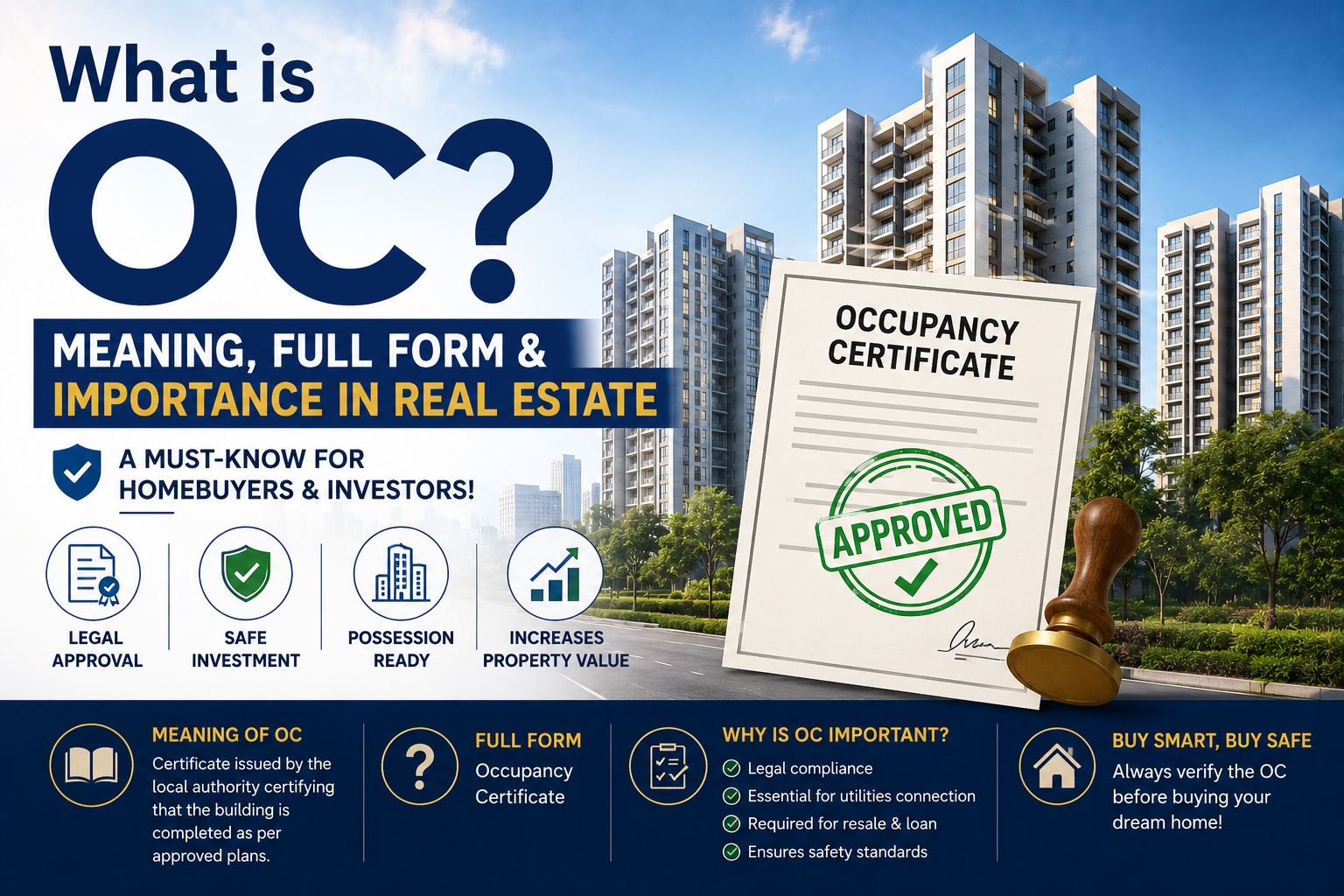
What Is OC? OC Full Form, Meaning, and Everything You Need to Know About Occupancy Certificate
If you are buying a flat, taking possession of a new home, or checking whether a building is legally ready to live in, “OC” usually means Occupancy Certificate in real estate.
In simple words, an Occupancy Certificate is an official document issued by the local municipal authority or development authority confirming that a building has been constructed according to the approved plan and is fit for occupancy. It tells buyers, lenders, and utility providers that the building is legally and technically ready to be used.
For search intent, this is the most important thing to understand first: while “OC” can have different meanings in different industries, in property and home-buying searches it most commonly refers to an Occupancy Certificate. That is why most top-ranking pages on this keyword are real estate-focused.
OC full form: Occupancy Certificate
In real estate, the full form of OC is Occupancy Certificate. It is the certificate that shows a building complies with approved plans, applicable rules, and basic safety requirements, and can therefore be occupied legally.
What is an Occupancy Certificate?
An Occupancy Certificate is a legal approval issued after construction is complete and the authority verifies that the building broadly follows the sanctioned plan and required norms. In buyer-friendly language, it means the property is not just built, but officially cleared for occupation.
A valid OC generally indicates the following:
- The building is constructed according to approved plans
- The structure is considered fit for occupancy
- Key compliance checks have been cleared
- The property can be legally occupied
- Utility connections and financial documentation become easier to process
Why is an Occupancy Certificate important?
This is where most articles stop at “it is important,” but the buyer needs to know exactly why.
- It proves the home is legally fit to occupy.
Without an OC, the property may be treated as incomplete or unauthorized for occupation, even if construction looks physically finished. This is one of the biggest reasons buyers should never rely only on the builder’s possession letter.
- It supports utility connections.
Water, electricity, sewage, drainage, and sometimes gas-related approvals are often linked to the property being officially occupiable. Several guidance pages and official municipal processes make it clear that compliance documentation is central to the OC stage.
- It reduces legal and financial risk.
If there are plan deviations, incomplete statutory approvals, or major safety non-compliances, the authority may delay or deny the OC. That means the buyer may face notices, penalties, delayed services, or prolonged disputes with the developer.
Who issues the Occupancy Certificate?
An Occupancy Certificate is generally issued by the local municipal corporation, municipal council, planning authority, or urban development authority after inspection and scrutiny of the building records. The issuing authority depends on the city, project type, and local development rules.
Who applies for OC?
In most cases, the builder or developer applies for the Occupancy Certificate after construction is completed. In some situations, the property owner may also apply, depending on local rules and the nature of the project.
When is an Occupancy Certificate issued?
OC is typically issued after:
- Construction is complete
- Required documents are submitted
- The site is inspected
- The authority confirms compliance or accepts only limited permissible deviations under local rules.
This is an important ranking opportunity for your article: many competing pages say “after completion,” but official pages show that the real-world process also includes documentation, inspection, deviation review, and approval layers before the certificate is granted.
Documents required for Occupancy Certificate
The exact list varies by authority, but these documents commonly appear across major guidance pages and official processes:
- Approved or sanctioned building plan
- Completion certificate
- Completion report from architect or engineer
- Structural stability certificate
- Fire safety NOC
- Water and sewage clearance
- Property tax receipts
- Photographs of the completed building
- Electrical or lift-related clearances in applicable cases
- Declarations, undertakings, or affidavits required by the local authority
Examples from official authorities
Official authority pages add useful practical detail that most general articles miss:
- HMDA asks for a building completion notice certified by the architect, PDF drawings as per construction, a declaration-cum-undertaking on stamp paper, and building photographs. It also notes scrutiny of deviations and approval routing through multiple officials.
- Guwahati Municipal Corporation lists forms, completion records, structural inspection report, electrical clearance, lift NOC, and fire NOC, and says the field engineer will inspect the building within 21 days.
- Margao Municipal Council requires an architect/engineer completion certificate, planning authority completion certificate, health, PWD and electricity-related final NOCs, structural stability certificate with RCC calculations, and in some cases fire clearance, conservation approval, and solid waste management undertaking.
Step-by-step process to get an Occupancy Certificate
Although the procedure differs by city, this is the broad process buyers and owners should expect:
Step 1: Construction is completed
The builder completes the structure according to the sanctioned plan and project approvals.
Step 2: Builder or owner files the application
The application is submitted to the municipal or development authority with all required certificates, plans, NOCs, and supporting records.
Step 3: Documents are scrutinized
The authority checks whether the building records, completion documents, and technical certifications are in order.
Step 4: Site inspection happens
Officials inspect the actual site to verify compliance. Some official pages specifically mention parking, rainwater harvesting, waste handling, plantation, structural documentation, or deviation checks as part of the review.
Step 5: Defects or deviations are addressed
If the authority notices deviations or missing documents, the builder may need to rectify them, pay applicable charges where permitted, or resubmit information.
Step 6: OC is issued
Once the authority is satisfied, it issues the Occupancy Certificate and the building becomes legally occupiable according to local rules.
How long does it take to get OC?
There is no one national timeline. General guidance pages often mention around 30 days after a proper application, but actual timelines depend on the city, completeness of documents, and whether deviations exist. One official GMC Assam page specifically says the field engineer will inspect within 21 days, which gives a useful real-world benchmark for localized processes.
How to check Occupancy Certificate online or offline
Buyers should never assume the OC exists just because the flat looks complete.
Online verification
Many authorities now allow online checking or downloading through their official websites using application number, property details, or project information.
Offline verification
You can also verify through the local municipal office, planning authority, residents’ association, or by requesting the builder to share the copy and then cross-checking it with the issuing authority.
Buyer checklist before accepting possession
- Ask for the OC copy, not just a promise
- Verify that the issuing authority’s name is correct
- Match project name, tower, wing, plot, and address details
- Check whether it is a full OC or a partial OC
- Confirm date of issue
- Ask if any conditions or pending compliances remain
- Cross-check through the authority portal or office if possible
OC vs CC vs Possession Letter vs Partial OC
This comparison section is worth including because many ranking pages mention it only briefly.
| Document | Meaning | What it proves | What it does not prove |
| OC | Occupancy Certificate | The building or approved part of it is fit for occupancy | It does not replace title verification or sale documents |
| CC | Completion Certificate | Construction is completed as per approved plans | It does not itself mean the property is ready to occupy |
| Possession Letter | Handover-related document from builder | The builder is offering possession | It is not a substitute for legal occupancy approval |
| Partial OC | Occupancy approval for a specific completed part | A certain tower, wing, or section is approved for use | It does not mean the entire project has full OC |
What is a Partial Occupancy Certificate?
A Partial Occupancy Certificate, or Part OC, is issued when only a part of the project is complete and compliant. For example, one tower in a multi-tower development may receive a Part OC while the rest of the project is still under construction or approval review. Buyers should check exactly which block, floor range, or section the certificate covers.
Is it safe to buy a flat without OC?
In practical terms, it is risky.
A property without OC may lead to problems with possession, utilities, resale, loans, insurance, penalties, or disputes about legal occupancy. Even if many buyers in some markets do move in before OC, that does not reduce the risk. The safer standard is simple: if you are buying a ready-to-move property, insist on a valid OC and verify it independently.
Can you get a home loan without OC?
For under-construction projects, lenders evaluate a wider document set. But for ready-to-move or completed property transactions, banks and finance companies often expect OC as an important compliance document. In short, the absence of OC can complicate or delay loan approval and increase lender caution.
Can you move into a property without OC?
You may see this happen in practice, but legally and from a buyer-risk perspective, it is not advisable. Multiple guides warn that occupation without OC can expose buyers or occupants to civic action, service issues, and legal complications.
What happens if the builder does not provide OC?
If the builder delays or fails to provide OC, buyers should not treat it as a minor paperwork issue.
What buyers can do
- Ask for the official application status
- Request the OC or acknowledgment copy in writing
- Verify directly on the authority portal or office
- Check whether the problem is document-related, deviation-related, or approval-related
- Escalate to RERA or consumer forum where appropriate
- Seek legal advice before final possession or full payment if the issue persists
State and city variation: why this matters
A strong article should say this clearly: there is no single India-wide OC checklist that applies identically everywhere.
Official pages show that different authorities ask for different combinations of forms, technical certifications, NOCs, inspections, and fees. For example:
- HMDA uses an online application, architect-certified completion notice, as-built drawing, undertaking, photographs, deviation review, and layered approval. HMDA
- GMC Assam says the service is not online, lists several prescribed forms, and mentions a field engineer inspection within 21 days.
- Margao Municipal Council includes planning, health, electricity, structural, and in some cases fire and conservation-related documentation, plus house tax registration before issuance.
That is why buyers should always verify the process with the specific local authority rather than relying only on a generic blog.
Common myths about Occupancy Certificate
Myth 1: OC and CC are the same
They are related, but not the same. CC confirms completion of construction. OC confirms legal fitness for occupation.
Myth 2: If possession is offered, OC must already exist
Not necessarily. A possession letter from the builder is not the same as a valid OC.
Myth 3: OC matters only for commercial buildings
No. Residential projects are equally affected, especially regarding legal occupation, utilities, home loans, and resale.
Myth 4: If the building is complete, OC is automatic
No. Official authority pages clearly show that documentation, inspection, and scrutiny are part of the process.
Final Word
If you remember only one thing, remember this: OC is not just a formality. It is one of the clearest indicators that a building is legally ready to be occupied.
For buyers, a valid Occupancy Certificate lowers risk, improves resale confidence, supports utilities and financing, and helps you avoid possession-related surprises. For builders and owners, it is an essential compliance milestone. And for anyone searching “What is OC?” in a property context, the most accurate short answer is this:
OC full form of OC is Occupancy Certificate, and it is the official approval that a building is fit and lawful to occupy.
FAQs
What is OC in real estate?
OC means Occupancy Certificate. It is issued by the local authority to confirm that the building complies with approved plans and is fit for occupation.
What is the full form of OC?
The full form of OC is Occupancy Certificate.
Is Occupancy Certificate mandatory?
In practical real estate compliance terms, yes, it is treated as a crucial legal requirement before lawful occupation of a completed building.
Who gives the Occupancy Certificate?
Usually the municipal corporation, municipal council, planning authority, or urban development body having jurisdiction over the project.
Can I buy a flat without OC?
You can, but it is risky and generally not advisable for a ready-to-move property because legal occupancy, utilities, financing, and resale may all be affected.
How do I verify an OC?
Ask for a copy, check the project details on it, and verify through the local authority website or office wherever possible.