Ravet Pune Infrastructure Update 2026-27: Metro, Roads & Upcoming Projects
Table of Contents
Ravet sits at one of the busiest crossroads in the Pune Metropolitan Region — right where the Mumbai-Pune Expressway meets the Katraj-Dehu Road bypass, a stone’s throw from Hinjewadi’s IT corridor. That location has made it one of PCMC’s fastest-growing residential belts, but it has also left the area chronically underserved by public transport, with residents openly naming water supply, road width, and the “metro isn’t here yet” gap as their top complaints heading into 2026.
That is now changing on multiple fronts at once. A ₹6,000 crore elevated corridor connecting Ravet to Narhe has just received DPR approval, a metro line is finally being planned through the neighbourhood, and long-stalled water infrastructure has regained political priority. Here is a complete, currently-accurate picture of what’s actually moving in Ravet for 2026-27 — not just what’s been announced.
Quick Snapshot: Ravet Pune Infrastructure Update at a Glance
| Project | Current Status | Expected Timeline | Estimated Cost |
| Ravet-Narhe Elevated Corridor | DPR approved (July 2026) | Construction not yet started | ₹6,000 crore |
| Khed Shivapur–Ravet NHAI Service Road | Approved, land acquisition ~90% done | Construction from 2025-26 | ₹604 crore |
| Nigdi-Chakan Metro (via Ravet) | DPR approved by PCMC General Body | Construction not yet started | ₹12,937 crore (full corridor) |
| Hinjewadi-Shivajinagar Metro (Line 3, Wakad interchange) | Phased launch underway | Mid-to-late 2026 | — |
| Mumbai-Pune Expressway Missing Link | Operational | Opened May 1, 2026 | — |
| Pavana Closed Pipeline (water) | Long-stalled, regaining priority | Under review, no firm date | — |
| Harit Setu Green Corridor & internal link roads | Ongoing/proposed | Phased | — |
| PCMC BRTS (Aundh-Ravet corridor) | Under civic review — possible removal | Decision pending | — |
Check Best Properties in Ravet by clicking here
1. Where Ravet Stands Today
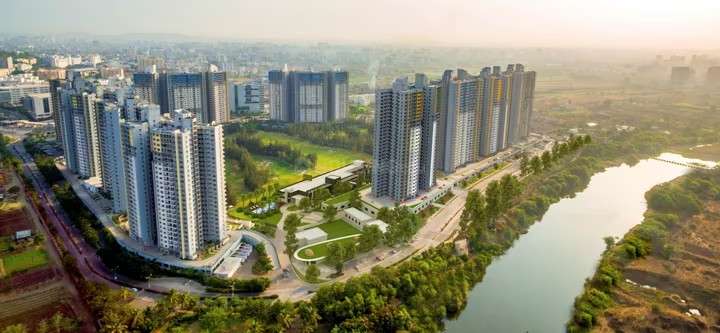
Ravet falls within Pimpri-Chinchwad Municipal Corporation (PCMC) limits, bordered by the Pavana River to the south and positioned directly at the Mumbai-Pune Expressway / Katraj-Dehu Road Bypass junction — which is why locals and real estate listings alike call it the “gateway to PCMC.” Neighbouring localities include Punawale, Tathawade, Kiwale, Nigdi, Akurdi, Wakad, and Pradhikaran, and the area has grown rapidly around mid-to-high-rise residential townships, campuses like D.Y. Patil and Symbiosis Skills & Professional University, and its direct road access to the Hinjewadi IT Park.
Despite that growth and connectivity advantage, residents surveyed ahead of the PCMC civic elections flagged three recurring, unresolved issues: poor internal road quality, an underpass at Punawale that has awaited widening for roughly a decade, and unreliable water supply that still forces many households to rely on tanker water.
2. Metro Connectivity: What’s Actually Planned for Ravet
Ravet does not have an operational metro station today, and locals commuting toward central Pune currently depend on PMPML buses, autos, and cabs. That is set to change, but not immediately — here’s exactly what’s on the table.
Nigdi-Chakan Metro Corridor (Phase 2) — Passes Directly Through Ravet
This is the metro line most relevant to Ravet residents. MahaMetro’s revised Phase 2 plan for Pimpri-Chinchwad runs from Bhakti-Shakti Chowk in Nigdi through a series of stops that include Ravet directly on its route, before continuing to Punawale, Tathawade, Wakad, Pimple Saudagar, and onward toward Bhosari and Chakan.
- Full route through Ravet’s immediate vicinity: Bhakti-Shakti Chowk (Nigdi) → Transport Nagar → Ganesh Nagar → Mukai Chowk → Ravet → Punawale Village → Punawale → Tathawade Village → Tathawade → Bhumkar Chowk → Wakad → onward toward Chakan
- Total corridor: approximately 45.3 km with 34 stations (28 within PCMC limits), at a revised estimated cost of ₹12,937.23 crore, as finalised in the July 2026 presentation to Pimpri-Chinchwad’s public representatives
- Status: Plan and cost structure approved by the PCMC General Body after amendments; construction has not yet begun. Local representatives have also asked for six-coach train capacity instead of three, given projected ridership growth in this belt
- Wakad interchange: Commuters will be able to switch to the Hinjawadi-Shivajinagar Metro (Line 3) at Wakad — a short distance from Ravet — once that line is fully operational
Hinjewadi-Shivajinagar Metro (Line 3) — The Nearest Operating Line
While it doesn’t run through Ravet itself, Line 3 (the Pink Line) is the metro corridor Ravet residents are most likely to use in the near term, given its proximity via Wakad. Built under a Tata-Siemens public-private partnership, the line has faced repeated delays — originally targeted for March 2023, then pushed to March 2025, and most recently to a phased launch around June-July 2026 for the first 12 stations, with the remaining stretch to the Civil Court interchange targeted for October-December 2026. Once open, Wakad’s proximity to Ravet (a short drive or feeder-bus ride) will meaningfully cut travel time to Hinjewadi and central Pune, even before the Nigdi-Chakan line reaches Ravet directly.
If you live in Ravet and want the fastest realistic metro access, plan around the Wakad station of Line 3 for 2026-27 — the line running directly through Ravet (Nigdi-Chakan Phase 2) is still in the pre-construction stage.
3. Ravet-Narhe Elevated Corridor: The Biggest Road Project for This Belt
This is the single most consequential infrastructure update for Ravet in 2026, and it has moved fastest of any project affecting the locality.
What it is: A fully elevated, six-lane road corridor connecting Ravet to Narhe, designed to relieve chronic congestion on the Mumbai-Bengaluru Highway (Old NH-4) through the Hinjewadi IT corridor.
Route: The corridor spans Wakad, Tathawade, Punawale, Ravet, Balewadi, Baner, Sus, and Bavdhan before reaching Narhe — directly serving the residential and IT-commuter population living in and around Ravet.
Length and cost: Estimates have shifted as the project moved through approval stages — early reports pegged it at roughly 24 km and ₹2,000-2,600 crore; by the time the Detailed Project Report (DPR) received approval in July 2026, the scope had grown to approximately 32 km at an estimated ₹6,000 crore.
Approval timeline:
- The DPR was submitted by NHAI to the Union Ministry of Road Transport and Highways in early 2025
- Central approval was delayed through much of 2025 pending Finance Ministry committee clearance, pushing the project back by roughly a year from its original schedule
- DPR approval was confirmed in July 2026, under Union Minister Nitin Gadkari’s road infrastructure push for Pune
- Construction has not yet started; the project will proceed to tendering next
Execution phases: Once construction begins, the project is planned in three phases — Ravet to Balewadi, Balewadi to Warje, and Warje to Narhe — meaning the Ravet-to-Balewadi stretch is likely to be prioritised first, given it directly serves the Hinjewadi commuter corridor.
Why it matters for Ravet specifically: This corridor would give Ravet residents an elevated, signal-free route toward central Pune and the Hinjewadi IT hub, bypassing the ground-level congestion that currently makes this stretch one of the worst commutes in the metropolitan region.
4. Khed Shivapur–Ravet NHAI Service Road
A separate but complementary NHAI project focuses on service roads along the highway corridor feeding into Ravet:
- Route: A 32.4-km, two-lane service road from Khed-Shivapur to Ravet, running along the Mumbai-Bengaluru National Highway
- Cost: ₹604 crore
- Purpose: Designed to handle daily traffic load of roughly 2.1 lakh vehicles and cut travel time by up to 20 minutes at chronic bottleneck points including Narhe, Navale Bridge, Warje, Chandani Chowk, and Ravet itself
- Land acquisition: As of the project’s approval stage, PCMC had completed roughly 90% of the land acquisition on its side, while PMC was handling the remaining portion
- Execution approach: The first phase focuses on land acquisition and road widening from Ravet to Wakad, with concretisation of service roads from Wakad to Khed Shivapur to follow
5. Local Road & Junction Improvements Inside Ravet
Beyond the two major highway-linked projects above, PCMC has a set of smaller, more immediate road works planned for the Ravet-Punawale-Tathawade belt:
- Harit Setu green corridor and new link roads: Ongoing and proposed works aimed at improving traffic flow and walkability along the Nigdi–Ravet–Akurdi belt
- 18-metre road near the river behind Sameer Lawns in the Ravet and Kiwale area
- Punawale underpass widening: A long-pending demand — residents note this has been promised in DPRs “for the last 10 years” without ground implementation, making it one of the most-watched local road items for 2026-27
- 30-metre road from Punawale underpass to Katewasti, and connecting internal roads toward Wakad and Indira Road
- Sangawade-Hinjawadi bridge over the Pavana river, near the Mamurdi crematorium — relevant for cross-river connectivity from Ravet’s western edge
The BRTS Question
PCMC is separately reviewing whether to scale back or remove its 60-km Bus Rapid Transit System network citywide, citing worsening congestion, road-narrowing effects, and a shortage of buses running on dedicated BRT lanes. Notably, PCMC officials have singled out the Aundh-Ravet BRTS road as one of the stretches where the road is wide enough that BRT isn’t the primary problem — unlike narrower corridors such as the Old Mumbai-Pune Highway, where removal is being more seriously considered. No final decision had been announced as of the review in August 2026.
6. Mumbai-Pune Expressway Missing Link: Indirect but Real Impact
While this project sits well outside Ravet itself, it directly affects traffic entering and exiting the Mumbai-Pune Expressway near Ravet’s junction:
- The 13.3-km Missing Link between Khopoli and Kusgaon opened on May 1, 2026, bypassing the accident-prone, congestion-heavy Bor Ghat (Khandala-Lonavala) section
- It is expected to cut Mumbai-Pune travel time by 20-30 minutes and shorten the route by nearly 6 km
- Initial restrictions (through October 31, 2026) limit the new stretch to light motor vehicles and buses, with heavy trucks continuing on the old ghat route — a decision under review for November 2026
- For Ravet residents, this means smoother expressway-linked travel and, over time, is expected to redistribute some traffic volume that currently backs up toward the Ravet/Dehu Road junction during peak travel periods and long weekends
7. Water Supply: Ravet’s Most Immediate Civic Concern
Unlike metro and road projects, which are aspirational for most Ravet residents, water is the infrastructure issue actively affecting daily life right now.
Current situation: PCMC serves Ravet primarily via the Pavana Dam, supplemented by the Andhra and Kasarsai dams. Compared to some other pockets of PCMC, the broader Wakad-Punawale-Ravet belt has been reported to receive somewhere in the range of 6-8 hours of daily supply on functioning days — but this masks significant local variation, and many households report needing to buy tanker water regularly, alongside complaints of inconsistent pressure and water quality.
The Pavana Closed Pipeline Project: Local corporators have repeatedly flagged this as the single fix Ravet, Tathawade, and Punawale need most. The project has been stalled for over 15 years due to funding and implementation issues, though it regained priority status in mid-2026 following direct engagement from Chief Minister Devendra Fadnavis. As of a June 2026 update, large-capacity elevated water tanks (4.5 million litres and 2.5 million litres) have already been constructed in Wakad, Tathawade, and Punawale — but remain non-functional because the pipeline supplying them isn’t complete, meaning crores of rupees of built infrastructure currently sit idle.
What this means practically: If you’re evaluating a home or planning around water reliability in Ravet, do not assume the presence of overhead tanks in your society or neighbourhood means daily supply — ask specifically whether the Pavana Closed Pipeline connection is live for that pocket, since infrastructure and actual water flow are currently two different things in this belt.
8. Public Transport: Buses, Feeder Routes & What’s Changing
Until direct metro access arrives, Ravet’s public transport backbone remains PMPML buses:
- Route VJR5 is among the PMPML routes directly connecting Ravet to key areas of Pune
- Shared autos and app-based cabs currently cover first- and last-mile connectivity gaps
- The nearest railway stations to Ravet are Akurdi, Dehu Road, Chinchwad, and Begdewadi
- As part of PMPML’s broader regional fleet expansion (targeting 4,000-4,500 buses across Pune and PCMC by end-2026), officials have stated a strategic shift toward feeder routes into metro stations rather than routes competing with the metro — meaning Ravet is likely to see improved bus connectivity specifically engineered to funnel commuters toward the Wakad Line 3 station and, eventually, toward Ravet’s own planned Nigdi-Chakan metro stop
9. Real Estate Context: Why Infrastructure Timing Matters Here
Ravet’s locality rating currently stands at roughly 4.6 out of 5 for connectivity, safety, lifestyle, and environment on major property platforms, ranking it among the higher-rated localities in the wider Pune region despite its unresolved civic issues. With several hundred residential projects active in the micro-market and steady price appreciation in the broader Punawale-Ravet-Tathawade belt over the past decade, most of that value has been priced in anticipation of exactly the projects covered above — the elevated corridor, the metro extension, and eventual resolution of the water pipeline. That makes the actual construction timelines (not just approval announcements) the detail worth tracking most closely if you’re buying, renting, or investing in this belt.
10. Ravet Infrastructure Readiness Score (2026)
To cut through announcement noise, here’s a readiness assessment for each project based on actual construction status, funding, and land acquisition progress — not just political statements:
| Project | Readiness Score (out of 10) | Reasoning |
| Mumbai-Pune Expressway Missing Link | 10/10 | Already open and operational (indirect benefit to Ravet traffic) |
| Khed Shivapur–Ravet NHAI Service Road | 6/10 | ~90% land acquired by PCMC, phased execution defined |
| Hinjewadi-Shivajinagar Metro (Line 3, via Wakad) | 5.5/10 | Phased launch underway through 2026, though it has a long history of missed deadlines |
| Ravet-Narhe Elevated Corridor | 4/10 | DPR just approved after a year-plus delay; construction and tendering not yet started |
| Pavana Closed Pipeline (water) | 3/10 | Regained political priority in 2026, but 15+ years of prior stalling and no firm completion date |
| Nigdi-Chakan Metro through Ravet (Phase 2) | 2.5/10 | Route and cost approved by PCMC, but no construction start date |
| Punawale Underpass Widening | 2/10 | Repeatedly promised in DPRs over a decade with no ground implementation |
| PMPML BRTS Review (Aundh-Ravet corridor) | N/A | Under review only — outcome (retain, modify, or scrap) undecided |
(Scores reflect construction and funding status as of September 2026, not the eventual importance of each project to Ravet residents.)
Frequently Asked Questions
Does Ravet have a metro station yet? No. As of September 2026, there is no operational metro station in Ravet. The Nigdi-Chakan Metro (Phase 2), which will run directly through Ravet, has an approved route and cost estimate but has not started construction. The nearest usable metro access for Ravet residents will be the Wakad station on the Hinjewadi-Shivajinagar Line 3, which is being launched in phases through 2026.
What is the status of the Ravet-Narhe elevated road? The Detailed Project Report (DPR) for this six-lane, roughly 32-km elevated corridor (revised cost ~₹6,000 crore) received approval in July 2026, after facing over a year of delay awaiting central Finance Ministry clearance. Construction and tendering have not yet begun.
Why is water supply still unreliable in Ravet despite new infrastructure? Large water storage tanks have been built in the Ravet-Tathawade-Punawale belt, but they remain non-functional because the Pavana Closed Pipeline project supplying water to them is incomplete. The pipeline has been stalled for over 15 years and regained state-level priority only in mid-2026, with no confirmed completion date yet.
How will the Mumbai-Pune Expressway Missing Link affect Ravet commuters? It doesn’t run through Ravet directly, but since Ravet sits at the expressway/bypass junction, the Missing Link (opened May 2026) is expected to ease overall traffic volume and reduce backups near this junction by cutting 20-30 minutes off Mumbai-Pune travel time and rerouting ghat-bound traffic away from the old bottleneck section.
Is the Punawale underpass widening actually happening? As of 2026, this remains a planned item repeatedly referenced in PCMC’s development plans over roughly a decade, without confirmed construction start. It’s one of the most locally-cited “promised but not delivered” projects in the Ravet-Punawale belt.
The Bottom Line
Ravet’s infrastructure story in 2026-27 is one of genuine momentum finally catching up to a decade of underinvestment — but with a real gap between what’s approved on paper and what’s under active construction. The Ravet-Narhe elevated corridor and the Nigdi-Chakan metro line are the two projects that would most transform daily life here, and both have only just cleared planning-stage approvals in 2026, meaning ground-level change is still likely 2-4 years out. In the meantime, the Khed Shivapur-Ravet service road, the Wakad metro interchange, and PMPML’s feeder-route expansion are the more near-term wins worth tracking. Water infrastructure remains the area’s most immediate unresolved concern, and is worth verifying directly for any specific pocket of Ravet rather than assuming citywide announcements apply equally everywhere.