Is an Occupancy Certificate Mandatory in India? Rules Explained
Table of Contents
Buying a house is a delightful event that often gets celebrated with joy. Yet, it is equally important to carry out thorough legal checking. The most crucial document for the buyer of a property in India is the Occupancy Certificate (OC). In fact, your “dream home” may be termed as unauthorised construction just because of the lack of it.
Recent court decisions and RERA regulations require that possession of property with an Occupancy Certificate is a legal possession. A mere submission of the Occupancy Certificate, That means it is no longer a mere formality but is a statutory mandatory requirement (NoBroker Legal, 2026).
What is an Occupancy Certificate?
An Occupancy Certificate (OC) refers to a document of legal nature that a local municipal authority or a civic body (like the DDA, BMC, or DTCP) issues after the completion of a building. It acts as a confirmation that:
- The work has been done exactly as per the sanctioned building plans.
- The building is in full compliance with the respective local building codes and safety standards.
- Besides the fire safety, sewage, and water, No Objection Certificates (NOCs) (NoBroker Legal, 2026; Casagrand, n.d.) have been obtained.
- The structure is an officially recognised one fit for human habitation (ADDA, 2025).
OC vs. CC: Knowing the Difference
It is common for buyers to confuse the Completion Certificate (CC) with the Occupancy Certificate (OC).
| Feature | Completion Certificate (CC) | Occupancy Certificate (OC) |
| Purpose | Confirms construction follows the approved plan. | Confirms the building is safe to live in. |
| Timing | Issued immediately after construction ends. | Issued after safety and utility checks. |
| Usage | Allows for the legal sale of the property. | Allows for the lawful occupation by residents |
| Utilities | Does not guarantee permanent utilities. | Necessary for permanent water/power/sewage. |
Is an Occupancy Certificate Mandatory in India?
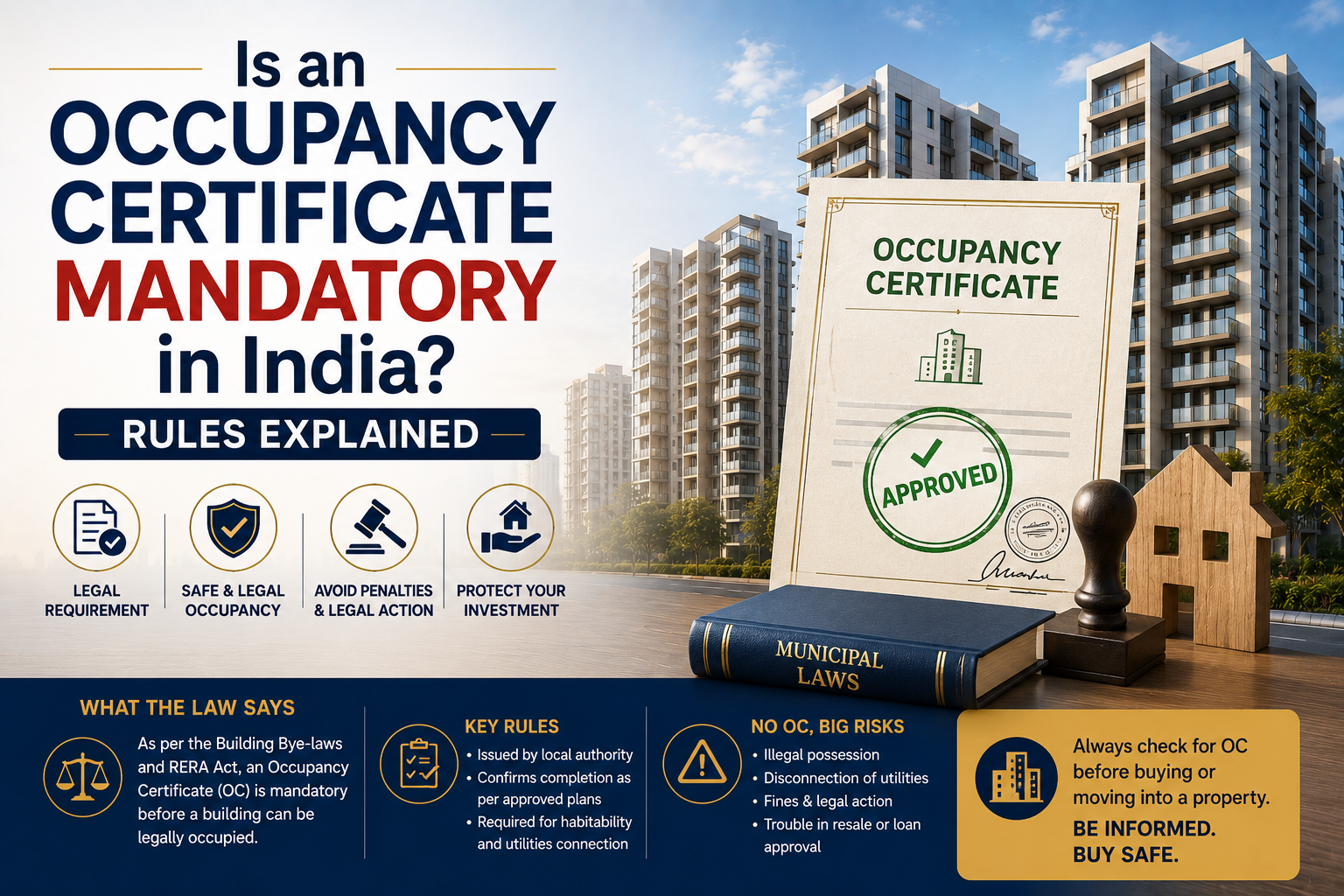
Yes, an Occupancy Certificate is a compulsory document for any high-rise or multi-unit residential project in India. Under the Real Estate (Regulation and Development) Act (RERA) 2016, the builder is legally required to get the OC before transferring possession to buyers (ADDA, 2025).
As per an historic decision dated February 20, 2026, the Supreme Court of India in Parsvnath Developers Ltd. v. Mohit Khirbat, emphasised that the builder cannot force a homebuyer to take possession of a flat in the absence of the mandatory OC (The Law Suits, 2026; Times of India, 2026). The court termed such a proposal as a “deficiency in service” (The Tribune, 2026).
Important Exception: In some places, the OC might not be mandatory for small, standalone row houses or low-rise buildings not exceeding a certain height (NoBroker Legal, 2026; ADDA, 2025). It is better to always verify your local state regulations for detailed exemptions.
Can I Buy a Flat Without an OC?
In fact, some states allow you to sign a sale agreement and even register the property without obtaining an OC, but it is very much against the spirit of the law to do so. Buying or moving into a flat without getting an OC involves serious risks:
- Legal eviction and demolition: The local authorities may classify the building as unauthorised. This exposes the owner to the risk of not only legal eviction but also the demolition of the structure (NoBroker Legal, 2026).
- Disruption of essential services: If the OC is not obtained, the local municipal corporation may decide not to give permanent water, electricity, and sewage connections (Godrej Properties, 2025).
- Monetary penalties: It is common to see municipalities charging much higher property taxes and water charges for buildings that are occupied without an OC (ADDA, 2025).
- Resale and loan issues: A home loan application will most likely be rejected by the banks if the house does not have an OC. Besides, it will be very difficult later on to locate a buyer without this document (Hallmark Builders, 2025).
What Happens if the Builder Doesn’t Give the OC?
If your builder is holding back the OC or pressuring you to take possession without it, you are protected by the law in several ways:
- Deny Possession
As per the Supreme Court decision made in 2026, you are not legally obligated to take possession until the OC is handed over. Even if the builder is offering “fit-out possession” (i.e. interiors’ keys), the project is still treated as officially delayed from a legal perspective (The Law Suits, 2026; Reddit, 2026).
- Seek Compensation
The courts have adjudicated that builders must remunerate delay interest (usually about 8% per annum) up to the point of obtaining the actual OC, even if the buyer, under pressure, has already moved in (The Tribune, 2026; Reddit, 2026).
- File a Complaint
- RERA: You may file a complaint with your State RERA authority. RERA can impose a fine upon the builder and give them a timeline for the issuance of the certificate.
- Consumer Forum: You have the option to make a complaint to the National Consumer Disputes Redressal Commission (NCDRC) against the “deficiency in service” (NoBroker Legal, 2026).
The Partial Occupancy Certificate (POC)
During a big township or multiphase project, the government may give out a Partial Occupancy Certificate. This means that the residents can start living in the fully finished blocks or towers while at the same time, the construction of other phases is going on (NoBroker Legal, 2026).
- Pro: Allows moving in early to finished areas.
- Con: It is only a temporary arrangement that eventually has to be changed to a final OC for the whole project (ADDA, 2025).
Conclusion: Don’t Compromise on the OC
An occupancy certificate is the only document which makes a concrete building your legal home. Indian courts are more consistent than ever on this issue in 2026: without an OC, there is no legal possession.
Check the OC status on your state’s RERA portal or get a sealed copy from the local municipal office (NoBroker Legal, 2026) before you finally sign the handover papers. Both your investment and peace of mind are at stake.