Is EOI Refundable in India? EOI Meaning, Why Builders Take It & Refund Policy (2026)
Table of Contents
1. What Is EOI, and Why Do Builders Take It?
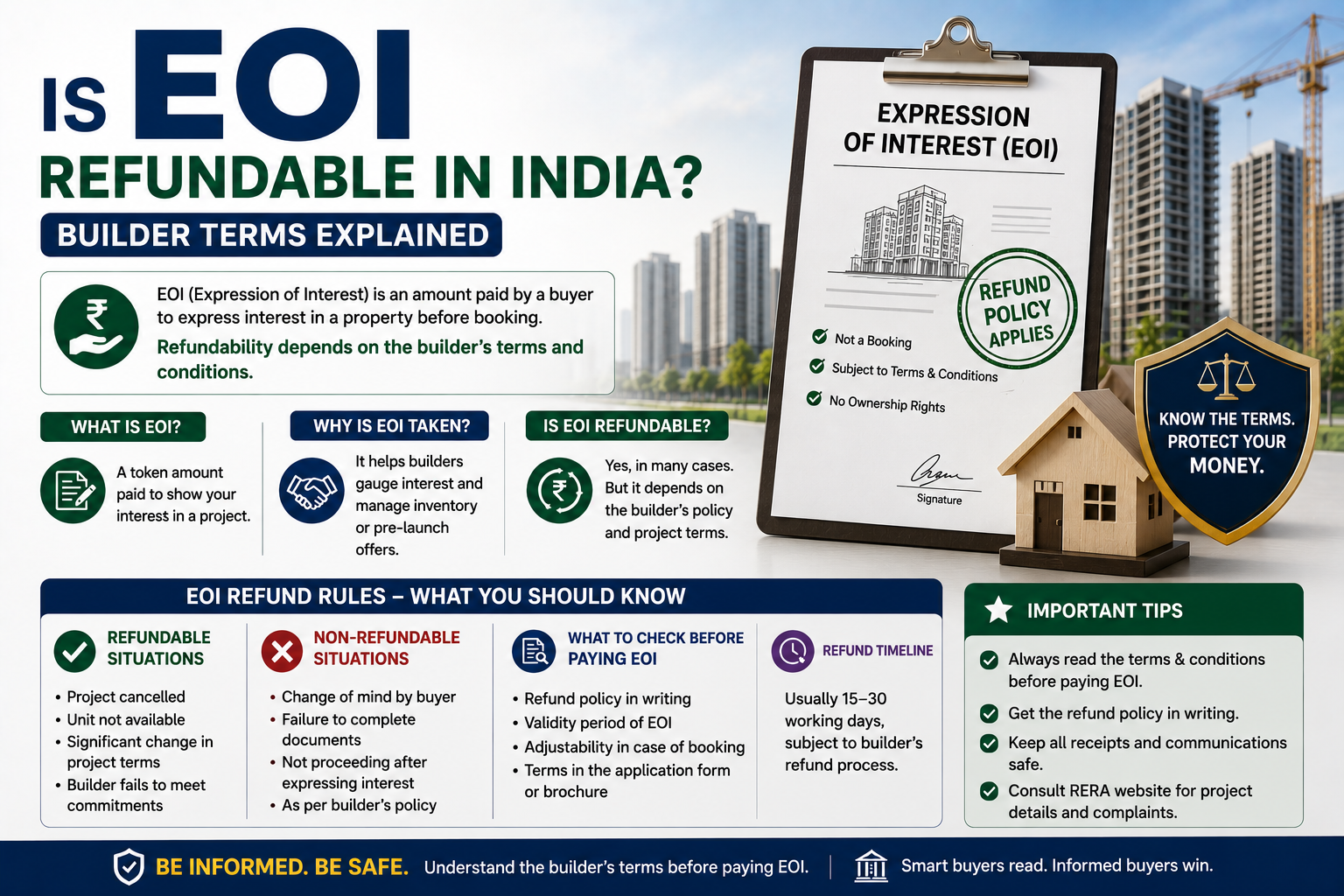
EOI stands for Expression of Interest. It’s a formal, generally non-binding declaration a buyer submits to a developer, usually along with a token payment, to signal genuine interest in a property, typically before a project’s official launch or before a formal sale agreement is signed.
Why builders take EOI money specifically (not just interest, but a payment):
- To filter serious buyers from casual enquirers. A financial commitment, even a modest one, weeds out browsers from buyers who are genuinely ready to transact.
- To gauge real market demand before finalizing pricing. The volume and profile of EOIs received help developers calibrate final pricing, decide which configurations to prioritize, and plan launch-day inventory.
- To build a warm, pre-qualified sales pipeline. Instead of launching cold, developers enter the public sales phase with a list of buyers who have already shown financial and behavioral commitment.
- To manage high-demand or limited-inventory launches. In premium or fast-selling projects, EOI helps developers allocate scarce units in an orderly, first-come or merit-based sequence rather than a chaotic rush at launch.
- To collect market intelligence. Buyer preferences captured through EOI (unit type, floor, budget band) directly shape a developer’s final product-pricing decisions.
“EOI provides a formal way for buyers to express their interest in properties, signalling seriousness without committing to a full purchase… developers benefit from receiving EOIs, as they gain insights into market interest and can identify serious buyers.” — a rationale echoed consistently across developer communications explaining why EOI has become a standard pre-launch collection tool.
Important nuance: the fact that builders collect a payment at the EOI stage does not, by itself, convert EOI into a binding sale. Indian courts and RERA authorities have consistently treated pre-agreement token payments, including EOI-stage amounts, as advances tied to an intended transaction, not proof of a completed one. This distinction is exactly why refund questions arise so often.
2. Is EOI Refundable in India? The Direct Answer
In the large majority of cases, yes, an EOI amount is refundable, particularly when:
- You are not shortlisted or allotted a unit by the developer
- You withdraw before converting your EOI into a formal booking
- The project is delayed, restructured, or cancelled by the developer
- The developer’s own written terms state the amount is refundable
However, refunds can be denied, delayed, or partially deducted when:
- The builder’s EOI terms explicitly state the amount is non-refundable once submitted (some developers do state this outright; it’s not universal, but it exists)
- You proceed to a formal booking and then withdraw, triggering the builder’s standard cancellation charges
- You miss a stated conversion deadline without formally withdrawing beforehand
- There’s a genuine dispute over whether you (the buyer) breached agreed terms first
The honest, complete answer: EOI refundability is contractual first, regulatory second. The specific terms you agreed to when paying matter enormously, which is exactly why reading (and keeping a copy of) the EOI terms and conditions before paying is the single most important protective step a buyer can take.
3. EOI Refund Policy in India: What the Rules Actually Say
There is no dedicated, standalone “EOI Refund Act” in India. Instead, EOI refund treatment is shaped by a combination of contract terms and broader real estate regulation:
| Governing Framework | What It Says (as applied to EOI-stage payments) |
| Developer’s own EOI Terms & Conditions | The primary, first-line rule for refund eligibility, deductions, and timelines as stated at the time of payment |
| RERA Act, 2016 Section 13 | Caps advance/application money a promoter can accept before a registered Sale Agreement at 10% of the property cost; a useful benchmark if EOI-stage collections start creeping toward a large share of total price |
| RERA Act, 2016 Section 18 | Gives allottees the right to withdraw and claim a full refund with interest if the promoter fails to deliver as agreed, directly relevant once an EOI has progressed toward a booking/allotment |
| Consumer Protection Act, 2019 | Treats unfair or non-transparent forfeiture of buyer payments (including advances like EOI) as a potential unfair trade practice or deficiency in service |
| RERA/MahaRERA Appellate Tribunal precedent | Has previously ruled that arbitrary or excessive forfeiture of a buyer’s advance payment is improper and directed builders to refund such amounts |
Typical industry-standard refund conditions (developer-set, not legally mandated, but widely followed as good practice):
- Refund processed within 30 to 45 days of a valid withdrawal request
- Refund issued to the same account/method the payment was originally made from
- Minimal or no deduction if withdrawal happens before the booking stage
- A small processing/administrative deduction (where stated upfront) may apply in some cases
4. Legal Backing: RERA, Consumer Protection Act, and Key Rulings
Forfeiture of buyer payments ruled unfair: In an appeal before the Maharashtra Real Estate Appellate Tribunal (MahaRERA Appellate Tribunal), a developer’s forfeiture of a home-buyer’s booking amount was held to be improper and against the provisions of the RERA Act, 2016, with the builder directed to refund the amount. The tribunal’s reasoning centered on RERA being a beneficial legislation meant to protect buyers from unfair terms, a principle that extends logically to earlier-stage payments like EOI amounts when forfeiture appears arbitrary or disproportionate.
Refund with interest is a statutory right under specific conditions: Under Section 18(1) of the RERA Act, if a promoter fails to deliver possession as per the agreed terms, the allottee has the right to withdraw from the project and claim a full refund along with interest. While this section is most directly triggered once a formal allotment/agreement exists, RERA authorities have consistently read the Act as buyer-protective across the transaction lifecycle, not just at the final agreement stage.
Consumer forums remain available even when RERA also applies: Courts have clarified that RERA and consumer forum remedies are concurrent; a buyer isn’t forced to choose only one path, and a RERA-registered project doesn’t bar a consumer commission from hearing a complaint about deficiency in service, including disputed refund of advance payments.
Contractual delay compensation has limits too: In a Supreme Court ruling (GMADA v. Anupam Garg), the Court held that contractual terms must be honoured and delay must be compensated, but compensation should not exceed what’s lawfully due under the agreed terms a reminder that both sides’ documented terms matter heavily in how these disputes resolve.
Practical takeaway from these rulings: Indian courts and regulators lean toward protecting buyers from arbitrary forfeiture, but they also enforce whatever specific terms were actually agreed to. This is exactly why documentation, not assumptions about “the law being on your side,” determines real-world outcomes.
5. When Builders Can (and Cannot) Legally Withhold Your EOI Amount
| Builder CAN generally withhold/deduct when… | Builder generally CANNOT justify withholding when… |
| Their written EOI terms clearly stated non-refundability upfront, and you accepted those terms | No refund policy was disclosed at all before you paid |
| You converted to a booking and then cancelled, triggering standard cancellation charges disclosed in advance | The developer changes the refund terms after collecting your payment |
| A reasonable, pre-stated processing fee applies to withdrawals | The deduction is disproportionate to any actual cost or loss incurred by the developer |
| You failed to act within a clearly communicated conversion/response deadline | The project itself was delayed, restructured, or never launched as promised |
| There’s documented evidence you breached agreed conditions | Payment was collected in cash/unofficial channels with no receipt, then the refund is denied citing “no record” |
6. Step-by-Step: How to Request an EOI Refund
- Review your EOI receipt and terms document to confirm the refund conditions and timeline you originally agreed to.
- Submit a written refund request to the developer’s sales team; email is preferable to a phone call, since it creates a timestamped record.
- Reference your specific EOI number/receipt, payment date, amount, and mode of payment in the request.
- State your reason for withdrawal clearly (change in decision, project delay, unit unavailability, etc.). This becomes relevant if the matter escalates later.
- Ask for a specific refund timeline in writing, referencing the developer’s own stated policy if one exists.
- Follow up in writing if the stated timeline (commonly 30–45 days) passes without resolution.
- Escalate formally (see Section 8 below) if the developer remains unresponsive or refuses without valid justification.
7. Sample EOI Refund Request Letter
Use this as a starting template, adapting the bracketed details to your situation:
Subject: Request for Refund of EOI Amount — [Your Name] — [Project Name], Unit Ref: [EOI/Receipt Number]
Dear [Developer/Sales Team],
I am writing to formally request a refund of the EOI amount of ₹[amount] paid on 2026 via [payment mode], receipt number [receipt number], for [project name].
As per the terms shared at the time of payment, this amount is refundable under the following circumstances: [state the specific condition — e.g., “withdrawal before booking confirmation”]. I am writing to withdraw my expression of interest and request that the refund be processed within the timeline specified in your policy.
Please confirm receipt of this request and share the expected refund date and mode. I have attached a copy of my original payment receipt for reference.
Regards, [Your Name] [Contact details]
8. What to Do If the Builder Refuses to Refund
If a written, polite refund request doesn’t resolve the matter, escalate in this order:
- Send a formal legal notice through a lawyer, clearly stating the payment details, the applicable refund terms, and a reasonable deadline for compliance.
- File a complaint with your state’s RERA authority, especially if the project is RERA-registered. RERA can direct refunds with interest and penalize non-compliant developers.
- Approach the Consumer Disputes Redressal Commission (District, State, or National, depending on the claim value) if the issue is better framed as a deficiency in service or an unfair trade practice; this route remains available even for RERA-registered projects.
- Escalate to the National Consumer Disputes Redressal Commission (NCDRC) for high-value disputes, generally where the claim exceeds the threshold set for state commissions.
- Keep every document, receipts, EOI terms, email correspondence, and any marketing material that referenced refund promises since documentation is what actually determines outcomes in these forums.
9. RERA vs Consumer Court: Where Should You Escalate?
| Factor | RERA | Consumer Court |
| Best suited for | Project-specific issues: delayed possession, plan deviation, refund tied to a registered project | Broader “deficiency in service” claims, including disputed advance/EOI refunds |
| Speed | Generally faster, purpose-built for real estate disputes | Can be slower, though state and district forums are widely accessible |
| Relief available | Refund with interest, possession orders, compensation, penalties on promoter | Refund, compensation, deficiency-in-service remedies |
| Applicability to pre-agreement EOI disputes | Strongest when the project is RERA-registered, and the dispute ties back to project registration terms | Often the more direct route for a standalone EOI refund dispute not yet tied to a formal allotment |
| Can you use both? | Courts have confirmed RERA and consumer remedies are concurrent — you’re not forced to pick only one | Same |
Practical guidance: for a straightforward “the builder won’t refund my EOI amount” dispute where no formal sale agreement exists yet, a consumer complaint is often the more direct route. If your EOI has already progressed into a registered project allotment with broken promises around delivery, RERA becomes the stronger forum.
10. State-Wise Variation in Refund Practices
While the underlying legal principles (RERA, Consumer Protection Act) apply nationally, practical refund experiences can vary by state due to differences in:
- How actively the state RERA authority enforces builder compliance and penalizes delayed refunds
- Average processing times at state and district consumer commissions
- Local real estate market norms (e.g., competitive, high-demand markets sometimes see stricter non-refundable EOI terms due to high buyer demand)
Buyer tip: before paying an EOI amount, it’s worth a quick search for your state RERA authority’s website to confirm the project’s registration status and check whether the authority has any public advisories or past orders involving the specific developer.
11. EOI Refund vs Token Amount Refund vs Booking Amount Refund
| Stage | Refund Likelihood | Typical Deduction if Withdrawn |
| EOI | High, most commonly refundable, especially pre-booking | Usually none, or a small stated processing fee |
| Token Amount | Moderate to high | Sometimes a small percentage deduction |
| Booking Amount | Lower treated as a stronger commitment | Cancellation charges apply as per the builder’s policy (historically as high as 10%, though tribunals have pushed back on excessive forfeiture) |
| After Sale Agreement signed | Governed by contract + RERA cancellation provisions | Can be substantial, per agreed contract terms, subject to what courts/RERA consider fair |
The further along the buying journey you go, the stronger the builder’s contractual position to retain part of your payment, which is exactly why understanding where you are in this sequence (EOI vs token vs booking) matters when a refund dispute arises.
12. Red Flags to Check Before You Even Pay an EOI
The single best way to avoid a refund dispute is prevention. Before paying any EOI amount:
- Get the refund policy in writing,g not a verbal assurance from the sales team
- Confirm the project’s RERA registration status or application progress
- Pay only through official, traceable channels (bank transfer, cheque, official payment portal), never cash, and always insist on a proper receipt
- Check whether the developer has a public track record of refund disputes — a quick search of the state RERA authority’s complaint records or consumer forum orders can be revealing.
- Read the fine print on “non-refundable” clauses carefully; some developers do state this explicitly, and no amount of goodwill assumption will override a signed term.
- Avoid high-pressure tactics (“only a few units left, pay now”) that push you to skip due diligence.
13. Frequently Asked Questions
1. Is EOI refundable in India? In most cases, yes, particularly if you withdraw before the booking stage and the developer’s own terms don’t explicitly state otherwise. Always confirm the specific policy before paying.
2. What is EOI, and why do builders take it? EOI (Expression of Interest) is a non-binding, formal signal of buyer interest, typically accompanied by a token payment. Builders take it to filter serious buyers, gauge demand, and build a pre-qualified sales pipeline before a formal launch.
3. How long does an EOI refund take? Commonly 30 to 45 days from a valid withdrawal request, though this varies by developer; always confirm the specific timeline in writing.
4. Can a builder legally refuse to refund my EOI amount? Only if their written terms, disclosed at the time of payment, clearly stated the amount is non-refundable, or if you triggered agreed cancellation charges by converting to a booking and then withdrawing.
5. What law protects EOI refunds in India? There’s no dedicated EOI law, but RERA (Sections 13 and 18), the Consumer Protection Act, 2019, and consumer/RERA tribunal precedent collectively shape how refund disputes are resolved.
6. Where should I complain if my EOI refund is refused? Start with a written request and legal notice, then escalate to your state RERA authority (if the project is registered) or the appropriate Consumer Disputes Redressal Commission.
7. Is there a case where courts ruled against builders forfeiting buyer payments? Yes, the MahaRERA Appellate Tribunal has ruled that forfeiture of a home-buyer’s payment was improper and directed a refund, reinforcing that arbitrary forfeiture isn’t automatically enforceable just because a builder claims it.
8. Does RERA registration of a project guarantee my EOI is refundable? Not automatically; RERA registration relates to the project’s compliance, not a blanket refund guarantee on every payment type. However, it does give you a stronger regulatory forum to escalate a dispute.
9. Should I pay EOI in cash to get a discount? No. Always pay through official, traceable channels with a proper receipt; cash payments significantly weaken your position in any future refund dispute.
10. Can I get interest on a delayed EOI refund? Interest entitlement is clearer once the payment is tied to a formal allotment/agreement under RERA Section 18. For a pure pre-booking EOI dispute, interest isn’t automatic, but you can request it as part of a consumer complaint if the delay is unreasonable.
11. What’s the difference between EOI refund and booking amount refund? EOI is earlier-stage and generally more refund-friendly with fewer deductions; a booking amount represents a stronger commitment and typically carries higher cancellation charges if withdrawn.
12. What documents do I need to support an EOI refund claim? Your original payment receipt, the EOI terms and conditions document, any written communication with the developer, and proof of your withdrawal request.
14. Key Takeaways
- EOI is generally refundable in India, but this rests on the specific written terms you agreed to, not a blanket national guarantee.
- Builders collect EOI amounts primarily to filter serious buyers, gauge demand, and build a pre-launch sales pipeline, not as a binding sale commitment.
- RERA Sections 13 and 18, the Consumer Protection Act, and tribunal precedent (including rulings against arbitrary forfeiture) collectively protect buyers, even though there’s no single dedicated “EOI law.”
- If a refund is refused, escalate methodically: written request → legal notice → RERA complaint (if registered project) → Consumer Disputes Redressal Commission.
- The further you progress from EOI → token → booking → signed agreement, the stronger a builder’s position to retain part of your payment; know exactly which stage you’re at before assuming automatic refundability.
- Prevention beats disputes: get refund terms in writing, pay only through official channels, and verify the developer’s track record before paying anything.