EOI vs Booking Amount: Which Is Safer For Buyers?
Table of Contents
1. What Is EOI in Real Estate?
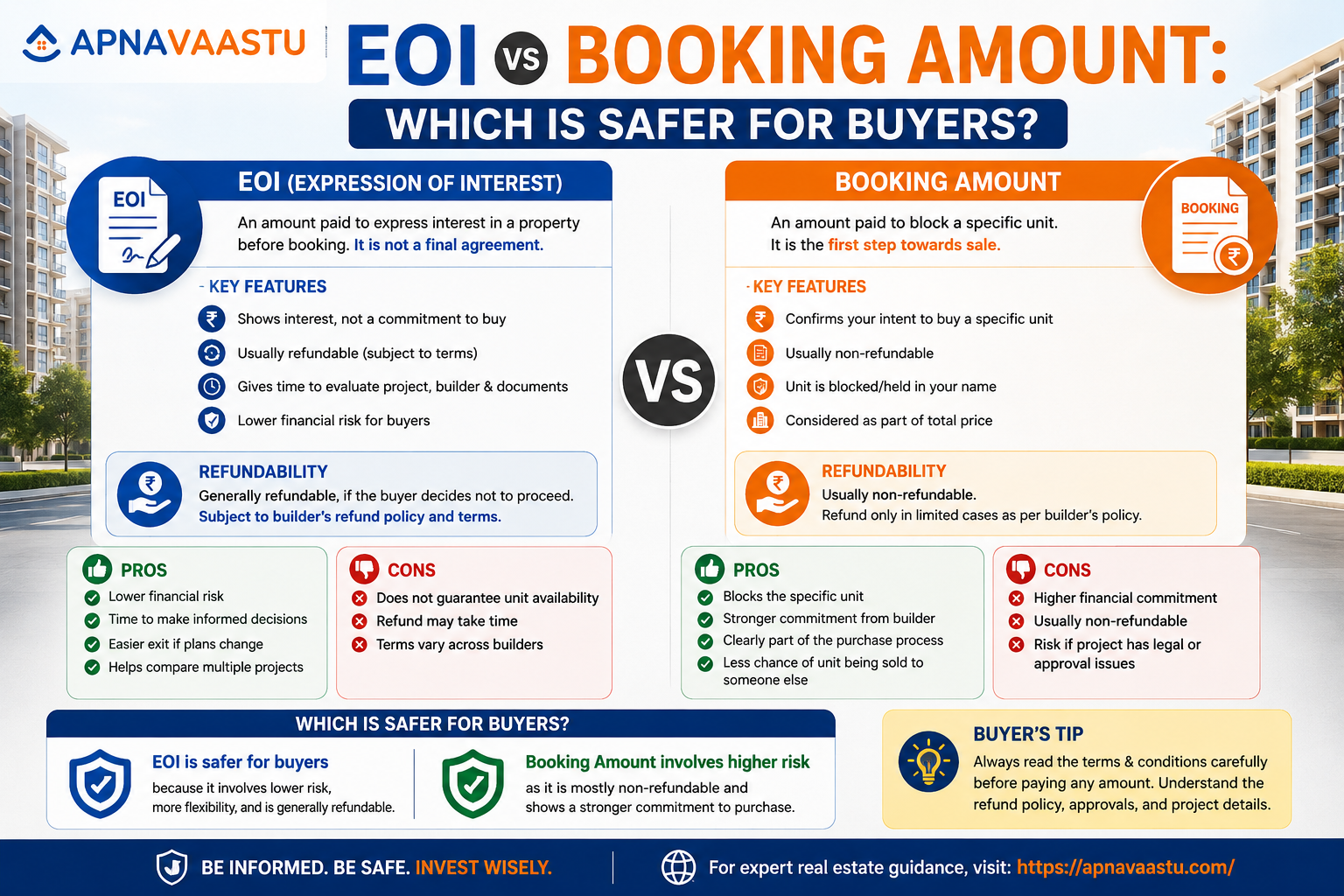
EOI stands for Expression of Interest. It’s a formal, non-binding declaration submitted by a prospective buyer to a developer, indicating genuine interest in a property typically before the project is officially launched for sale, or before a specific unit has even been finalized.
Key characteristics of an EOI:
- Non-binding on both sides. The buyer isn’t obligated to purchase, and the developer isn’t obligated to allot a specific unit.
- Usually accompanied by a small token payment, which acts more as a seriousness filter than a legal commitment.
- Most common in pre-launch phases, high-demand projects, luxury developments, and off-market or commercial deals.
- Doesn’t lock in final pricing; in most cases, indicative pricing shared at the EOI stage can change before formal booking.
- Generally refundable, though this depends entirely on the developer’s specific stated terms.
Why developers collect EOIs: to gauge genuine market demand, filter serious buyers from casual enquirers, and build a warm, pre-qualified pipeline before opening formal sales — all before committing to final pricing or unit allocation.
2. What Is Booking Amount (Token Amount)?
Booking Amount (often used interchangeably with “Token Amount,” though some developers distinguish the two as sequential steps) is the payment made to formally reserve a specific unit once you’ve selected the floor, configuration, view, and price, all confirmed. Unlike an EOI, this is a real commitment with legal and financial consequences attached.
Key characteristics of a Booking Amount:
- Confirms a specific unit, not just general interest in the project, but this flat, on this floor, at this price.
- Carries real cancellation consequences if you back out,t governed by both the developer’s policy and RERA rules (explained in detail in Sections 5 and 6 below).
- Usually results in an Allotment Letter, a document confirming the reservation, unit details, price, and payment schedule.
- Forms part of the total purchase price; it isn’t a separate fee; it’s the first instalment toward the property cost.
- Precedes the formal Agreement for Sale, which is the fully binding legal contract, typically required to be registered once payments cross the threshold defined under RERA.
Important distinction some buyers miss: a Token Amount is sometimes used as an intermediate step between EOI and the full Booking Amount — a smaller sum paid to temporarily hold a specific unit before the larger booking payment is made. Not every developer uses this three-tier structure (EOI → Token → Booking); many go straight from EOI to Booking. Always confirm which structure your specific project follows.
3. EOI vs Booking Amount: Full Comparison Table
| Parameter | EOI (Expression of Interest) | Booking Amount (Token Amount) |
| Stage in buying journey | Earliest often pre-launch | Later after a specific unit is selected |
| Legally binding? | No | Yes, to a significant degree |
| What it reserves | General priority/queue position | A specific unit, floor, and price |
| Typical amount | ₹50,000 – ₹5,00,000+ (project-dependent) | Often 5–10% of the total property cost |
| Refund likelihood if you withdraw | High; usually fully refundable | Partial subject to RERA-capped deductions |
| Governing document issued | EOI receipt/acknowledgment | Allotment Letter |
| Price lock-in | Usually indicative only, not guaranteed | Price is confirmed and fixed |
| RERA Section 13 relevance (10% cap before Agreement for Sale) | Indirectly relevant if cumulative payments approach the cap | Directly relevant; this is the primary payment the cap addresses |
| Cancellation deduction (per current RERA guidance) | Minimal to none, per developer policy | Capped commonly around 2% if cancelled within 45 days of the allotment letter, per updated RERA guidance in several states |
| Next stage after this | Convert to Booking Amount, or withdraw | Convert to Agreement for Sale, or cancel |
4. The Buying Journey: From EOI to Booking to Agreement
Understanding where EOI and Booking Amount sit in the overall sequence makes the distinction much clearer:
- Developer opens pre-launch registrations and invites EOIs from interested buyers.
- Buyer submits EOI, often with a small token payment, expressing general interest — no specific unit finalized yet.
- Developer reviews EOIs, finalizes pricing, and invites shortlisted buyers to a priority booking session.
- Buyer selects a specific unit (floor, configuration, view) and pays the Booking Amount to reserve it.
- Developer issues an Allotment Letter, confirming the unit, price, and payment schedule.
- Buyer and developer execute the Agreement for Sale, the legally binding contract — typically required to be registered once cumulative payments cross the RERA-defined threshold.
- Construction-linked or time-linked payments continue as per the agreed schedule until possession.
Where things get confusing: some developers merge steps 2 and 4, collecting an EOI-labeled payment that’s actually functioning as a booking amount from day one. Always ask directly which stage a given payment represents, regardless of what label is used.
5. Refund and Cancellation Rules EOI vs Booking Amount
This is where the practical stakes of the EOI-vs-booking distinction become very real.
EOI cancellation:
- Generally low-risk. Since it’s non-binding, withdrawing before the booking stage typically results in a full or near-full refund, per the developer’s stated terms.
- Some developers do state EOI amounts are non-refundable; always confirm this specific point in writing before paying.
Booking Amount cancellation:
- Historically, developers could deduct up to 10% of the total property cost as a cancellation penalty when a buyer withdrew before signing a formal Agreement for Sale.
- More recent RERA guidance in several states has significantly tightened this: buyers who cancel within 45 days of receiving the Allotment Letter may only face a deduction of around 2% of the booking amount a substantial buyer-friendly shift from the earlier 10% norm.
- If the developer is at fault (project delay, changed unit, misrepresentation), buyers are generally entitled to a full refund, not a penalty, and this has been reinforced in tribunal rulings (see Section 6).
- Cancelling after a registered Agreement for Sale is signed brings the specific cancellation clauses of that contract into play, which can be stricter.
| Cancellation Timing | Typical Deduction |
| Before booking (EOI stage only) | None to minimal |
| Within 45 days of Allotment Letter | Around 2% of booking amount (per updated RERA guidance in several states) |
| Before Agreement for Sale, beyond 45 days | Historically up to 10%, now increasingly challenged/capped by regulators and tribunals |
| After registered Agreement for Sale | Governed by specific contract clauses, subject to RERA fairness review |
| Developer at fault (delay, misrepresentation) | Full refund, often with interest |
6. Legal Backing: RERA Rules Explained (10% Cap, 2% Deduction Rule, and Key Rulings)
Section 13 of the RERA Act, 2016 is the foundational rule here: a promoter cannot accept more than 10% of the property’s cost as an advance or application fee before a registered Agreement for Sale is executed. This applies cumulatively, meaning EOI, token, and booking payments combined are meant to stay within that 10% ceiling before the formal agreement stage.
The evolving 2% deduction norm: Several state RERA authorities and tribunal rulings have moved toward capping cancellation deductions at roughly 2% of the booking amount, specifically when a buyer cancels within 45 days of receiving the allotment letter a meaningful tightening from the older, more commonly cited 10% forfeiture practice. This reflects a broader regulatory trend of treating large forfeitures as inherently unfair to buyers rather than a routine cost of doing business.
A landmark tribunal ruling worth knowing: The Maharashtra Real Estate Appellate Tribunal (MREAT) has held that forfeiture of a buyer’s booking amount was improper and contrary to the provisions of the RERA Act, reasoning that RERA is beneficial legislation meant to protect allottees, and that developers cannot rely on ambiguous, one-sided terms buried in standard application forms or allotment letters to justify large forfeitures. The tribunal directed a refund of the forfeited amount in that case.
Interest on delayed refunds: Where a state RERA authority orders a refund, interest is often calculated at a benchmark rate; for example, in Maharashtra, refunds ordered by MahaRERA can carry interest at the State Bank of India’s Marginal Cost of Lending Rate (MCLR) plus 2%, starting a couple of months after the developer accepts the cancellation, until the amount is fully repaid.
Practical takeaway: the days of assuming a flat “10% forfeiture, no questions asked” are increasingly outdated. Buyers cancelling a booking especially soon after receiving the allotment letter have real, regulator-backed grounds to push back against excessive deductions.
7. Typical Amounts: How Much Is EOI vs Booking Amount?
| Type | Typical Range | Basis |
| EOI | ₹50,000 – ₹2,00,000 for mid-range projects; up to ₹5,00,000+ for premium/luxury projects | Flat token amount, project-tier dependent |
| Token Amount (if used as a separate intermediate step) | Often a smaller fixed sum, or a modest percentage of unit price | Developer-specific |
| Booking Amount | Commonly around 5–10% of total property cost | Percentage-based, tied to unit price |
Always confirm the exact figures and their treatment (refundable, adjustable against final price, or forfeitable) directly with the developer’s official sales team rather than relying on general industry ranges.
8. Documents You Receive at Each Stage
| Stage | Document You Should Receive |
| EOI submission | EOI form copy/acknowledgment and payment receipt |
| Booking Amount payment | Allotment Letter confirming unit, price, floor, payment schedule |
| Agreement execution | Agreement for Sale (registered once payment thresholds are crossed) |
| Possession | Possession letter, along with CC/OC documentation for the specific unit |
Buyer tip: never accept a verbal confirmation in place of these documents. The Allotment Letter, in particular, is your primary evidence in any future refund or cancellation dispute — insist on receiving it promptly after paying the booking amount.
9. Which One Should You Pay, and When? A Decision Guide
- Pay an EOI if: you’re interested in a pre-launch project, want early access or potential pre-launch pricing, but aren’t yet ready to commit to a specific unit or finalize your budget decision.
- Pay a Booking Amount if: you’ve identified the exact unit you want, are satisfied with the confirmed price and payment schedule, and are financially and mentally ready to move toward a binding purchase.
- Avoid paying a Booking Amount (or anything labeled as one) if: you haven’t yet verified the project’s RERA registration, haven’t reviewed the draft Agreement for Sale terms, or are still uncertain about loan eligibility since walking back from this stage carries real financial consequences, even under the more buyer-friendly 2% rule.
10. Common Myths and Mistakes
- “EOI and Booking Amount are basically the same thing.” They’re not; one is non-binding and low-risk, the other is a real financial commitment with regulated cancellation consequences.
- “Once I pay the booking amount, I’ll lose all of it if I cancel.” Not necessarily true anymore — updated RERA guidance in many states caps this at around 2% if cancelled promptly after the allotment letter.
- “The developer can charge whatever cancellation fee they want.” Tribunals have specifically ruled against arbitrary, one-sided forfeiture clauses that developers unilaterally impose through standard forms.
- “Paying an EOI guarantees I’ll get the unit I want.” No, it typically only signals priority consideration, not guaranteed allocation.
- “I don’t need anything in writing at the EOI stage.” Always get a receipt and the stated refund terms in writing, regardless of how early-stage the payment feels.
11. Checklist Before Paying Either Amount
- Confirm exactly which stage this payment represents: EOI, token, or booking, regardless of what label is used.
- Get the refund/cancellation terms in writing before paying anything
- Verify the project’s RERA registration number or application status
- For booking amounts, confirm you’ll receive a formal Allotment Letter promptly
- Check whether the amount is adjustable against the final property price
- Pay only through official, traceable channels with a proper receipt
- If cancelling, act quickly; ly cancelling within 45 days of the allotment letter carries a much lower deduction under current RERA guidance than waiting longer
- Keep all documentation (EOI receipt, allotment letter, payment records) for future reference
12. Frequently Asked Questions
1. What is the main difference between EOI and Booking Amount? EOI is a non-binding, early-stage signal of interest, generally refundable with minimal deduction. Booking Amount is a binding reservation of a specific unit, governed by RERA cancellation rules, and part of the actual purchase price.
2. Is EOI adjusted against the Booking Amount? Often, yes. If you proceed from EOI to a formal booking, the EOI amount is typically adjusted against the booking amount or total price, rather than being a separate, additional payment.
3. How much can a builder deduct if I cancel my booking? Under updated RERA guidance followed in several states, cancelling within 45 days of receiving the allotment letter typically limits the deduction to around 2% of the booking amount a significant reduction from the older 10% norm.
4. Is Booking Amount refundable at all? Yes, subject to applicable deductions. If the developer is at fault (delay, misrepresentation, changed unit), buyers are generally entitled to a full refund, often with interest.
5. What is Section 13 of the RERA Act? It caps the amount a promoter can collect as an advance or application fee — including cumulative EOI, token, and booking payments at 10% of the total property cost before a registered Agreement for Sale is signed.
6. Can a builder forfeit my entire booking amount if I cancel? Not automatically. Tribunal rulings, including from the Maharashtra Real Estate Appellate Tribunal, have held that arbitrary full forfeiture is improper and against the spirit of the RERA Act.
7. What document should I receive after paying a Booking Amount? An Allotment Letter, confirming the specific unit, price, floor, and payment schedule. This is essential documentation for any future refund or cancellation claim.
8. Is there a Token Amount stage separate from EOI and Booking Amount? Some developers use a three-tier structure (EOI → Token → Booking), while others go directly from EOI to Booking. Always confirm which structure applies to your specific project.
9. Can I negotiate the booking amount percentage? It’s set by the developer, generally in the 5–10% range, and isn’t typically negotiable below the developer’s stated minimum, though this can vary by project and market conditions.
10. What happens if I don’t convert my EOI to a booking within the given time? Policies vary; some developers automatically lapse the EOI and refund the amount, others may require an active withdrawal request. Always confirm the specific timeline and process in writing.
11. Does RERA registration protect my Booking Amount? It provides a stronger regulatory forum to escalate disputes and generally means the developer is subject to RERA’s fund-handling and disclosure obligations, but it doesn’t eliminate all cancellation-related deductions; it primarily caps and regulates them.
12. Should I pay a large Booking Amount before seeing the Agreement for Sale draft? It’s advisable to review the draft Agreement for Sale terms, especially cancellation and refund clauses, before making a substantial booking payment, since those terms govern what happens if things don’t proceed as planned.
13. Key Takeaways
- EOI is a low-risk, non-binding early signal of interest; Booking Amount is a real, regulated financial commitment tied to a specific unit.
- The EOI amount is typically adjusted against the booking amount if you proceed, or refunded if you withdraw before booking.
- Cancellation of a booking amount is increasingly buyer-friendly; many states now cap deductions at around 2% if cancelled within 45 days of the allotment letter, a major shift from the older 10% norm.
- RERA Section 13’s 10% cap applies cumulatively to advance payments (including EOI, token, and booking amounts combined) before a registered Agreement for Sale.
- Tribunal precedent has specifically pushed back against arbitrary full forfeiture of booking amounts, reinforcing that buyers have real recourse.
- Always insist on an Allotment Letter after paying a booking amount, and review cancellation terms in writing before paying either amount.