Should You Buy Property When Repo Rate Is High?
Table of Contents
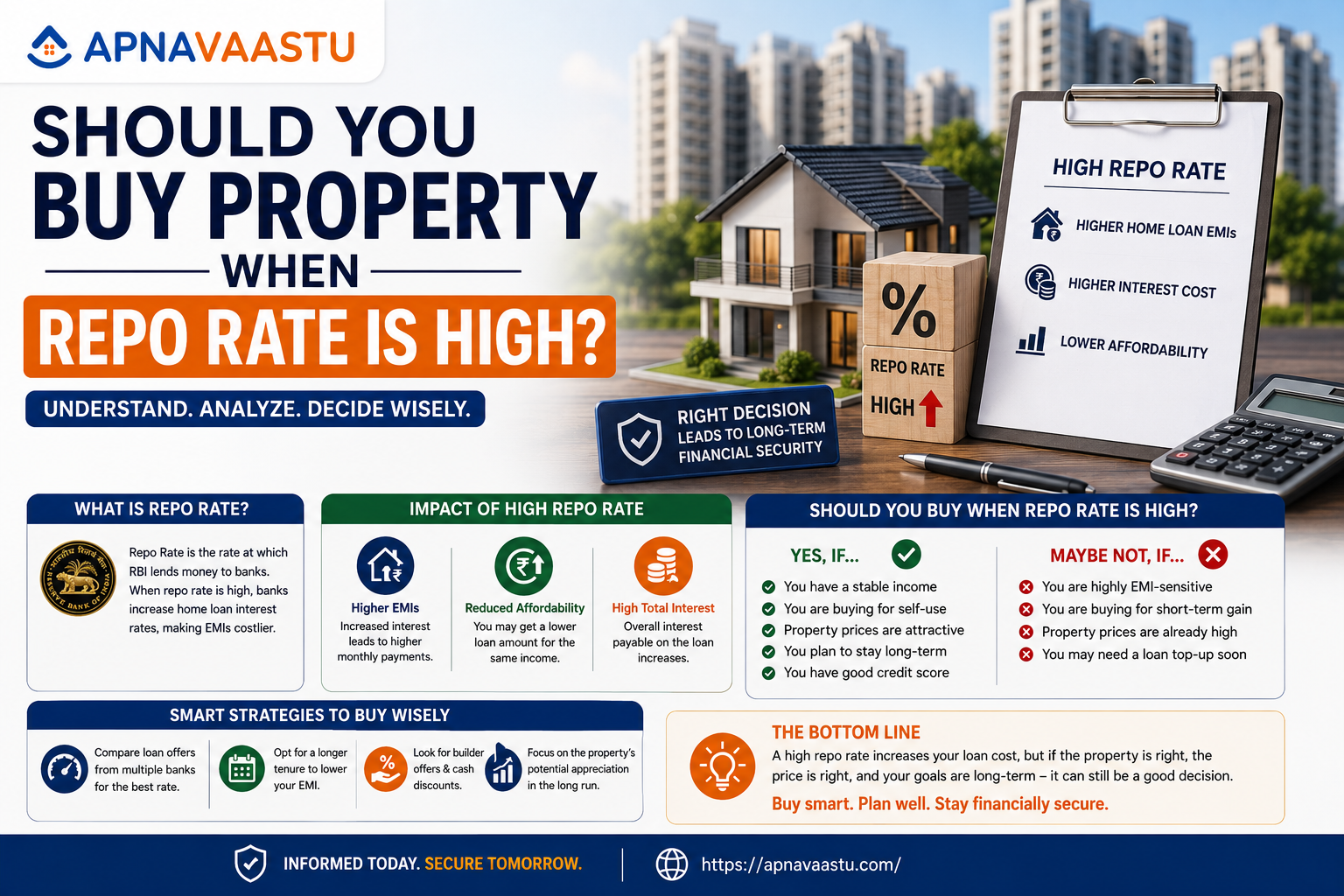
1. What Is the Repo Rate, in Plain English?
The repo rate (short for “repurchase rate”) is the interest rate at which the Reserve Bank of India (RBI) lends short-term funds to commercial banks against government securities. Think of it as the “wholesale” interest rate for the entire banking system; when the RBI’s Monetary Policy Committee (MPC) changes it, every bank’s cost of funds changes with it.
- When the RBI raises the repo rate: Banks’ borrowing costs go up, so they raise interest rates on home loans, personal loans, and car loans. Your EMI on a floating-rate loan increases.
- When the RBI cuts the repo rate: Borrowing becomes cheaper, home loan rates fall, and EMIs on floating-rate loans go down.
Since 2019, almost all floating-rate retail loans in India, including home loans, are linked to an External Benchmark Lending Rate (EBLR), which is directly tied to the repo rate. This is why repo rate announcements (made every two months by the MPC) move home loan interest rates almost immediately for new and existing floating-rate borrowers.
“A change in the repo rate is one of the fastest and most transparent ways interest rate movements reach the common borrower, because EBLR-linked loans reset automatically, unlike the older MCLR system, which had built-in lag.”
Repo rate is not the same as your home loan rate. Your actual home loan interest rate = Repo Rate + Bank’s Spread/Margin. So even when the repo rate is unchanged, your rate can still differ from your neighbor’s based on your credit score, loan-to-value ratio, and lender.
2. Current RBI Repo Rate in 2026 (Updated)
As of the June 2026 MPC meeting (the 61st meeting), the RBI has kept the repo rate unchanged at 5.25%, maintaining a neutral policy stance after a series of rate cuts through late 2025 and early 2026. The next MPC meeting is scheduled for August 4–6, 2026, and markets are watching closely for a possible cut if inflation stays within the RBI’s 2–6% comfort band.
| Policy Rate | Current Value (2026) |
| Repo Rate | 5.25% |
| Standing Deposit Facility (SDF) Rate | 5.00% |
| Marginal Standing Facility (MSF) / Bank Rate | 5.50% |
| Reverse Repo Rate (largely replaced by SDF) | 3.35% |
Repo Rate Trend: Where We’ve Been (Last 5 Years)
| Period | Approx. Repo Rate | Context |
| 2020–2021 (Covid era) | 4.00% | Emergency cuts to support the economy |
| May–Dec 2022 | 4.00% → 6.25% | Sharp hikes to control post-pandemic inflation |
| Feb 2023 – Feb 2025 | 6.50% | Longest pause in recent history |
| Feb 2025 – Dec 2025 | 6.50% → 5.50% | Gradual rate-cut cycle as inflation eased |
| Dec 2025 | 5.50% → 5.25% | 25 bps cut |
| Feb–June 2026 | 5.25% (unchanged) | Neutral stance, RBI in “wait and watch” mode |
For context, India’s repo rate touched a peak of 8.50% in 2012, so today’s 5.25% is still on the lower side of its historical range — even though it feels “high” compared to the ultra-cheap 4% Covid-era loans many buyers got used to. This is an important nuance most articles on this topic miss: “high” is relative to recent memory, not to history.
3. How the Repo Rate Actually Changes Your Home Loan EMI
Most home loans in India today are linked to EBLR, calculated as:
Home Loan Rate = Repo Rate + Bank’s Spread (typically 2.0%–3.5%) + Risk Premium (based on CIBIL score)
As of mid-2026, with the repo rate at 5.25%, home loan interest rates from major lenders range roughly as follows:
| Bank | Home Loan Rate Range (2026) |
| Bank of India / Central Bank of India | From ~7.10% p.a. |
| Canara Bank | From ~7.15% p.a. |
| Punjab National Bank / Bank of Baroda | From ~7.20% p.a. |
| State Bank of India (SBI) | ~7.25%–8.45% p.a. |
| ICICI Bank | ~7.50%–7.65% p.a. |
| Kotak Mahindra Bank | From ~7.60% p.a. |
| HDFC Bank | ~7.75%–7.90% p.a. |
| Axis Bank | From ~8.00% p.a. |
Rates vary by CIBIL score, loan amount, employment type, and LTV ratio. Always confirm current rates directly with the lender before applying, as these change with every MPC cycle.
Why a “small” rate change feels big on a home loan
Because home loans run for 15–30 years, even a 0.5%–1% change in interest rate has a disproportionate effect on total interest paid far more than it would on a short-term loan. This is the single biggest reason people panic about “high” repo rates, and it’s also why understanding the actual EMI math (see Section 9) matters more than watching the headline rate.
4. Should You Buy Property When Repo Rate Is High? The Real Answer
Here’s the nuanced answer most articles skip: a high repo rate changes the cost of your loan, not the wisdom of owning a home. Whether you should buy depends on three things that have nothing to do with the RBI:
- Your job stability and income growth: can you comfortably absorb your EMI even if rates rise another 0.5–1%?
- Your time horizon:n are you buying to live in for 7+ years, or flipping in 2–3 years?
- Local market conditions: is inventory high (buyer’s market) or tight (seller’s market) in your target location?
If your answers are “yes, stable job,” “yes, long horizon,” and “buyer’s market,” a high repo rate is actually one of the best times to buy because sellers and builders are more willing to negotiate, and you can refinance to a lower rate later if the RBI cuts again. If your income is uncertain or you’re already stretching your budget, a high rate is a signal to wait, save a larger down payment, and revisit in 6–12 months.
“Property is a 15–20 year decision. A 0.5% swing in the repo rate that lasts 12–18 months should rarely be the deciding factor for a first-time buyer with a stable income and a genuine need for a home.” Common view among Indian personal finance advisors
5. Should You Buy a House When Interest Rates Are High? (Global View)
This question isn’t unique to India. In the US, UK, and other markets, buyers face the same dilemma under different central bank frameworks (the Fed Funds Rate in the US, the Bank Rate in the UK). As of 2026, US 30-year mortgage rates are hovering in the 6%–6.8% range, well above the 3% pandemic-era lows, but below the 8% peak seen in 2023. Financial experts there echo a similar theme:
Higher rates have made mortgages more expensive and slowed buyer movement in the housing market, making renting relatively more attractive on paper, yet home prices haven’t fallen as sharply as textbook economics would predict, because inventory remains tight in most cities.
The common thread across markets: high interest rates rarely crash prices the way buyers hope, because reduced demand is often offset by tight supply. Waiting for both low rates AND low prices at the same time is usually wishful thinking; historically, low rates and rising prices tend to arrive together (rates fall → more buyers can afford homes → demand pushes prices up), which can erase the very savings you were waiting for.
6. The Case FOR Buying When Rates Are High
- Less competition, more negotiating power. Fewer buyers can qualify for large loans, so sellers and builders are more open to price cuts, free upgrades, and flexible payment plans.
- Rates are cyclical, prices are stickier. Interest rates move up and down every few years; property prices rarely fall back to previous levels once they’ve risen. Buying now and refinancing later (when rates drop) often beats waiting for rates to fall first, by which time prices may have already climbed.
- You can refinance later; you can’t “re-buy” at yesterday’s price. A home loan balance transfer to a lower-rate lender is a simple, low-cost process once rates ease, but you can’t go back and buy the same flat at last year’s price.
- Rental costs keep rising regardless of rates. If you’re currently renting, your rent is likely to increase 5–10% annually irrespective of what the RBI does. A fixed EMI, even a “high” one, becomes relatively cheaper over time as your income grows and rent inflation continues.
- Builder discounts and freebies peak during high-rate slowdowns. Developers sitting on unsold inventory often offer stamp duty waivers, free modular kitchens, flexible payment plans, or price locks precisely when demand softens due to high rates.
- Tax benefits remain unchanged. Deductions under Sections 80C (principal repayment, up to ₹1.5 lakh) and 24(b) (interest, up to ₹2 lakh for self-occupied property) apply regardless of the interest rate environment, softening the effective cost of a higher EMI.
7. The Case AGAINST Buying When Rates Are High
- Higher EMI eats into eligibility. At a higher rate, banks approve a smaller loan amount for the same income, which may force you into a smaller home or a longer tenure than you’d like.
- More of your EMI goes toward interest, less toward principal; especially in the early years, this slows down actual equity building.
- Risk of over-leveraging. If you stretch to buy now assuming rates will fall, and they don’t (or your income takes a hit), you could face repayment stress.
- Waiting a few months can genuinely help if a rate-cut cycle is clearly underway (as it is heading into the August 2026 MPC meeting); timing your purchase just after a policy cut, rather than before one, can lock in a lower EBLR from day one.
- Opportunity cost of your down payment. If you’re not in a hurry and don’t have an urgent need to move, parking your down payment in short-term debt instruments while rates (and FD returns) are relatively high can be a reasonable “wait and watch” strategy for 6–12 months.
8. High Repo Rate vs. Low Repo Rate: Side-by-Side Comparison
| Factor | High Repo Rate Environment | Low Repo Rate Environment |
| Home loan interest rate | Higher | Lower |
| EMI for same loan amount | Higher | Lower |
| Buyer competition | Lower (fewer qualified buyers) | Higher (more buyers can afford loans) |
| Builder discounts/negotiation room | Higher | Lower |
| Property price growth | Tends to slow or flatten | Tends to accelerate |
| Loan eligibility (same income) | Lower | Higher |
| Best strategy | Negotiate hard on price, buy floating rate, plan to refinance later | Consider locking in a fixed rate before rates rise again |
| FD/savings returns | Higher | Lower |
| Ideal buyer profile | Long-term, stable income, genuine end-use buyer | Anyone, including short-term investors |
9. Real EMI Example: How Much Does 1% Actually Cost You?
Let’s take a ₹50 lakh home loan over a 20-year tenure and see how the EMI and total interest change at different rates.
| Interest Rate | Monthly EMI | Total Interest Paid (20 yrs) | Total Repayment |
| 7.25% p.a. | ₹39,590 | ₹45.02 lakh | ₹95.02 lakh |
| 8.00% p.a. | ₹41,822 | ₹50.37 lakh | ₹100.37 lakh |
| 8.75% p.a. | ₹44,111 | ₹55.87 lakh | ₹105.87 lakh |
| 9.50% p.a. | ₹46,454 | ₹61.49 lakh | ₹111.49 lakh |
Key takeaway: Moving from 7.25% to 9.50% (a 2.25-point jump, a fairly extreme scenario) raises your EMI by about ₹6,864/month, or roughly ₹16.5 lakh in extra interest over 20 years. That’s real money,y but it’s also manageable with a slightly larger down payment, a shorter tenure, or part-prepayments once your income rises. Compare that to waiting 12–18 months for rates to fall while property prices in a good micro-market rise 8–10%; the price appreciation alone could easily exceed the interest savings.
10. How a High Repo Rate Affects Property Prices
When the RBI raises rates, the transmission to the real estate market typically follows this chain:
- Home loan rates rise → EMIs increase for the same loan amount
- Fewer buyers qualify for large loans, or existing buyers reduce their budget
- Demand softens, especially in the mid-to-premium segment where buyers are more loan-dependent
- Builders sitting on unsold inventory offer discounts, freebies, or flexible payment plans to maintain sales velocity
- Price growth slows or flattens; outright price drops are rare in India except in oversupplied micro-markets, because land costs, construction costs, and developer margins put a floor under new-launch pricing.
Historically, when the RBI has raised rates sharply (as in 2013 and again through 2022–23), developers have publicly acknowledged the demand hit, but broad-based price crashes haven’t materialized in most cities, because supply-side costs (land, cement, steel, labor) rarely fall in tandem with interest rates. This is exactly why “waiting for prices to crash” alongside high rates is often a losing strategy you may get a slightly better negotiating position, but not the dramatic price correction many buyers hope for.
11. 5-Point Decision Framework: Should YOU Buy Right Now?
Ask yourself these five questions honestly:
- Can my EMI stay under 35–40% of my monthly take-home income, even after accounting for a possible future rate hike of 0.5–1%?
- Yes → Good sign to proceed
- No → Wait, save more, or look at a smaller property
- Do I have 6+ months of expenses saved as an emergency fund, separate from my down payment?
- Yes → You have a cushion against rate/income shocks
- No → Build this first
- Am I planning to stay in or hold this property for at least 5–7 years?
- Yes → Short-term rate fluctuations matter less.
- No → High rates + short holding period is a riskier combination
- Is my target property/locality priced reasonably relative to rental yields and recent transaction data (not just the builder’s asking price)?
- Yes → You’re not overpaying even if rates are high
- No → Negotiate harder or look elsewhere before committing
- Do I have a genuine end-use need (marriage, relocation, growing family, lease ending) rather than trying to “time” an investment?
- Yes → Buy based on your life needs, not the RBI calendar
- No (pure investment) → You have more flexibility to wait for a better rate cycle
If you answered “yes” to at least 4 of these 5, a high repo rate should not stop you from buying.
12. Smart Strategies to Buy Property Without Getting Hurt by High Rates
- Improve your CIBIL score before applying. A score of 750+ can shave 0.15%–0.40% off your offered rate compared to a sub-700 score, often a bigger lever than waiting for an RBI cut.
- Negotiate on price, not just the loan. In a high-rate market, builders and resale sellers have more room to move;e target a 5–10% discount off the asking price rather than only chasing loan rate discounts.
- Make a larger down payment. Reducing your loan-to-value ratio (e.g., from 90% to 75–80%) lowers both your EMI and your interest rate risk exposure, and some lenders offer better rates at lower LTV bands.
- Choose a shorter tenure if you can afford the EMI. You’ll pay significantly less total interest, and you’re less exposed if rates rise further.
- Compare at least 4–5 lenders, including public sector banks, which currently offer some of the lowest starting rates, alongside private banks and housing finance companies.
- Use step-up or flexible EMI options if your income is expected to grow steadily (common for young salaried professionals), so today’s EMI doesn’t have to be your ceiling forever.
- Check for PMAY or other subsidy eligibility; if you qualify, your interest subsidies can meaningfully offset a high headline rate.
- Plan to prepay aggressively in year 2–3 once your income stabilizes; even small annual prepayments significantly cut total interest on a long-tenure loan.
- Time your rate-reset carefully. If your bank resets EBLR-linked loans quarterly, check the reset date — applying just after an RBI rate cut (rather than right before an MPC meeting where a hike is expected) can lock in a slightly better starting rate.
13. Fixed vs. Floating Rate: Which Should You Choose in 2026?
| Feature | Floating Rate | Fixed Rate |
| Rate movement | Changes with repo rate / EBLR | Stays constant for the fixed period |
| Starting rate | Usually lower | Usually 0.5–1.5% higher than floating |
| Best when | RBI is expected to cut rates soon | RBI is expected to hike rates further |
| Prepayment charges | Typically nil (RBI mandate for individual floating loans) | May apply, depending on lender |
| 2026 context | RBI is in a neutral-to-easing stance — floating loans are likely to benefit from further cuts | Less attractive right now unless you strongly value payment certainty |
Bottom line for 2026: With the RBI holding steady at 5.25% and market watchers anticipating a possible cut at the August MPC meeting, most borrowers are better served by a floating-rate loan, since any future rate cuts pass through automatically. Fixed rates make more sense only if you have zero appetite for EMI fluctuation and are willing to pay a premium for that certainty.
14. Rent vs. Buy When Rates Are High
| Factor | Renting | Buying (at a high rate) |
| Upfront cost | Low (deposit + 1–2 months’ rent) | High (down payment + registration + stamp duty) |
| Monthly outflow | Rises with lease renewals (5–10%/year typical) | Fixed EMI (floating loans can move, but predictably vs. open-ended rent hikes) |
| Wealth building | None — 100% expense | Builds equity with every EMI |
| Flexibility to relocate | High | Low |
| Tax benefits | Limited (HRA only) | Significant (80C + 24(b) deductions) |
| Best for | Uncertain job/city plans, <3–5 year horizon | Stable income, 5+ year horizon, genuine end-use |
A useful rule of thumb: if your price-to-annual-rent ratio for a comparable property is under 15–16, buying tends to make more financial sense even at a higher interest rate; above 20–21, renting and investing the difference may work out better. Run your own numbers with an EMI + rent-growth calculator before deciding; don’t rely on the interest rate alone.
15. What Experts Are Saying
“Stable repo rates create a strong window for real estate decision-making: buyers get predictability, and developers get a stable planning horizon, which is often more valuable than chasing the absolute lowest rate.”
“With interest rates elevated compared to pandemic-era lows, there’s naturally less movement in the housing market, but that doesn’t mean it’s a bad time to buy for someone with a genuine, long-term need; it mainly means fewer people are competing for the same inventory.”
“Rates are cyclical and will eventually decrease. If you have a long-term investment horizon, high interest rates shouldn’t deter you from investing in property. Buying during a high-rate period can even mean purchasing at a comparatively better price before demand (and prices) pick up again.”
These views, echoed across Indian and international housing-finance commentary in 2025–26, converge on one point: rate levels affect affordability at the margin, but they rarely outweigh the fundamentals of your own financial readiness and the property’s underlying value.
16. Common Mistakes Buyers Make in a High-Rate Market
- Waiting indefinitely for the “perfect” rate often misses good property deals while rates stay flat for years.
- Maxing out loan eligibility instead of buying within a comfortable EMI-to-income ratio.
- Ignoring the resale/negotiation opportunity that high rates create, and paying full asking price anyway.
- Choosing a fixed rate for the wrong reason (fear) when a floating rate would benefit more from an expected cut cycle.
- Forgetting to compare lenders; the spread over the repo rate varies significantly bank to bank, sometimes more than the repo rate movement itself.
- Not budgeting for a further 0.5–1% rate increase as a stress test before signing the loan agreement.
- Skipping the emergency fund to stretch for a bigger down payment, leaving no buffer for job loss or medical emergencies.
17. Frequently Asked Questions
Q1. Is 2026 a good time to buy property in India given the current repo rate? The repo rate at 5.25% is moderate by historical standards (well below the 2012 peak of 8.5%), and the RBI’s neutral-to-easing stance suggests limited near-term downside risk to home loan rates. Combined with softer buyer competition, 2026 is reasonable for genuine end-use buyers with stable income, though everyone should run their own affordability numbers.
Q2. Will home loan interest rates fall further in 2026? Possibly. The next MPC meeting (August 4–6, 2026) could bring a rate cut if inflation remains within the RBI’s target band, but this isn’t guaranteed and depends on global factors like crude oil prices and geopolitical developments.
Q3. Should I wait for a repo rate cut before buying a house? Only if you can genuinely afford to wait without losing a specific property or facing rising rent. If you have a suitable property at a fair price today, waiting for a 0.25–0.5% rate cut (which may take multiple MPC cycles to materialize) could cost you more in price appreciation than you’d save in interest.
Q4. How much does a 0.5% repo rate change affect my EMI? On a ₹50 lakh, 20-year loan, roughly ₹1,600–₹1,800 per month, depending on your current rate and lender’s spread. Use your bank’s EMI calculator for an exact figure based on your loan terms.
Q5. Is it better to choose a fixed or floating rate home loan right now? In the current environment (neutral-to-easing RBI stance), most borrowers benefit more from a floating rate, since they’ll automatically get the benefit of any future rate cuts. Fixed rates suit only those who strongly prioritize payment certainty over potential savings.
Q6. Does a high repo rate mean property prices will fall? Not necessarily. High rates typically slow the pace of price growth and improve your negotiating position, but outright price declines are uncommon in India except in specific oversupplied micro-markets, since land and construction costs rarely fall alongside interest rates.
Q7. What credit score do I need to get the best home loan rate in 2026? Most lenders offer their lowest advertised rates to borrowers with a CIBIL score of 750 or above. Scores between 700–749 may still qualify but typically at a slightly higher rate.
Q8. Can I refinance my home loan later if rates drop? Yes. A home loan balance transfer to a lender offering a lower rate is a standard, relatively low-cost process (RBI prohibits foreclosure/prepayment penalties on individual floating-rate loans), so buying now and refinancing later is a legitimate strategy.
18. Final Verdict
A high repo rate makes borrowing more expensive, but it is not, on its own, a reason to avoid buying property. The decision should hinge on your income stability, your holding horizon, the fairness of the property’s price, and whether you have a genuine need to buy — not on trying to perfectly time an RBI announcement. If your finances comfortably support the EMI even after stress-testing for a further rate increase, and you’re buying for the long term, a high-rate environment can actually work in your favor through softer competition and stronger negotiating leverage. If your budget is already tight, it’s wiser to strengthen your down payment, improve your credit score, and revisit the decision in 6–12 months rather than overextend yourself chasing a property at any cost.