What Are GCCs and Why Are They Increasing Real Estate Demand in India?
Table of Contents
1. What Is a GCC? A Simple Definition
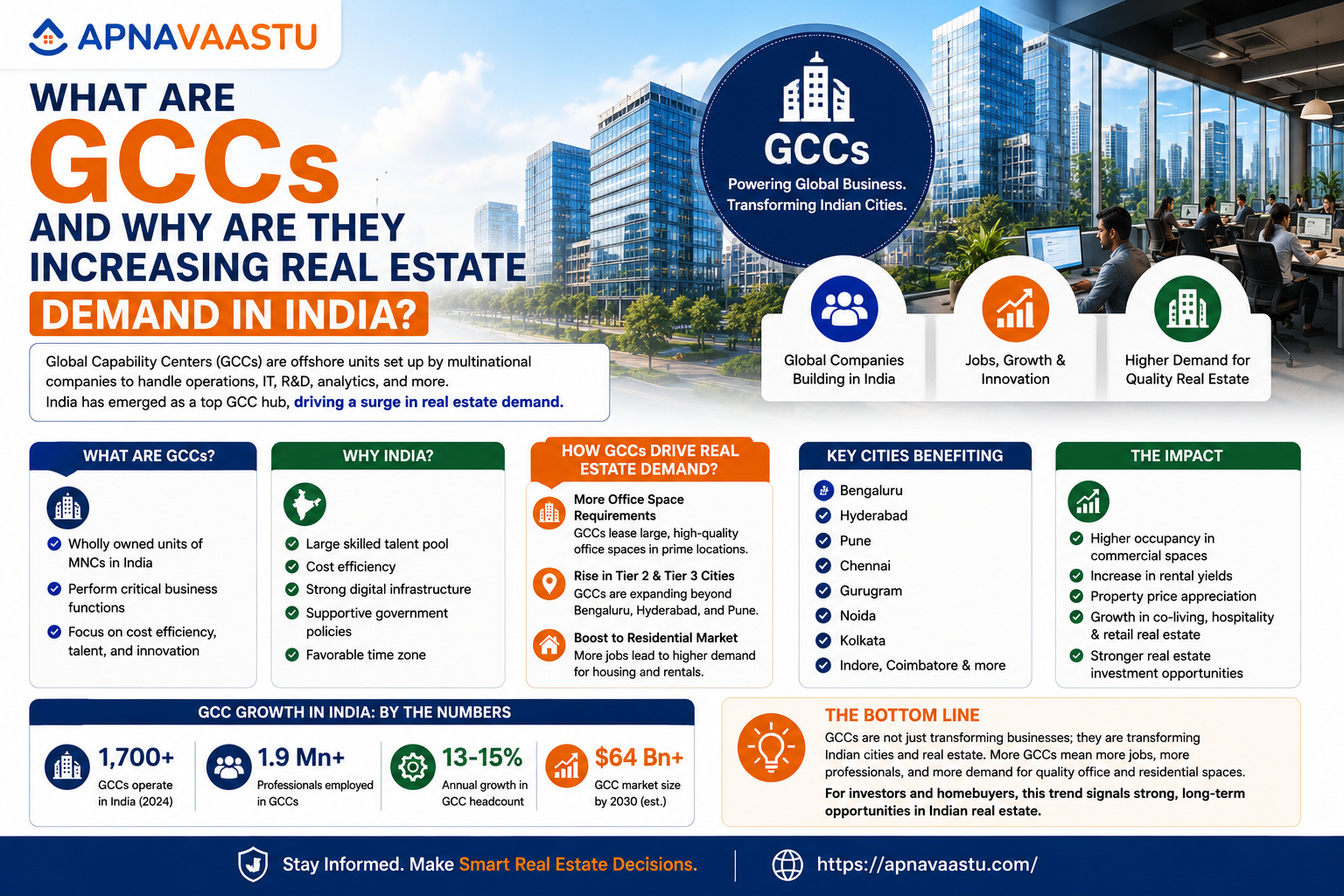
A Global Capability Center (GCC), also called a Global In-house Center (GIC), captive center, or offshore center of excellence, is a fully owned extension of a multinational company set up in another country (most often India) to handle critical, high-value business functions in-house rather than through an outsourcing vendor.
Unlike a traditional outsourcing arrangement where a third-party company delivers a service, a GCC is staffed by employees of the parent company itself, giving it direct control over talent, technology, intellectual property, and quality. The parent company decides what the center does, how it’s structured, and how deeply it’s integrated into global operations.
“The definition of GCCs has evolved from labor arbitrage to capability arbitrage. Cost efficiency still matters, but enterprises now prioritize expertise depth, decision ownership, and innovation velocity.”
In simple terms: a BPO does work FOR a company; a GCC IS the company, just operating out of an India address.
How GCCs have evolved
| Era | What GCCs Did |
| 1990s–2000s | Basic back-office support, call centers, data entry |
| 2000s–2015 | IT support, transaction processing, finance & accounting |
| 2015–2020 | Software development, analytics, shared services |
| 2020–2023 | Product engineering, digital transformation, cloud migration |
| 2023–2026 (GCC 3.0) | AI/ML development, GenAI centers of excellence, cybersecurity, full product ownership, R&D leadership |
This evolution matters for the real estate story: today’s GCCs hire senior, highly paid talent data scientists, product managers, engineering leads not just entry-level staff. That shift in workforce profile is a major reason GCCs are now reshaping premium housing markets, not just budget rental belts.
2. GCC vs. BPO vs. IT Outsourcing: What’s the Difference?
| Feature | GCC | BPO | IT Outsourcing Vendor |
| Ownership | Wholly owned by the parent MNC | Third-party company | Third-party company |
| Control over IP & processes | Full | Limited/none | Limited |
| Talent | Directly employed by parent company | Employed by BPO firm | Employed by vendor |
| Scope of work | Strategic engineering, R&D, AI, finance, product | Transactional support, call centers | Project-based IT delivery |
| Employee seniority/pay | Often mid-to-senior, specialized | Largely entry-level | Mixed |
| Real estate footprint | Large, long-lease, premium Grade A space | Smaller, cost-focused space | Variable |
3. Why India? The Making of the World’s GCC Capital
India didn’t become the world’s largest GCC hub by accident. A combination of structural advantages compounded over two decades:
- Talent depth at scale: India produces roughly 2.5 million STEM graduates every year — the largest technical talent pool in the world, giving GCCs a deep, continuously replenished hiring base.
- Favorable cost-to-quality ratio: Enterprises typically save 40–60% on operating costs while accessing skilled, English-speaking professionals, a combination few other GCC destinations can match at this scale.
- Policy support: Streamlined GCC regulations, Special Economic Zones (SEZs), dedicated tech parks, 100% FDI allowance in most sectors, and single-window clearances have made setup faster than in competing markets like the Philippines, Poland, or Mexico.
- Time-zone and English-language advantage: India’s overlapping working hours with both US and European time zones, combined with strong English proficiency, make coordination easier than most alternative offshore hubs.
- Digital-first infrastructure: Nationwide 5G rollout, mature cloud ecosystems, and a strong startup/product culture create an environment suited to AI, automation, and next-gen product development, not just support functions.
- Two decades of proven delivery: Unlike newer GCC destinations, India has a 25+ year track record with global brands, giving CFOs and boards confidence to commit to large, multi-year real estate leases.
4. GCCs in India: Key 2026 Numbers at a Glance
| Metric | 2026 Figure |
| Total GCCs in India | 1,800–2,100+ (estimates vary by source/methodology) |
| Professionals employed | ~1.9–2 million |
| Annual GCC revenue contribution | USD 64 billion+ |
| Share of India’s office leasing (H1 2026) | 43% (up from 38% in full-year 2025) |
| GCC office space leased (H1 2026) | 16.6–19.6 million sq. ft. across top 7 cities |
| GCC share of large (2 lakh+ sq ft) transactions | 53% |
| YoY growth in GCC transactions | ~30% |
| Projected GCCs by 2030 | 2,400–2,500+ |
| Projected employment by 2030 | 2.8–2.9 million professionals |
| Projected 2030 revenue contribution | USD 105 billion |
| Forecast GCC share of 2026 full-year office leasing | 45–50% (Colliers estimate) |
5. Top GCC Cities in India (2026 Ranking)
| Rank | City | GCC Share / Highlights |
| 1 | Bengaluru | ~35–40% of India’s total GCC base (~870 centers); hosts Goldman Sachs, J.P. Morgan, Microsoft, Amazon, Rolls-Royce; “second headquarters” status for many MNCs |
| 2 | Hyderabad | ~355+ GCCs, ~13% of India’s tech workforce; fastest-growing new-launch hub in early 2026, with 3 new GCCs launched in just two months |
| 3 | Pune | Strong engineering/manufacturing and Industry 4.0-focused GCC base |
| 4 | Chennai | Established BFSI, fintech, and digital finance GCC nucleus |
| 5 | Mumbai | Financial services and enterprise GCC hub, strong Grade A demand |
| 6 | Delhi NCR / Gurgaon | Rapidly growing GCC cluster, especially around Cyber City and Udyog Vihar; increasingly reshaping the region’s residential belt |
| 7 | Tier-II emerging hubs (Ahmedabad, Coimbatore, Jaipur, Indore, Vizag) | “Next-wave” GCC destinations attracting cost-sensitive and specialized centers as metro real estate costs rise |
6. Types of GCC Setup Models
- Wholly Owned Subsidiary (Full Captive): The parent company fully owns and operates the India entity, with maximum control, used by mature GCC programs.
- Build-Operate-Transfer (BOT): A local partner sets up and runs the center initially, then transfers ownership to the parent company after a defined period, popular for first-time entrants who want lower initial risk.
- Managed/Vendor-Supported GCC: A third-party GCC-enablement partner handles HR, real estate, compliance, and operations on the company’s behalf, often as a stepping stone toward a full captive later.
- Hybrid/Delivery Pod Model: Smaller, function-specific pods (e.g., a dedicated AI or cybersecurity pod) that scale independently within a broader GCC structure.
7. What Functions Do GCCs Actually Perform?
Modern GCCs go far beyond the “back office” stereotype. In 2026, typical GCC mandates include:
- Software product engineering and full product ownership
- Artificial intelligence and generative AI centers of excellence
- Cybersecurity operations and threat intelligence
- Data analytics, data engineering, and business intelligence
- Finance, accounting, and financial planning & analysis (FP&A)
- Enterprise R&D and innovation labs
- Customer experience and digital transformation programs
- Supply chain and procurement analytics
- HR technology and global shared services
This breadth of function is precisely why GCCs need large, high-quality, long-lease office space;e they’re not temporary cost centers anymore; they’re permanent strategic hubs designed to run for a decade or more.
8. Why Are GCCs Increasing Real Estate Demand in India?
This is the core of the story, and it plays out through two connected channels: commercial and residential.
- Direct commercial demand: GCCs need enormous, high-spec office campuses to house thousands of employees, and they sign long, stable leases (often 9–15 years) that give developers the confidence to build more Grade A supply.
- Indirect residential demand: Every GCC office creates a cluster of well-paid employees who need to live nearby. This drives up demand and eventually prices for rental and owned housing in a widening radius around GCC campuses.
“GCCs are now influencing workplace strategy, office design, infrastructure planning, and even residential development… More jobs nearby means more demand for housing nearby.”
Put simply: GCCs don’t just lease office floors they import households. A single 2,000-employee GCC campus effectively creates instant demand for thousands of rental units and, within 2–3 years, thousands of home purchases as employees transition from renting to buying.
9. Commercial Real Estate Impact: The Office Leasing Boom
The commercial real estate numbers for 2026 are the clearest evidence of GCC dominance in India’s property market:
- India’s office market recorded its strongest-ever quarter in Q2 2026, with gross leasing hitting an all-time high of 24.6 million sq. ft.
- GCCs alone leased a record 10.3 million sq. ft. in Q2 2026, a 10% jump over Q1.
- Across H1 2026, GCCs accounted for 43% of total office leasing (some estimates put it as high as 46%, per Colliers), against record overall absorption of 45.5 million sq. ft., the highest six-month total ever recorded.
- GCCs represented 53% of all large transactions (over 2 lakh sq. ft.) in H1 2026, meaning they’re not just active;e they’re driving the biggest, most consequential deals in the market.
- Developers responded with a record 32 million sq. ft. of new supply in H1 2026, up 14% year-on-year, much of it green-certified, since 76% of new supply and 73% of leasing activity in 2026 involved sustainable, ESG-compliant buildings.
- Colliers projects GCCs will lease 30–35 million sq. ft. across India’s top seven cities for the full year 2026, rising to 35–40 million sq. ft. in 2027, pushing their share of total office demand toward 50%.
| Quarter/Period | Total Office Leasing (India, top cities) | GCC Share |
| Full Year 2025 | ~31.3 million sq. ft. (GCC portion) | 38% |
| Q1 2026 | GCC leasing: ~9.3 million sq. ft. | |
| Q2 2026 | 24.6 million sq. ft. (record quarter) | 42% (10.3 million sq. ft. from GCCs) |
| H1 2026 | 45.5 million sq. ft. (record half-year) | 43% |
| Full Year 2026 (forecast) | 45–50% |
10. Residential Real Estate Impact: The Ripple Effect
This is the part most GCC explainer articles skip entirely, and it’s arguably the more important story for homebuyers and investors. GCC-driven commercial growth doesn’t stay confined to office parks; it flows directly into housing markets through a predictable, well-documented chain:
The GCC-to-housing chain:
- A GCC signs a large office lease and begins hiring.
- Newly hired employees, many relocating from other cities, rent housing first, almost always close to the office for commute convenience.
- Sustained rental demand near the campus pushes up rents, often by high single digits to double digits annually in the immediate vicinity.
- Two to three years in, many of these same employees now settled, promoted, and earning more start actively looking to buy rather than rent.
- Buying demand concentrates in nearby corridors, pushing up both transaction volumes and per-square-foot prices.
- Rising land values and buyer demand attract developers to launch new premium projects nearby, and the cycle reinforces itself.
Industry data backs this chain directly:
- In Hyderabad’s HITEC City corridor, a 10% rise in commercial rents has been linked to a 6–8% increase in nearby residential rents, and homes within 5 km of major office hubs have appreciated 15–25% faster than peripheral locations.
- Residential rents in Hyderabad’s Madhapur–Gachibowli belt,t a dense GCC corridor, have climbed to roughly ₹9,000–₹12,000 per sq. ft.
- In Bengaluru, residential prices rose about 9% in H1 2026 on sustained demand, with North Bengaluru (near expanding office corridors around Hebbal, Airport Road, and Devanahalli) emerging as the fastest-growing residential market, posting 10% growth in launches and 11% growth in sales.
- In Gurgaon, a 3BHK apartment near Cyber City now commands rents of ₹60,000 to ₹1.2 lakh/month, with senior GCC hires paying these rates with minimal negotiation; buying demand in the ₹1.5–5 crore range typically follows 2–3 years after employees first move to the city.
“When companies lease large office spaces, rental demand rises in nearby residential areas… The constant influx puts pressure on housing supply, especially in areas near IT hubs.”
Why this matters more than a typical “IT jobs boost housing” story: GCC employees today skew senior and highly compensated compared to the traditional IT/BPO workforce of the 2000s and 2010s, because modern GCCs run AI, product, and R&D functions rather than basic support work. That means GCC-driven housing demand isn’t just about volume; it’s disproportionately concentrated in the premium and upper-mid housing segments (₹1–5 crore homes), which is exactly where India’s residential price growth has been strongest through 2025–26.
11. City-Wise Breakdown: How GCCs Are Reshaping Local Property Markets
| City | Commercial Signal | Residential Ripple Effect |
| Bengaluru | Outer Ring Road rentals up 6.7% YoY to ₹105–135/sq ft/month; 14.1 million sq ft office transactions in H1 2026 | Residential prices up ~9% H1 2026; North Bengaluru sales up 11% YoY; 27,968 housing units sold in H1 2026 (+5% YoY) |
| Hyderabad | 355+ GCCs, 13% of India’s tech workforce; 3 new GCCs launched in first 2 months of 2026 | Madhapur–Gachibowli rents at ₹9,000–12,000/sq ft; forecast 10–15% residential appreciation in prime corridors for 2026 |
| Gurgaon/NCR | GCC clusters expanding around Cyber City, Udyog Vihar | 3BHK rents up to ₹1.2 lakh/month near Cyber City; buying demand of ₹1.5–5 crore following 2–3 years after rental influx; Golf Course Extension Road, SPR, Dwarka Expressway emerging as key buying corridors |
| Pune | Strong engineering/Industry 4.0 GCC growth | Housing demand rising in corridors near Hinjewadi and Kharadi tech parks |
| Chennai/Mumbai | BFSI and finance-focused GCC hubs | Steady premium housing demand tied to financial-sector GCC hiring |
12. Why This Demand Is Structural, Not a Bubble
A fair question for any real estate trend: is this sustainable, or is it a temporary spike? Several factors suggest the GCC-driven demand is structural rather than speculative:
- Long lease commitments: GCCs typically sign 9–15-year office leases; unlike short-term co-working or project-based occupiers, this locks in years of stable employment and housing demand around each campus.
- Multi-year hiring pipelines: Enterprises building GCCs plan headcount 3–5 years ahead, meaning today’s leasing activity is a leading indicator of housing demand still to come, not a one-off event.
- Government policy alignment: State governments (especially Telangana, Karnataka, and Haryana) are actively courting GCCs with dedicated policies, SEZ benefits, and infrastructure investment, reinforcing the trend rather than letting it plateau.
- Diversification beyond IT: Unlike the earlier BPO wave, today’s GCC growth spans BFSI, pharma, manufacturing, retail, and engineering firms, reducing dependence on any single global industry’s fortunes.
- Supply is struggling to keep pace: Despite record new office and housing supply in 2026, low vacancy rates in prime corridors (e.g., ~6% in Hyderabad’s HITEC City) show that demand is still outrunning new construction, which is the opposite of what you’d expect in a bubble scenario.
13. What This Means If You’re Buying, Renting, or Investing
If you’re a homebuyer/investor:
- Properties within a 5–8 km radius of established or upcoming GCC campuses have historically outperformed city-wide average appreciation; this is measurable, not anecdotal.
- Tier-II GCC hubs (parts of Pune, Coimbatore, Ahmedabad, Indore) may offer better entry valuations today, before prices catch up to what’s already happened in Bengaluru and Hyderabad.
- Track GCC announcements, not just IT company news;s a single large GCC campus launch (5,000+ planned employees) is often a stronger localized demand signal than broader city GDP or infrastructure headlines.
If you’re a renter/relocating professional:
- Expect rents in GCC-dense micro-markets to keep outpacing city averages; budgeting for annual rent hikes of 8–12% in these specific corridors is more realistic than assuming citywide averages.
If you’re a developer:
- Grade A, green-certified, and larger-floor-plate assets are commanding the strongest demand; 73% of 2026 leasing occurred in green-certified buildings, and 70% in buildings under 10 years old, reflecting a clear “flight to quality.”
14. Risks and Counterpoints to Consider
No trend is risk-free, and a genuinely useful analysis should flag the counterarguments:
- Global economic sensitivity: GCC expansion depends on the financial health and strategic priorities of parent companies headquartered abroad; a global slowdown or major shift in a parent company’s strategy could slow new leasing, even if existing centers remain stable.
- AI-driven headcount efficiency: As GCCs increasingly embed AI and automation into their own operations, headcount growth per unit of office space could moderate over time, even as revenue and functional scope keep expanding meaning office and housing demand growth may not scale linearly with GCC revenue forever.
- Localized oversupply risk: Aggressive developer response in hot micro-markets (e.g., certain Bengaluru or Gurgaon corridors) could eventually outpace genuine end-user demand if GCC hiring plans slow or shift to newer tier-II locations.
- Geopolitical and trade policy shifts: Changes in visa policy, data localization rules, or trade tensions between India and key GCC-parent countries (the US, UK, EU) could influence expansion pace, even if the long-term structural case remains intact.
- Affordability strain for non-GCC residents: Rapid rent and price appreciation in GCC-heavy corridors can price out long-term residents and other professions, a social and policy concern that’s increasingly discussed alongside the growth story.
15. The Road Ahead: GCC and Real Estate Outlook to 2030
| Metric | 2026 | 2030 (Projected) |
| Number of GCCs in India | ~1,800–2,100 | 2,400–2,500+ |
| Employees | ~1.9–2 million | 2.8–2.9 million |
| Annual revenue contribution | USD 64 billion+ | USD 105 billion |
| Share of India office leasing | 43–46% | ~50% |
If these projections hold, India will add roughly 800,000–1 million new GCC jobs over the next four years a workforce expansion large enough, on its own, to justify sustained real estate demand in India’s key metro and tier-II corridors well beyond any single real estate cycle.
16. Frequently Asked Questions
Q1. What does GCC stand for in the real estate and business context? GCC stands for Global Capability Center, a wholly owned offshore unit set up by a multinational company to run core business functions such as engineering, R&D, analytics, and finance directly, rather than through third-party outsourcing.
Q2. How many GCCs are there in India in 2026? Estimates range from approximately 1,800 to 2,100+, depending on the research firm’s methodology and definition of what qualifies as a distinct GCC. Employment across these centers is estimated at 1.9–2 million professionals.
Q3. Which city has the most GCCs in India? Bengaluru leads with roughly 35–40% of India’s total GCC base (around 870 centers), followed by Hyderabad, which has become the fastest-growing GCC hub in 2026, with 355+ centers and several new campus launches this year alone.
Q4. Why do GCCs increase real estate demand specifically, more than regular IT companies? GCCs typically sign longer leases (9–15 years), occupy larger and higher-quality office floors, and hire more senior, higher-paid employees than traditional outsourcing firms. This combination drives both stronger commercial leasing and stronger downstream residential demand, since GCC employees have greater purchasing power for premium rentals and home purchases.
Q5. Do GCCs affect residential property prices, or just office rents? Both. Commercial office demand is the first-order effect, but residential rental and buying demand near GCC clusters is a well-documented second-order effect, with data showing 6–8% residential rent growth for every 10% rise in nearby commercial rents, and homes within 5 km of major office hubs appreciating 15–25% faster than peripheral areas.
Q6. Is investing near a GCC hub still a good idea in 2026, or is it too late? Established hubs like central Bengaluru and Hyderabad have already seen substantial appreciation. Still, emerging corridors (North Bengaluru, western Hyderabad, Dwarka Expressway in Gurgaon, and tier-II cities like Coimbatore and Indore) are earlier in their growth curve. They may offer better relative value, though they also carry higher uncertainty.
Q7. What’s the difference between a GCC and a BPO? A GCC is wholly owned and operated by the parent multinational company itself, giving it full control over talent, IP, and strategic direction. A BPO is a separate third-party company that delivers outsourced services to multiple clients, typically with a narrower, more transactional scope of work.
Q8. Which sectors are setting up the most GCCs in India right now? Technology, BFSI (banking, financial services and insurance), pharmaceuticals/life sciences, manufacturing/engineering, and retail are among the most active sectors establishing or expanding GCCs in India through 2026, according to multiple real estate consultancy reports.
17. Final Takeaway
GCCs have moved well beyond their old “back-office” reputation in 2026; they are India’s single largest driver of commercial office demand, responsible for 43%+ of all office leasing nationally, and their impact is now clearly visible in residential markets too, from Bengaluru’s North corridor to Hyderabad’s Gachibowli belt to Gurgaon’s Golf Course Extension Road. The connection is straightforward: GCCs bring large numbers of well-paid, long-term professionals into specific micro-markets, and housing supply, especially in the premium and upper-mid segment, has consistently struggled to keep pace with the resulting demand. For homebuyers, renters, developers, and investors alike, tracking GCC expansion plans city by city, and even corridor by corridor, has become one of the most reliable leading indicators in Indian real estate today.