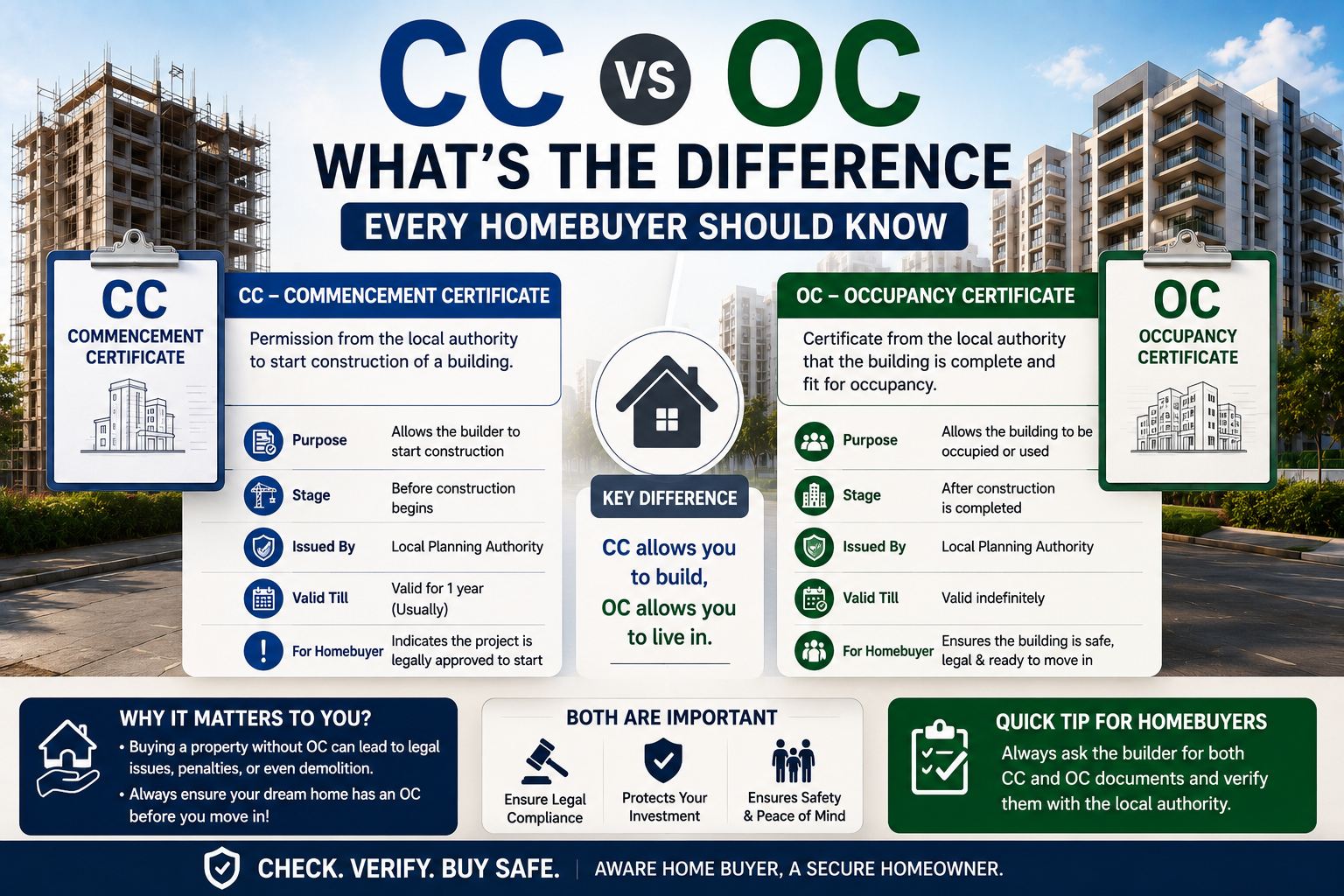
CC vs OC: What’s the Difference Every Homebuyer Should Know
Table of Contents
1. What Is a Completion Certificate (CC)?
A Completion Certificate (CC), also called a Certificate of Completion, is issued by the local municipal corporation or development authority once a building’s construction is finished. It certifies that:
- The structure was built exactly as per the sanctioned building plan and approved layout
- Floor Space Index (FSI)/Floor Area Ratio (FAR) limits were respected
- Structural safety and building-code requirements were met
- Required NOCs (fire, environment, tree plantation, etc.) were obtained
In short, the CC is a construction-compliance document; it says “this is what was approved, and this is what got built, and they match.”
2. What Is an Occupancy Certificate (OC)?
An Occupancy Certificate (OC) is issued after the CC, once the local authority verifies that the completed building is actually safe and ready for people to live or work in. An OC confirms:
- Water supply, electricity, and sewage/drainage connections are functional
- Fire-fighting systems and emergency exits are operational
- Sanitation and health standards are met
- Lifts, parking, and common infrastructure are in usable condition
- No structural or safety violations exist at the time of final inspection
In short, the OC is a habitability-and-safety document; it’s the government’s official permission for people to actually occupy the space.
“The Completion Certificate is a reaffirmation that the building has been constructed as per the building byelaws. The Occupation Certificate signals that there is no violation of construction norms, and thus, the structure is safe for occupants,” a description echoed by multiple developers and real estate leaders when explaining the CC-OC distinction to homebuyers.
3. CC vs OC: Full Comparison Table
| Parameter | Completion Certificate (CC) | Occupancy Certificate (OC) |
| Full form | Completion Certificate | Occupancy Certificate |
| Issued by | Municipal corporation/development authority | Same authority, after CC |
| Issued when | Immediately after construction finishes | After CC, following a habitability inspection |
| What it certifies | Building matches the approved plan and structural norms | Building is safe and ready for people to occupy |
| Order of issuance | First | Second (depends on CC) |
| Legal purpose | Confirms lawful construction | Confirms lawful occupation |
| Required for moving in? | No, by itself | Yes, mandatory before legal possession |
| Required for utility connections? | Sometimes (temporary connections) | Yes, typically for permanent connections |
| Required for home loan disbursement? | Needed for early-stage checks | Needed for final disbursement in most cases |
| Required for property registration? | Yes, in many states | Yes, in several states, alongside or instead of CC |
| Consequence if missing | Building may be treated as unauthorized construction | Occupation may be treated as illegal; risk of eviction notices, utility disconnection, fines |
| Covers common areas/amenities? | Yes,s includes non-habitable spaces like clubhouses, parking | Focuses on habitable, occupiable spaces |
| Can be partial? | Yes Partial/Provisional CC for phased projects | Yes, Part OC for a specific tower/block |
4. The Core Difference, Explained Simply
If you remember only one line from this article, remember this:
CC = “It was built correctly.” OC = “It’s safe to live in.”
A building can technically have a CC and still not be fit for people to move into; that’s precisely the gap the OC exists to close. Builders sometimes hand over “possession” once the CC is issued, but possession without an OC does not carry the same legal weight, and courts have increasingly treated it as a deficiency in service (see Section 10 below).
5. Documents Required: CC vs OC
| For CC | For OC |
| Approved building plan / sanctioned layout | Valid Completion Certificate |
| Commencement Certificate | Fire safety NOC / final fire clearance |
| Architect’s/structural engineer’s completion report | Structural stability certificate |
| Structural stability certificate | Lift/elevator inspection certificate |
| Fire safety NOC | Water and sewage connection proof |
| Environmental clearance (if applicable) | Electricity connection/meter installation proof |
| Property tax receipts | Building photographs post-completion |
| RERA project registration proof | Compliance report confirming no deviation from sanctioned plan |
| Tree plantation/landscaping compliance | Health/sanitation department clearance |
6. Process and Timeline: CC vs OC Side by Side.
In practice, delays are more common on the OC side. A completed structure can sit for a long time without an OC if the builder has unresolved plan deviations, unpaid regularization fees, or simply deprioritizes it because the OC process can also trigger the release of security deposits back to the municipal corporation — an incentive some builders are in no hurry to act on.
| Stage | CC Process | OC Process |
| Step 1 | Complete construction as per approved plan | Ensure CC has already been granted |
| Step 2 | Architect prepares completion report | Apply to municipal authority with CC and supporting documents |
| Step 3 | Submit application with NOCs to municipal authority | Authority schedules a habitability/safety inspection |
| Step 4 | Authority inspects the structure | Inspectors check utilities, fire safety, sanitation |
| Step 5 | Authority verifies against sanctioned plan | Authority reviews compliance report |
| Step 6 | CC issued (typically 3–4 weeks to a few months) | OC issued (commonly cited as roughly 1–2 months after a clean application, longer if there are deviations) |
7. Why the Order Matters: CC Always Comes Before OC
Municipal authorities will not process an OC application without a valid CC on file, because the OC inspection assumes the underlying construction has already been verified as compliant. This sequencing exists specifically to prevent unsafe or unauthorized structures from being certified as occupiable. If someone tells you a building has an OC but no CC, treat that as a red flag worth independently verifying;g it shouldn’t be procedurally possible in most jurisdictions.
8. What If You Have a CC But No OC? (The Most Common Real-World Scenario)
This is, in practice, the situation most Indian homebuyers actually encounter: not “no documents at all,” but CC obtained, OC pending or deliberately delayed.
Industry estimates cited by developer bodies suggest that a significant share of completed urban housing projects, commonly cited around 40% in recent surveys, remain without an OC for 12 months or longer after possession is handed over. Builders often use the possession letter to satisfy contractual delivery timelines while quietly deferring the OC application, since finalizing it can trigger refunds of security deposits to the municipal corporation and limit their flexibility to make further plan changes.
If you’re in a CC-but-no-OC building, here’s what that practically means for you:
- Your occupation is technically not fully legalized until the OC comes through
- Utility providers may only offer temporary/provisional connections
- Banks may hold back the final tranche of a home loan
- Insurance claims tied to structural or habitability issues could be complicated
- Resale becomes harder, since the next buyer’s lawyer and bank will flag it too
9. Part CC vs Part OC For Phased/Large Projects
Large townships or multi-tower developments are frequently built and certified in phases. This creates two important partial-certificate concepts many articles skip entirely:
- Partial/Provisional Completion Certificate (Part CC): Issued for a specific tower, wing, or phase that’s finished, even while other parts of the project remain under construction.
- Part Occupancy Certificate (Part OC): Issued for a specific tower/wing once that section clears habitability checks, allowing residents of that section to move in while construction continues elsewhere in the complex.
Buyer tip: If you’re purchasing in a phased project, don’t accept “the project has an OC” as a blanket answer. Ask specifically whether your tower/wing has received its own Part OC — the fact that another block in the same complex is certified tells you nothing about your unit’s legal status.
10. 2026 Update: Supreme Court Ruling on Possession Without OC
This is one of the most significant recent developments on this topic, and most existing “CC vs OC” articles online do not yet reflect it.
In February 2026, the Supreme Court of India ruled in Parsvnath Developers Ltd. v. Mohit Khirbat (2026 INSC 170) that a homebuyer cannot be compelled to accept possession of a flat without a valid Occupancy Certificate, even where a builder-buyer agreement is silent or attempts to bypass the requirement. The court held that:
- An OC is a statutory precondition for lawful delivery of possession
- Offering possession without an OC constitutes a deficiency in service under consumer protection law
- Builder-buyer agreement clauses cannot override a buyer’s right to insist on statutory approvals like the OC
What this means practically for buyers in 2026: if a builder pressures you to “take the keys” while the OC is still pending, you now have clearer legal backing to decline or to seek compensation for delay — the CC alone, or a promise that the OC is “in process,” is not sufficient legal cover for the builder to treat the handover as complete and compliant.
11. What Happens If You Buy or Occupy a Property Without CC/OC
| Consequence | Missing CC | Missing OC |
| Legal status of construction | May be classified as unauthorized construction | Construction may be legal, but occupation is not |
| Risk of penalties/demolition | Yes, in cases of major deviation | Rare in practice, but legally possible; more commonly fines/notices |
| Utility connections | Difficult to get even temporary connections | Only provisional connections likely available |
| Home loan | Can block loan approval entirely | Can block final disbursement |
| Property registration | Blocked in many states | Blocked or complicated in several states |
| Property registration | Blocked in many states | Blocked or complicated in several states |
| Resale | Significantly harder | Significantly harder |
| Insurance | Claims can be denied | Claims can be denied or delayed |
| Eviction risk | Low but non-zero | Technically present; municipal bodies can issue vacate notices, though mass evictions are rare in practice |
12. How to Verify CC and OC Before Buying (Step-by-Step)
- Ask the builder for both the CC and OC (or Part OC for your specific tower) with reference/application numbers.
- Visit the municipal corporation’s official website and use its “building plan search” or “completion/occupancy certificate status” tool.
- Search using the property’s survey number, plot number, or application number.
- Confirm the certificate covers your exact unit/tower, not just “the project” broadly.
- Cross-check the RERA project page for the same project completion/possession status shown there should be consistent with the municipal CC/OC records.
- If online records are unavailable or unclear, file an RTI (Right to Information) request with the municipal corporation, or consult a property lawyer for formal verification.
13. What to Do If the Builder Withholds the OC Escalation Path
If possession has been offered or already taken but the OC is missing, buyers typically have a structured escalation path:
- Written request to the builder, asking for the OC application status and expected timeline, in writing (email creates a paper trail).
- Municipal Corporation: file a complaint or RTI query directly with the sanctioning authority about the pending application.
- RERA can escalate to the state Real Estate Regulatory Authority; RERA can direct the builder to regularize deviations, pay penalties, or complete pending compliance within a fixed timeframe, and can order interest for delayed possession.
- Consumer forum/courts where RERA relief is inadequate, or the builder remains non-compliant, buyers can pursue consumer protection remedies, now further strengthened by the 2026 Supreme Court position on OC as a precondition for lawful possession.
14. CC/OC’s Impact on Home Loans, Insurance, Resale, and Property Tax
- Home loans: Lenders generally require the CC for early-stage compliance checks and the OC before releasing the final loan tranche. Missing either can delay or reduce your sanctioned amount.
- Insurance: Structure and householder insurance providers may deny or complicate claims if the property lacks a valid CC/OC, since the policy assumes legally compliant construction and occupation.
- Resale: Buyers and their banks in a resale transaction will ask for the same documents you should have asked for — missing CC/OC depresses resale value and narrows your buyer pool.
- Property tax: Municipal property tax assessments are often tied to the completion/occupancy status recorded for the building; missing documentation can complicate assessment or dispute resolution later.
15. Common Myths About CC and OC
- “Possession means the property is legally ready.” Not necessarily; possession without an OC is not automatically legal, and per the 2026 Supreme Court ruling, buyers can now more firmly decline it.
- “If one tower in the project has an OC, my flat is covered too.” False for phased projects;s you need the Part OC specific to your tower/wing.
- “CC and OC are basically the same thing.” They certify different things at different stages; having one does not imply the other exists.
- “A reputed builder means documentation isn’t an issue.” Compliance is project- and phase-specific, not brand-specific; always verify independently.
- “Once OC is delayed, there’s nothing a buyer can do.” Buyers have a real, structured escalation path: a municipal complaint, RERA, and consumer forums, and recent court rulings strengthen this position.
16. Pre-Purchase Checklist
- Confirm CC exists and matches your exact unit/tower
- Confirm OC (or Part OC) exists for your specific tower/wing, not just the overall project
- Verify both documents independently on the municipal portal
- Cross-check completion/possession status on the state RERA portal
- Ask your bank whether current documentation is sufficient for full loan disbursement
- Get written confirmation from the builder on OC application status if it’s still pending
- Consult a property lawyer before taking possession if the OC is not yet issued
17. Frequently Asked Questions
1. What is the main difference between CC and OC? CC confirms the building was constructed as per the approved plan; OC confirms the building is safe and ready for people to occupy. CC comes first, OC comes second.
2. Can I move into a flat with only a CC and no OC? Legally, no, the OC is the document that permits occupation. Moving in without it carries legal and practical risk, and recent Supreme Court rulings support a buyer’s right to decline possession without a valid OC.
3. Who issues CC and OC? Both are issued by the same local municipal corporation or development authority, with the OC issued only after the CC.
4. Is OC compulsory for a home loan? In most cases, yes, especially for the final disbursement tranche. Some lenders may process partial disbursement against a CC, but full disbursement typically requires the OC.
5. What is a Part OC? It’s an Occupancy Certificate issued for a specific tower, block, or phase of a larger project, allowing residents of that section to legally move in while other phases are still under construction.
6. What happens if a builder never applies for the OC? Buyers can escalate through the municipal corporation, the state RERA, and consumer forums. RERA can direct builders to regularize the project and pay penalties for non-compliance.
7. Does CC guarantee the building is safe to live in? No. CC confirms construction compliance with the approved plan; it does not certify utilities, fire safety systems, or overall habitability that’s the OC’s job.
8. Can OC be issued without CC? No. Municipal authorities require a valid CC on file before processing an OC application, since the OC inspection builds on the CC’s verification.
9. How do I check if my building has an OC? Search the municipal corporation’s official “occupancy certificate status” or “building plan search” tool using your property’s survey/plot number, or request the information via RTI.
10. What’s the 2026 Supreme Court ruling about OC? In Parsvnath Developers Ltd. v. Mohit Khirbat (2026 INSC 170), the Supreme Court held that builders cannot force buyers to accept possession without a valid OC, and that doing so amounts to a deficiency in service under consumer law.
11. Is CC or OC more important for property registration? Requirements vary by state; some states require CC before registration, others also factor in OC status. Always confirm the specific requirement with your state’s registration/sub-registrar office.
12. Can I get insurance on a property without OC? It’s possible, but often complicated; insurers may deny or delay claims on properties lacking a valid OC, since coverage typically assumes legally compliant occupation.
18. Key Takeaways
- CC certifies construction compliance; OC certifies occupation safety; they are sequential, not interchangeable.
- CC must exist before an OC can be applied for or issued.
- A large share of “completed” projects in India still lack a timely O; always verify independently rather than trusting possession letters alone.
- For phased/multi-tower projects, confirm the Part OC specific to your unit’s tower, not just the project’s overall status.
- The 2026 Supreme Court ruling in Parsvnath Developers Ltd. v. Mohit Khirbat significantly strengthens a buyer’s right to refuse possession without a valid OC.
- If a builder delays the OC, buyers have a real escalation path: written request → municipal corporation/RTI → RERA → consumer forum.