How GCC Growth Is Impacting Property Prices in Pune
Table of Contents
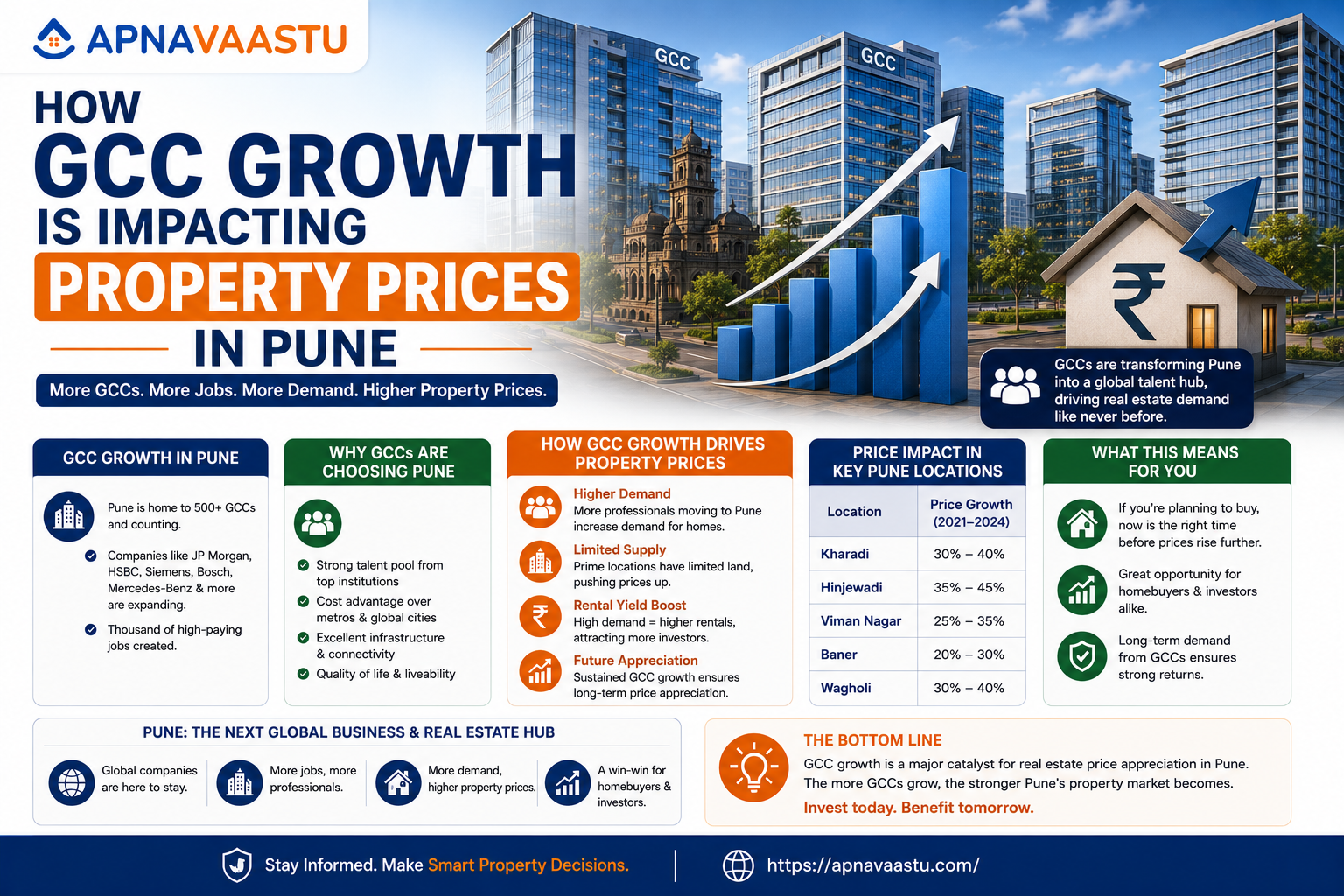
1. What Is a GCC? Quick Definition
A Global Capability Center (GCC), also known as a Global In-house Center (GIC) or captive center, is a wholly owned offshore unit that a multinational company sets up to run critical business functions directly, using its own employees, rather than outsourcing to a third-party vendor. Unlike a BPO, a GCC gives the parent company full control over talent, technology, intellectual property, and strategic direction.
In Pune specifically, GCCs have moved well past the old “cost center” reputation. According to a 2026 KPMG–AMCHAM whitepaper on Pune’s GCC ecosystem, many centers in the city now own product roadmaps, core engineering platforms, and global process charters not just back-office support. This is central to understanding why Pune’s GCC growth translates into serious, sustained real estate demand: these are highly paid, long-tenure engineering and R&D jobs, not transient support roles.
2. Why Pune? The Structural Case for Pune as a GCC Hub
Pune’s rise as a GCC destination isn’t accidental; it’s built on a specific combination of advantages that set it apart from India’s larger GCC hubs:
- Deep engineering and automotive R&D legacy. Pune has been India’s automotive and manufacturing hub for decades (Tata Motors, Bajaj Auto, Force Motors, and dozens of auto-component majors), giving it a talent base perfectly suited to engineering-heavy GCC mandates like electric mobility, autonomous systems, and industrial automation.
- Strong presence of US-headquartered firms. The KPMG-AMCHAM report specifically highlights Pune’s growing base of US multinational GCCs as a key growth driver, alongside supportive state policy and expanding digital infrastructure.
- Cost advantage over Bengaluru. Pune offers roughly 10–20% lower operational costs than Bengaluru, while still providing access to specialized engineering talent from institutions like COEP, PICT, and Symbiosis, making it attractive for companies scaling mid-size or “nano” GCCs (10–300 engineers) that don’t need Bengaluru’s scale but do need its talent depth.
- Government and policy support. The Maharashtra Industrial Policy 2026 includes five-year power duty exemptions particularly relevant for AI and simulation-heavy workloads, and accelerated depreciation on eligible capital expenditure,e both directly beneficial to engineering-intensive GCCs. Maharashtra’s broader IT-ITeS policy framework (2023 onward) also targets ₹95,000 crore in investment aimed at creating 3.5 million jobs statewide, alongside a ₹2,150 crore allocation for AI centers of excellence.
- Proximity to Mumbai. Being roughly 150 km from India’s financial capital gives Pune-based GCCs easy access to Mumbai’s BFSI ecosystem, corporate headquarters, and international airport connectivity, without Mumbai’s real estate costs.
- Quality of life. Repeatedly cited in industry reports as a differentiator Pune’s climate, urban planning, and social infrastructure make it easier to attract and retain senior talent relocating from other cities, compared to more congested metros.
- A specific niche: mid-market and nano GCCs. Pune currently hosts around 11% of India’s mid-market GCCs (50–300 engineers) and 13% of large-scale GCCs; this is arguably its most distinctive competitive position, rather than trying to out-scale Bengaluru or Hyderabad on total headcount.
3. Pune’s GCC Ecosystem: Key 2026 Numbers
| Metric | 2026 Figure |
| Total GCCs in Pune | 350–500+ (estimates vary by source; KPMG’s 2026 report cites 500+) |
| Countries represented | 30+ |
| Industries represented | 20+ |
| GCC workforce in Pune | 100,000+ professionals |
| Pune’s share of India’s mid-market GCCs (50–300 engineers) | ~11% |
| Pune’s share of India’s large-scale GCCs | ~13% |
| Share of nationwide office transactions (2023–2025) | 34%, with GCCs taking 81% of that share |
| Q2 2026 office leasing in Pune | 3.22 million sq. ft. (54% QoQ increase, highest-ever quarterly leasing) |
| GCC share of Q2 2026 Pune office leasing | 52% (~1.66 million sq. ft.) |
| H1 2026 total Pune office leasing | 5.31 million sq. ft. — Pune’s highest-ever half-year total |
| Projected GCCs in Pune by 2030 | 500+ (with continued acceleration) |
4. Which Companies Have GCCs in Pune?
Pune’s GCC base spans automotive engineering, IT services, BFSI, and enterprise software. Notable operators include:
- Mercedes-Benz Research and Development India- a major R&D center for electric mobility and autonomous driving systems
- BMW Group India — automotive engineering and advanced manufacturing
- Infosys, TCS, Wipro, Cognizant, Capgemini, Accenture large-scale IT and digital transformation operations
- Numerous specialized mid-market and nano GCCs across automotive, industrial automation, enterprise software, life sciences, and BFSI analytics
This mix of global auto majors alongside IT services giants and a fast-growing base of specialized mid-size centers is what gives Pune’s GCC ecosystem its distinct engineering-and-R&D character, compared to the more IT-services-dominated profiles of some other Indian cities.
5. Pune’s GCC Micro-Markets: Who’s Based Where
| Locality | GCC Specialization |
| Hinjewadi | IT and Engineering R&D (ER&D) GCCs; home to Rajiv Gandhi Infotech Park across three phases |
| Magarpatta | IT and ER&D GCCs, established mixed-use tech township |
| Kharadi | BFSI belt; anchored by EON IT Park |
| Viman Nagar | BFSI belt, premium residential overlap |
| Chakan | Automotive and industrial R&D pocket |
| Yerwada | BFSI and knowledge services |
| Baner–Balewadi | Popular with IT professionals for proximity to Hinjewadi plus strong social/retail infrastructure |
6. What Kind of Work Do Pune’s GCCs Actually Do?
Pune’s GCC mandates have shifted decisively from support functions toward strategic, product-owning work:
- Electric mobility and autonomous driving systems engineering (automotive GCCs)
- Industrial automation and Industry 4.0 platforms
- Cloud platforms and SaaS product development
- Cybersecurity operations
- BFSI analytics and financial shared services
- Enterprise software product engineering
- Life sciences and healthcare technology (a steadily growing segment)
7. Pune vs. Bengaluru vs. Hyderabad: How Pune’s GCC Story Is Different
| Factor | Pune | Bengaluru | Hyderabad |
| GCC specialization | Automotive/engineering R&D, mid-market & nano GCCs | Deep tech, AI, largest overall GCC base | BFSI, pharma, fast-growing greenfield setups |
| Approx. GCC count (2026) | 350–500+ | ~870 (35–40% of India’s total) | 355+ |
| Cost vs. Bengaluru | 10–20% lower | Benchmark (highest cost among top hubs) | Competitive, similar tier |
| Best fit for | Mid-size engineering-focused centers (50–300 employees) | Large-scale, high-visibility flagship GCCs | Rapidly scaling new entrants, BFSI-heavy mandates |
| Office leasing share via GCCs (2026) | 52% (Q2 2026) | ~40%+ (Bengaluru’s overall share of India leasing) | High and rising |
The key distinction: Pune isn’t trying to compete with Bengaluru or Hyderabad on raw scale; it has carved out a specific, defensible niche in engineering-heavy and mid-market GCCs, which is arguably a more resilient position than chasing headcount alone, since it draws on decades of local automotive and manufacturing expertise that competing cities simply don’t have.
8. How GCC Growth Is Impacting Property Prices in Pune
This is the central question,n and the data through mid-2026 shows a clear, measurable connection between GCC expansion and residential price growth in specific corridors.
The mechanism, step by step:
- A GCC signs a large office lease (often multi-year, in Grade A parks) in a corridor like Hinjewadi, Kharadi, or Baner.
- Hiring ramps up, often bringing in engineers and specialists relocating from other cities.
- New employees rent housing close to the office first, pushing up rental demand and rents in that specific micro-market.
- Within 2–3 years, many of these employees, now earning more and settled in the city,y shift from renting to buying, concentrating demand (and price growth) in nearby residential corridors.
- Developers respond with new launches targeting this demand, and infrastructure investment (metro lines, roads) follows the same corridors, reinforcing the cycle.
The 2026 numbers confirm this pattern directly:
- Pune’s average residential price rose 5% YoY to ₹10,063 per sq. ft. in H1 2026, with Baner, Kharadi, and Hinjewadi specifically called out as the strongest-performing micro-markets.
- Residential capital values rose 5.4% quarter-on-quarter in Q2 2026 alone, a sharp pace that closely tracks the same quarter’s record 54% QoQ jump in GCC-driven office leasing.
- Pune’s residential market posted its highest quarterly launch volume in three years in Q2 2026 (13,756 new units, up 21% QoQ and 27% YoY), with developers concentrating supply precisely in GCC-adjacent corridors.
- The NH4 Bypass (North) corridor led by Hinjewadi and Tathawad accounted for 41% of all new launches in Q2 2026, making it Pune’s single most active residential market, directly mirroring Hinjewadi’s status as Pune’s largest GCC and IT employment cluster.
- Broader locality data shows Hinjewadi, Wakad, Baner, and Aundh have seen real estate demand surge over 300% with prices rising 25–30% since 2021, a period that closely tracks Pune’s GCC expansion curve.
- Analysts forecast 7–12% price appreciation for 2026–27 in established IT corridor localities (Hinjewadi, Kharadi, Viman Nagar), while peripheral/budget localities (Pimpri Chinchwad, Undri) are expected to see sharper percentage gains as metro connectivity matures and affordability-seeking GCC employees move outward.
“Robust demand from GCCs, flex operators and technology-led occupiers, coupled with improving infrastructure and expanding metro connectivity, reinforces the city’s position as one of India’s most preferred commercial destinations.” Vilas P Menon, National Director, Knight Frank India (Pune)]
9. Area-Wise Property Price Impact Table (2026)
| Locality | Zone | Approx. Price Range (₹/sq. ft.) | GCC/IT Connection | 2026 Trend |
| Baner / Balewadi | West | ₹12,000–22,000 | Proximity to Hinjewadi; lifestyle + retail premium | Strong; resale 2BHK time-on-market fell from 75–90 days (2024) to 45–60 days (2026) |
| Hinjewadi | West | ₹5,500–14,000 (wide range by phase) | Direct GCC/IT hub — Rajiv Gandhi Infotech Park | Prices up ~10% YoY on metro connectivity |
| Wakad / Tathawade | West | ₹8,500–11,500 | Spillover market for Baner–Balewadi & Hinjewadi | Rising steadily; leading Q2 2026 launch volume corridor |
| Kharadi | East | ₹8,000–16,000 | BFSI belt anchored by EON IT Park | Among Pune’s strongest-performing markets |
| Viman Nagar / Koregaon Park / Kalyani Nagar | East | ₹12,000–22,000+ | Premium/luxury housing for senior GCC & NRI buyers | Stable premium demand |
| Wagholi / Moshi | East/North | ₹5,000–8,000 | Affordable entry point within GCC catchment | High growth rate off a lower base |
| Chakan | North | Emerging/affordable | Automotive & industrial R&D GCC pocket | Early-stage appreciation |
| NIBM Road / Undri / Kondhwa | South | ₹6,500–9,500 | Family residential zone, indirect GCC spillover | Expected sharper gains as Ring Road/metro mature |
| Pimpri-Chinchwad / Ravet / Kiwale | North/PCMC | ₹5,000–7,000 | Affordable township zone, manufacturing + spillover demand | Forecast for sharper percentage gains 2026–27 |
10. The Rental Market: Where GCC Impact Shows Up First
Rental demand is typically the earliest and most visible signal of GCC-driven housing pressure, since new hires rent before they buy:
- 2 BHK apartments in Hinjewadi Phase 3 are fetching ₹22,000–28,000 per month, reflecting chronic undersupply of quality rental inventory near Pune’s largest employment cluster.
- Residential rents rose approximately 7–9% in early 2025, with a similar trajectory expected through 2026 as more GCC and IT staff return to office full-time.
- Pune’s overall residential rental yields of 3–5% outperform Mumbai’s roughly 2.5% average and are comparable to Bengaluru’s IT-corridor yields, with IT-adjacent Hinjewadi and Kharadi offering the higher end of this range.
- Commercial rental yields in Baner and Kharadi reach 7–9%, reflecting sustained office-space demand from GCCs and flexible workspace operators in these corridors.
- A well-furnished 3BHK in Baner (priced around ₹2 crore) can fetch ₹55,000–70,000/month in rent, driven specifically by demand from high-income IT and GCC professionals working in nearby Hinjewadi.
11. Why the Price Rise Isn’t (Yet) a Bubble
A fair, balanced article should address whether Pune’s GCC-linked price growth is speculative or sustainable. The evidence leans toward the latter:
- End-user dominated market: Roughly 80% of buyers in Pune purchase homes for self-use, not speculation; this creates a stronger price floor than markets driven by investor flipping.
- Demand is tied to real employment growth, not sentiment: Pune’s Q2 2026 office leasing volume (3.22 million sq. ft.) was a genuine record, not a projection, with GCCs directly responsible for 52% of it.
- Supply is responding, not lagging dangerously: Q2 2026 also saw Pune’s highest quarterly residential launch volume in three years (13,756 units), suggesting developers are matching demand rather than starving the market into a speculative spiral.
- Office vacancy remains manageable: Pune’s office vacancy stood around 13.2% in Q2 202,6 elevated enough to avoid acute scarcity pricing, but not so high as to suggest oversupply risk.
- Diversified economic base: Unlike a single-industry boomtown, Pune’s GCC growth spans automotive, BFSI, enterprise software, and life sciences, reducing dependence on any one sector’s fortunes.
12. Infrastructure Multiplier: Metro, Ring Road, and Airport Expansion
Infrastructure investment is compounding the GCC effect on property values:
- Pune Metro Line 3, connecting Hinjewadi to Shivajinagar, is being rolled out in phases and is already credited with pushing Hinjewadi prices up roughly 10% YoY.
- Planned metro expansion toward Kharadi and Hadapsar is expected to extend similar appreciation dynamics to Pune’s eastern GCC corridor.
- The 128-km Pune Ring Road under phased construction, with partial sections due by 2027–28, is expected to unlock new residential growth corridors on the city’s periphery (Undri, Wagholi, Talegaon), similar to how CIDCO infrastructure transformed Navi Mumbai’s periphery.
- Lohegaon International Airport’s runway extension and terminal upgrade are expected to boost Pune’s air connectivity through 2026–27, an important factor for GCCs whose leadership and clients travel internationally.
13. Best Areas to Invest Near Pune’s GCC Corridors in 2026
| Priority | Area | Why |
| Established, higher entry cost | Baner, Balewadi, Kharadi | Proven GCC/IT demand, strong rental yields, fastest resale absorption |
| Balanced growth + affordability | Wakad, Tathawade, Viman Nagar | Spillover markets with continued infrastructure investment |
| Higher growth potential, lower entry cost | Wagholi, Chakan, Undri | Early-stage appreciation, Ring Road/metro-linked upside, better entry pricing |
| Long-term/peripheral bet | Talegaon, Ravet, Charholi, Moshi | Affordable township zones benefiting from manufacturing + logistics growth and future Ring Road connectivity |
14. Risks Buyers and Investors Should Watch
- Water scarcity in parts of East Pune, including Kharadi, Keshavnagar, and Wagholi a genuine practical due-diligence item, since tanker-dependent properties carry ongoing operational costs and can affect tenant satisfaction.
- Office vacancy at 13.2% (Q2 2026), while not alarming, is worth monitoring; a sustained rise could signal that new office supply is outpacing genuine GCC absorption in specific micro-markets.
- Global dependency: Pune’s automotive-heavy GCC base (Mercedes-Benz, BMW) ties local demand partly to the health and strategic priorities of the global automotive and EV sector; a slowdown there could disproportionately affect Chakan and nearby corridors.
- Concentration risk in a few corridors: With 41% of Q2 2026 launches concentrated in the NH4 Bypass/Hinjewadi corridor alone, buyers should be mindful of hyper-local supply build-up even as citywide fundamentals stay strong.
- Infrastructure delays: Ring Road and Metro Line 3 extensions are multi-year projects; buying purely on the promise of future connectivity carries timeline risk if projects face delays.
15. 5-Year Outlook: Pune GCCs and Property Prices to 2030
| Metric | 2026 | 2030 (Projected) |
| GCCs in Pune | 350–500Plus | 500Plus (continued acceleration) |
| GCC workforce | 100,000Plus | Expected to grow substantially in line with national GCC employment trend |
| Forecast price appreciation, established IT corridors (2026–27) | — | 7–12% |
| Forecast price appreciation, peripheral/budget localities (2026–27) | — | Sharper % gains as metro/Ring Road mature |
If Pune sustains its current trajectory 34% of nationwide GCC-related office transactions between 2023–2025, and a record 52% GCC share of Q2 2026 leasing the city is on track to remain one of India’s top three GCC-driven property markets through the rest of the decade, with its distinctive engineering/automotive R&D specialization likely to keep it more insulated from pure-IT sector cyclicality than some competing hubs.
16. Frequently Asked Questions
Q1. What does GCC mean in the context of Pune real estate? GCC stands for Global Capability Center, a wholly owned India-based unit of a multinational company running core functions like engineering, R&D, IT, and analytics. In Pune specifically, GCC growth is a major driver of both commercial office leasing and residential property demand in IT-adjacent corridors.
Q2. Why do companies choose Pune over Bengaluru or Hyderabad for their GCC? Pune offers 10–20% lower operational costs than Bengaluru, strong specialized engineering and automotive R&D talent, supportive Maharashtra state policy, and a distinct niche in mid-market and nano GCCs (50–300 employees), rather than trying to match Bengaluru’s scale.
Q3. Which Pune localities are most affected by GCC-driven property price growth? Hinjewadi, Baner, Balewadi, Kharadi, Wakad, and Tathawade are the areas most directly affected, with Hinjewadi and the surrounding NH4 Bypass corridor alone accounting for 41% of new residential launches in Q2 2026.
Q4. How much have property prices risen in Pune due to GCC growth? Pune’s citywide average residential price rose 5% YoY to ₹10,063 per sq. ft. in H1 2026, with capital values up 5.4% quarter-on-quarter in Q2 2026 alone. Specific IT-corridor localities like Hinjewadi, Wakad, Baner, and Aundh have seen demand surge over 300,% and prices rise 25–30% since 2021.
Q5. Is Pune’s property price rise driven by GCCs sustainable, or a bubble risk? Most indicators point to sustainable, end-user-driven growth: roughly 80% of Pune buyers purchase for self-use rather than speculation, office vacancy remains at a manageable 13.2%, and new residential supply is scaling alongside demand rather than lagging behind it.
Q6. What rental yields can investors expect in GCC-heavy Pune localities? Residential yields in Pune range from 3–5%, with IT-adjacent areas like Hinjewadi and Kharadi at the higher end of that range outperforming Mumbai’s roughly 2.5% average. Commercial properties in Baner and Kharadi can achieve 7–9% yields.
Q7. Which industries dominate Pune’s GCC ecosystem? Automotive engineering and R&D lead Pune’s GCC landscape (Mercedes-Benz, BMW Group India), followed by industrial automation, enterprise software, BFSI analytics, and a steadily growing life sciences/healthcare segment.
Q8. What infrastructure projects will most affect GCC-linked property values in Pune going forward? Pune Metro Line 3 (Hinjewadi–Shivajinagar), planned metro extension to Kharadi and Hadapsar, the 128-km Pune Ring Road, and the Lohegaon Airport expansion are the key infrastructure catalysts expected to shape property values in and around Pune’s GCC corridors through 2027–28.
17. Final Takeaway
Pune’s GCC story in 2026 is defined less by scale and more by specialization:n deep automotive and engineering R&D talent, a distinctive niche in mid-market and nano GCCs, and meaningful cost advantages over Bengaluru have combined to make the city one of India’s fastest-growing capability center hubs, with GCCs now driving over half of Pune’s record quarterly office leasing. That commercial momentum has translated directly into residential price and rental growth across Hinjewadi, Baner, Kharadi, and their surrounding corridors, with the data showing this is a genuine, end-user-backed demand cycle rather than speculative froth, at least for now. For homebuyers and investors, tracking GCC leasing activity corridor by corridor, alongside infrastructure milestones like Metro Line 3 and the Ring Road, offers one of the clearest forward-looking signals available in Pune’s property market today.