Is a Completion Certificate Required for Home Loan Approval?
Table of Contents
1. Why Lenders Care About the Completion Certificate
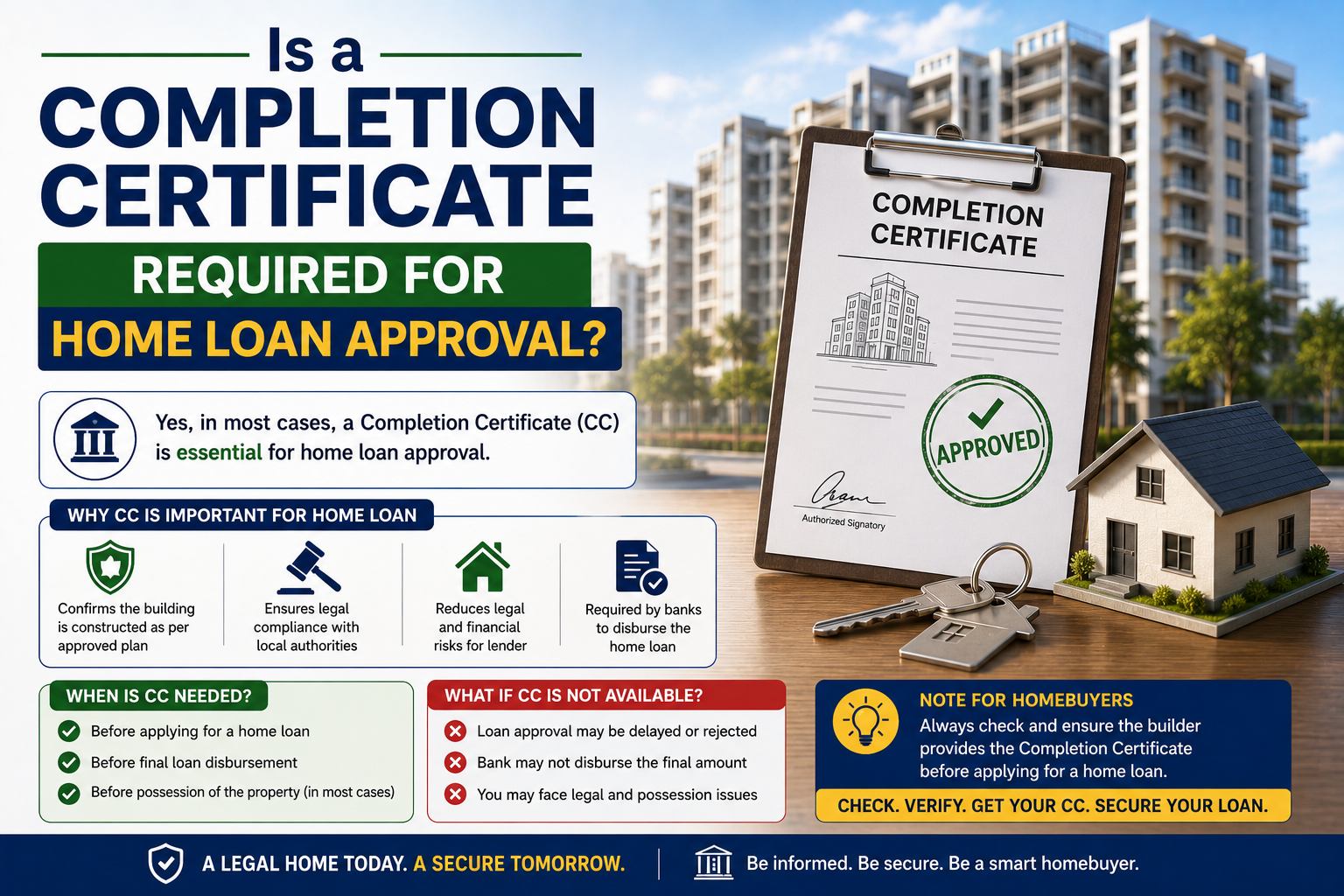
Banks and housing finance companies (HFCs) are risk-averse by design; the property is their collateral. A Completion Certificate confirms the structure was built exactly as per the sanctioned plan and safety norms, which matters to a lender for very concrete reasons:
- It reduces the risk of funding an illegal or non-compliant structure that could later face demolition or penalty notices
- It confirms the collateral’s legal standing, which protects the lender’s ability to recover the loan through the property if needed
- It’s frequently a precondition for the property to even qualify for full valuation and mortgage registration
- Loan insurance and mortgage insurance products often require proof of compliant construction
2. Ready-to-Move/Resale Property vs Under-Construction: Different Rules
This is the single most important distinction most articles blur together; the CC requirement plays out very differently depending on what you’re buying.
| Property Type | CC Requirement | Disbursement Pattern |
| Ready-to-move-in (new, from builder) | CC is checked and required before/at final disbursement | Usually full disbursement in one go, subject to CC/OC verification |
| Resale (older, completed property) | CC required as part of legal due diligence before sanction | Full disbursement at once, after title and CC/OC checks |
| Under-construction (buying from builder pre-completion) | Not required at sanction stage; required for the final tranche | Staged/tranche disbursement tied to construction milestones |
| Self-construction (buying land + building yourself) | Interim engineer certificates used during construction; final CC needed for loan closure and tax benefit purposes | Staged disbursement tied to architect-certified progress |
For ready and resale properties, most lenders will simply not process full disbursement,t and some won’t sanction the loan at all without a valid CC on file, because there’s no “construction in progress” excuse; the building already exists.
For under-construction properties, the absence of a CC at the time of application isn’t a blocker, because it’s genuinely not supposed to exist yet. What matters here is whether the project is RERA-registered and progressing on approved lines;s the CC becomes relevant only near the end.
3. Home Loan Disbursement Stages and Where CC Fits In
For under-construction properties, disbursement is never a single lump sum. Understanding this staged structure is key to understanding exactly when CC becomes a gatekeeper.
| Stage | What Happens | CC Relevant? |
| 1. Loan sanction | Lender approves loan based on income, credit profile, and project legal/technical appraisal | No |
| 2. First disbursement | Released after signing the loan agreement and paying your own contribution | No |
| 3. Milestone-based tranches | Released as construction reaches stages certified by the builder/project engineer (foundation, slab, structure, finishing) | No architect/engineer certificates are used instead |
| 4. Pre-EMI period | You pay interest only on the disbursed amount, not full EMI | No |
| 5. Final disbursement | Released once construction is fully complete | Yes, CC is typically required here |
| 6. Regular EMI begins | Full EMI (principal + interest) starts after final disbursement | Indirectly delayed CC can delay this transition |
Practical implication: if your builder is late in obtaining the CC, your loan can get stuck exactly at Stage 5 you may keep paying pre-EMI indefinitely instead of transitioning to a normal EMI schedule, even though you might already be occupying the flat.
4. Documents Lenders Check Alongside CC
CC is rarely the only document under scrutiny. A complete legal/technical check for home loan approval typically includes:
- Approved building plan and sanctioned layout
- Commencement Certificate
- RERA project registration certificate (for under-construction purchases)
- Completion Certificate (CC)
- Occupancy Certificate (OC), especially for final disbursement on ready properties
- Encumbrance certificate and clear title documents
- Property tax receipts
- NOCs (fire, environment, structural stability, as applicable)
- Sale agreement/sale deed
- Builder’s demand letter and payment receipts (for under-construction)
5. Can You Get a Home Loan Without a CC? (Real Scenarios)
Scenario A: New ready-to-move flat, builder hasn’t obtained CC yet: Difficult. Most lenders will hesitate to fully disburse, and some will decline the loan entirely until the CC (and often OC) is produced, because a “completed” property without a CC is, on paper, still non-compliant construction.
Scenario :B: Old resale property, original CC missing or untraceable: This happens often with older buildings, especially independent houses built decades ago before digitization. Some lenders may accept an alternative combination of documents: it’s a long-standing property tax payment history, an approved building plan, and a structural stability certificate from a licensed engineer,r but this is assessed case by case and is generally treated as higher-risk lending. Expect closer scrutiny, possibly a lower loan-to-value ratio, or outright refusal from more conservative lenders.
Scenario C Under-construction property, project not yet complete: Perfectly normal; no CC is expected at this stage, and staged disbursement continues based on construction progress, not CC status.
Scenario D Self-construction on owned land: Interim engineer/architect certificates support tranche disbursement; the final CC (obtained from your local municipal body after your own construction is done) is generally required to close the loan file and, importantly, to support tax-benefit documentation later.
6. Bank vs NBFC/Housing Finance Company: Does Policy Differ?
While the general principle CC required for full/final disbursement holds across the industry, the strictness can vary:
- Public sector banks and larger private banks tend to apply CC/OC requirements more rigidly, particularly for resale and ready properties, given tighter internal risk and audit frameworks.
- Housing Finance Companies (HFCs) and NBFCs sometimes show slightly more flexibility on documentation for resale or older properties, occasionally accepting a broader documentation package in place of a strictly formal CC, but this comes with its own trade-offs, such as potentially higher interest rates or stricter valuation.
- Regardless of lender type, none of them will treat a missing CC as a non-issue on a completed structure; it always affects either approval, loan amount, interest rate, or disbursement timing in some way.
Practical tip: if your CC situation is unusual (old property, missing records, builder delay), it’s worth shopping across 2–3 lender types rather than assuming a blanket “no” from one bank applies everywhere.
7. CC vs OC: Which One Actually Matters More for Your Loan?
Buyers often ask this, and the honest answer is: both matter, at different points.
- CC demonstrates the construction is compliant; lenders use this to validate the collateral’s legal soundness and to release the final construction-linked tranche.
- OC demonstrates the property is safe to occupy; many lenders specifically ask for OC (not just CC) before releasing the very last portion of disbursement on ready properties, since occupancy readiness is what completes the “usable asset” picture for their records.
If you’re buying a ready-to-move home, don’t assume showing the CC alone will unlock full disbursement; ask your lender explicitly whether they also require the OC, since practice varies by lender and city.
8. Home Loan Tax Benefits Tied to Completion Certificate (Often Overlooked)
This is a major piece of the picture that most “CC for home loan” articles skip entirely;y the completion status of your property also directly controls your income tax deductions, not just your loan disbursement.
Under Section 24(b) of the Income Tax Act:
- You can claim a deduction of up to ₹2 lakh per year on home loan interest for a self-occupied property but only if construction is completed within 5 years from the end of the financial year in which the loan was taken.
- If construction is not completed within that 5-year window, the maximum deduction drops sharply to just ₹30,000 per year, ar a difference of ₹1.7 lakh in annual tax benefit.
- Interest paid during the pre-construction period (before you get possession) isn’t lost;t it can be claimed in 5 equal annual instalments starting from the year construction is completed, but only once completion is documented.
- To support this claim, you need documentary proof of completion, typically the Completion Certificate or Occupancy Certificate from the local municipal authority, along with your interest certificate from the lender.
Additional related deductions:
- Section 80C allows up to ₹1.5 lakh on principal repayment; this can be claimed during construction as EMIs/principal payments happen, but stamp duty and registration charge deductions apply only after construction is complete.
- Section 80EEA offers an additional deduction of up to ₹1.5 lakh on interest for eligible affordable housing loans, subject to conditions on stamp duty value and loan sanction dates.
Practical takeaway: a delayed CC doesn’t just hold up your loan disbursement; it can also cost you real money at tax-filing time if construction drags past the 5-year mark. This makes chasing a delayed CC a financial priority, not just a legal formality.
9. What Happens If Construction Isn’t Completed Within 5 Years
If your builder delays possession and the CC beyond the 5-year tax window:
- Your Section 24(b) interest deduction cap falls from ₹2 lakh to ₹30,000 per year for a self-occupied property permanently, for that loan, unless the property later becomes let-out (rented), in which case different rules on interest deduction apply without the same upper cap.
- You continue accumulating pre-construction interest, which you can still eventually claim in instalments once completion happens but the core annual deduction cap remains reduced.
- This is a strong reason to track your builder’s CC application status proactively rather than waiting passively; possession delays aren’t just an inconvenience, they carry a quantifiable tax cost.
10. If the Builder Hasn’t Obtained the CC Your Options
If you’re already in a home loan and the builder is sitting on the CC application:
- Request a written status update from the builder on the CC application, including the expected timeline.
- Check the municipal corporation’s online portal directly for the CC application status using the project’s survey/plot number.
- Escalate to your state’s RERA authority if the project was RERA-registered and the delay is unreasonable RERA can direct builders to regularize compliance issues and pay penalties for delay.
- Inform your lender proactively most banks would rather know about a documented delay than discover it during a routine disbursement check; this can help you negotiate continued pre-EMI terms instead of facing sudden repayment pressure.
- Consult a property lawyer if the delay stems from unresolved plan deviations or disputes, since these can take longer to resolve and may affect your ability to claim tax benefits on schedule.
11. Loan Against Property (LAP) and Resale Loans Without CC
If you’re taking a Loan Against Property (LAP) using an existing structure as collateral, or applying for a loan on a resale property, the CC question resurfaces with extra weight:
- Lenders view LAP as higher risk than a standard home purchase loan, since the property is being leveraged rather than newly acquired a missing CC compounds this risk further and can significantly reduce the loan-to-value ratio offered.
- For very old, independently built resale houses where a formal CC was never obtained (common in smaller towns or older colonies), lenders may request a combination of an approved building plan, long-term property tax records, and a structural safety certificate as a workaround but approval isn’t guaranteed, and terms are typically less favorable.
- If you’re the seller in such a case, proactively regularizing or obtaining a CC (even retroactively, where local rules allow compounding/regularization fees) can significantly widen your buyer pool, since it removes a major loan-approval obstacle for whoever buys from you.
12. 2026 Update: How the OC Supreme Court Ruling Affects Loan Timing
In February 2026, the Supreme Court ruled in Parsvnath Developers Ltd. v. Mohit Khirbat (2026 INSC 170) that builders cannot compel buyers to accept possession without a valid Occupancy Certificate. While this ruling centers on possession rights rather than lending directly, it has a real knock-on effect for home loan borrowers:
- Buyers now have stronger legal standing to delay taking possession and therefore delay the final loan disbursement and EMI transition until the OC (which depends on the CC) is actually issued, rather than being pressured to accept an incomplete handover.
- This gives borrowers more leverage to push builders on CC/OC timelines specifically because their loan terms and tax benefits are tied to that documentation, reinforcing that rushing to “take the keys” without the paperwork isn’t in a buyer’s financial interest.
13. Pre-Application Checklist for Loan Applicants
- [ ] Confirm whether you’re buying ready/resale (CC required upfront) or under-construction (CC required later)
- [ ] Ask the builder/seller for the CC copy and reference number before signing the agreement
- [ ] Verify the CC independently on the municipal corporation’s portal
- [ ] Ask your specific lender whether they also require the OC for final disbursement
- [ ] If under-construction, ask your lender how CC delays would affect your pre-EMI-to-EMI transition
- [ ] Track the 5-year completion window relative to your loan sanction date for Section 24(b) tax planning
- [ ] Keep copies of the CC/OC, interest certificate, and possession letter for future tax filing and resale purposes
14. Frequently Asked Questions
1. Is a Completion Certificate mandatory for a home loan? For ready-to-move-in and resale properties, yes, it’s required for full loan approval and disbursement in almost all cases. For under-construction properties, it’s not required upfront but becomes necessary for the final disbursement tranche.
2. Can I get a home loan for an under-construction property without a CC? Yes,s this is normal. Lenders disburse in stages based on construction progress certified by the builder/engineer, not the CC, until the final tranche.
3. What happens to my loan if the builder delays the CC? You may remain on pre-EMI (interest-only) payments longer than expected, since full disbursement and the shift to regular EMI is often tied to CC issuance.
4. Does missing CC affect my income tax benefits on a home loan? Yes, significantly. If construction isn’t completed (and documented via CC/OC) within 5 years of the loan’s financial year, your Section 24(b) interest deduction cap drops from ₹2 lakh to ₹30,000 annually for a self-occupied property.
5. Can I get a loan on a resale property that never had a CC? It’s possible, le but harder; lenders may accept alternative documentation (property tax history, structural certificates) on a case-by-case basis, often with a lower loan amount or stricter terms.
6. Do all banks have the same CC policy? The core principle is consistent, but strictness varies; public sector and larger private banks tend to apply CC/OC checks more rigidly than some NBFCs/HFCs, which may show more flexibility (with trade-offs) for older or resale properties.
7. Is OC also required, or just CC, for home loan disbursement? Many lenders require both, especially for final disbursement on ready properties CC alone may not be sufficient. Always confirm your specific lender’s requirement.
8. Can I claim pre-construction interest if the CC is delayed? Yes,s you can still claim it in 5 equal instalments once construction is eventually completed and documented, but the deduction can’t be claimed during the delay itself.
9. What documents can substitute for a missing CC on an old property? Some lenders accept a combination of the approved building plan, long-standing property tax receipts, and a structural stability certificate, though this varies by lender and is not guaranteed to be accepted.
10. Does a missing CC affect Loan Against Property applications? Yes, es it’s treated as a higher-risk factor and can reduce your loan-to-value ratio or complicate approval, since the property’s legal compliance underpins the loan’s collateral value.
11. Should I inform my lender if my builder’s CC is delayed? Yes, proactively informing your lender is generally better than having them discover it during a routine disbursement check, and it can help you negotiate continued pre-EMI arrangements.
12. Is CC required to register a home loan/mortgage? In several states, mortgage and sale deed registration processes reference the completion status of the property, making CC relevant to registration timelines,s as well requirements vary by state, so check locally.
15. Key Takeaways
- For ready and resale properties, a CC is effectively mandatory for full home loan approval. For under-construction properties, it becomes relevant only at the final disbursement stage.
- A delayed CC can leave you stuck on pre-EMI payments longer than planned, even if you’ve already moved in.
- CC delays carry a real tax cost; missing the 5-year completion window under Section 24(b) cuts your interest deduction from ₹2 lakh to ₹30,000 annually.
- Lender flexibility on missing/old CCs varies by institution banks are generally stricter, some HFCs/NBFCs somewhat more flexible, but no lender treats it as a non-issue.
- Both CC and OC can matter for disbursement always confirm with your specific lender which document unlocks your final tranche.
- The 2026 Supreme Court ruling on possession-without-OC strengthens a buyer’s position to hold builders accountable on CC/OC timelines, which directly protects your loan and tax position.