What is CC? Full Form and Its Role in Property Buying
Table of Contents
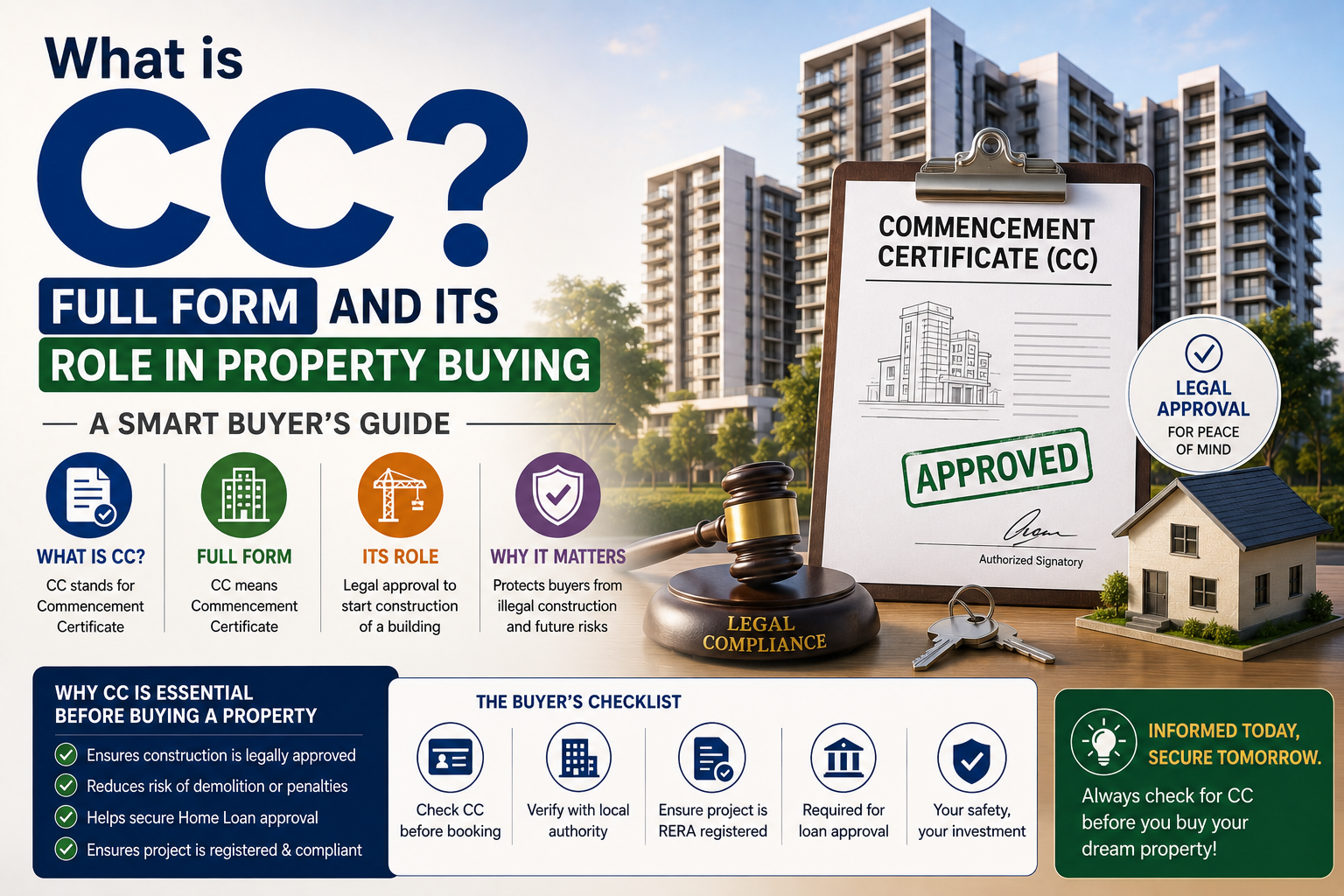
1. What Does CC Mean in Real Estate?
In the property and construction industry, CC is the abbreviation for “Completion Certificate,” sometimes also written as “Certificate of Completion.” You may also come across these related terms, all referring to the same core document with slightly different regional naming conventions:
- Building Completion Certificate (BCC)
- Completion cum Occupancy Certificate (COC) used in Delhi and a few other jurisdictions where completion and occupancy are certified together
- Completion Report / Completion Affidavit: the architect’s supporting document that feeds into the CC
No matter the label, the underlying purpose is identical: it’s official proof that a building was constructed the way it was approved to be constructed.
2. What Is a Completion Certificate Explained in Detail
A Completion Certificate in real estate is issued by a local governing authority, typically a municipal corporation, town planning department, or urban development authority,y after the authority has inspected the finished structure and verified that it matches:
- The sanctioned building plan
- The approved layout and Floor Space Index (FSI)/Floor Area Ratio (FAR)
- Structural safety norms
- Fire safety requirements
- Drainage, sewage, and water supply provisions
- Parking and setback regulations
- Environmental and tree-plantation clearances, where applicable
Think of the CC as the final “sign-off” on the physical construction of a project. It doesn’t grant permission to move in; that’s the job of the Occupancy Certificate (OC), but without a valid CC, an OC usually cannot be issued at all. In effect, the CC is the gateway document that unlocks everything that follows: occupancy, utility connections, registration, and resale.
“A Completion Certificate is not a formality; it is the difference between a building that legally exists and a structure that is merely standing,” a principle echoed across most state municipal building bylaws in India.
3. Why Is a Completion Certificate Important?
A CC protects three different stakeholders in a real estate transaction, and each has different reasons to care about it.
For homebuyers:
- Confirms the flat/villa/office you’re buying was built as promised, with no unauthorized deviations
- Required before the local authority will issue an Occupancy Certificate
- Often a prerequisite for property registration in several states
- Needed for water, electricity, and sewage connections in the buyer’s name
- A missing CC can delay or block a home loan disbursement
For builders/developers:
- Legal closure of the project with the regulatory authority
- Required to release the remaining amount from RERA-mandated escrow accounts
- Needed to hand over possession legally to buyers
- Protects the developer from penalties, project deregistration, or litigation
For banks and financial institutions:
- Used as a compliance check before approving home loans or loans against property
- Reduces the lender’s legal risk on the mortgaged asset
For government and civic bodies:
- Confirms the structure is safe for occupation and use
- Feeds into the property tax assessment for the completed building
- Creates an official record for future civic planning (roads, drainage capacity, water supply load, etc.)
4. Who Issues a Completion Certificate?
The issuing authority varies by city and state, but it is always a local government or municipal body, never a private entity. Common issuing authorities in India include:
| City/Region | Issuing Authority |
| Mumbai / Greater Mumbai | Municipal Corporation of Greater Mumbai (MCGM/BMC) |
| Bengaluru | Bruhat Bengaluru Mahanagara Palike (BBMP) / BDA |
| Delhi NCR | Municipal Corporation of Delhi (MCD) / relevant Development Authority |
| Pune / PCMC areas | Pune Municipal Corporation / PCMC |
| Chennai | Chennai Metropolitan Development Authority (CMDA) / Corporation of Chennai |
| Hyderabad | Greater Hyderabad Municipal Corporation (GHMC) / HMDA |
| Gurugram / Faridabad | Director, Town & Country Planning (DTCP), Haryana |
| Ahmedabad | Ahmedabad Municipal Corporation (AMC) / AUDA |
| Tier-2/3 towns | Respective Municipal Council, Nagar Nigam, or Development Authority |
An architect or licensed structural engineer empanelled with the authority typically prepares and submits the completion report and supporting certificates on behalf of the builder, which the municipal body then verifies before formally issuing the CC.
5. CC vs OC vs PCC vs Partial CC (Comparison Table)
This is one of the most searched confusions in real estate, and most existing articles only cover CC vs OC. Here’s the fuller picture, including the two other variants buyers frequently run into.
| Document | Full Form | Issued When | What It Confirms | Who Needs It Most |
| CC | Completion Certificate | After construction is fully finished | Building matches the sanctioned plan and safety norms | Builders, buyers, banks |
| OC | Occupancy Certificate | After CC is granted and final habitability checks are done | Building is safe and legally fit for people to move in | Buyers before taking possession |
| PCC | Provisional/Partial Completion Certificate | When part of a large project is complete, but the whole isn’t | That specific block/tower/phase can proceed to occupancy while other phases continue construction | Buyers in large phased townships |
| COC | Completion-cum-Occupancy Certificate | Some cities (e.g., Delhi) issue this as a single combined document | Both completion and occupancy readiness together | Buyers in cities that don’t separate the two |
Key distinction to remember: CC is about how the building was built; OC is about whether people can live in it. You need the CC first; it’s the foundation the OC is built on.
6. What Information a Completion Certificate Contains
While the exact format differs by state and municipal body, a standard CC typically includes:
- Name of the project/building and developer
- Complete site address and plot/survey number
- Building plan approval number and date
- Total built-up area and number of floors sanctioned vs. constructed
- Name and license number of the architect/structural engineer who certified completion
- Confirmation of compliance with fire, structural, and environmental NOCs
- Date of inspection and date of issue
- Signature and seal of the competent municipal authority
- A unique certificate/reference number (used for online verification)
7. Documents Required to Apply for a CC
Builders (or property owners doing self-construction) generally need to submit:
- Approved building plan / sanctioned layout
- Commencement Certificate (the permission that started construction)
- Architect’s/structural engineer’s completion certificate and site photographs
- Structural stability certificate
- Fire safety NOC (mandatory for multi-storey buildings)
- Environmental clearance, where applicable
- Lift/elevator inspection certificate, if installed
- Tree plantation or landscaping compliance certificate
- Property tax payment receipts up to date
- Proof of RERA project registration (for projects covered under RERA)
- Sewage and drainage connection approvals
8. Step-by-Step Process to Obtain a Completion Certificate
- Complete construction strictly as per the sanctioned plan; any deviation must be regularized before applying.
- Engage an empanelled architect/structural engineer to inspect the site and prepare the completion report.
- Compile all supporting documents (see list above), including NOCs from fire, environment, and other relevant departments.
- Submit the CC application to the municipal or development authority online through the civic body’s portal, or offline at the ward/zonal office, depending on the city.
- Pay the prescribed processing fee, which varies based on built-up area and municipal jurisdiction. The authority conducts a physical site inspection to verify structural safety, fire protection systems, parking, drainage, and adherence to the approved plan.
- The authority reviews documentation and cross-checks it against the sanctioned plan and any amendments.
- The certificate is issued once all checks are cleared, usually a few weeks to a few months depending on the city’s backlog and project complexity.
- CC number is uploaded to the civic portal, enabling buyers to verify it independently.
If discrepancies are found unauthorized floors, FSI violations, missing NOCs the authority can reject the application until the issue is regularized, sometimes with a penalty.
9. How to Apply for CC Online (State-Wise Portals)
Most large Indian cities now allow digital submission and status tracking, though physical inspection remains mandatory:
- Mumbai/MMR: MCGM’s online building proposal portal
- Bengaluru: BBMP’s e-Khata and building plan approval system
- Delhi: MCD’s online building permission and completion module
- Pune/PCMC: Respective municipal corporation’s e-governance portal
- Gujarat cities: Common Gujarat single-window town planning portal
- Haryana (Gurugram/Faridabad): DTCP Haryana online services
General online steps: register/log in on the municipal portal → fill the CC application form → upload documents → pay the fee online → track status → download the certificate once approved. For older properties or smaller towns without full digitization, the offline route through the ward office is still common.
10. How Long Does It Take and What Does It Cost?
- Timeline: Typically 3–4 weeks for straightforward, compliant projects; it can stretch to several months if there’s a backlog of inspections, incomplete documentation, or non-compliance issues that need correction.
- Cost: Processing fees are usually calculated per square foot/square metre of built-up area and vary significantly by city and building category (residential vs. commercial). There may be additional charges for regularizing minor deviations, if applicable.
- Delays commonly happen due to: missing NOCs, unresolved building-plan deviations, disputes over FSI usage, or a shortage of municipal inspection staff.
11. How to Check/Verify a Completion Certificate Before Buying
Before finalizing any purchase, independently verify the CC rather than relying only on the builder’s word:
- Ask the builder/seller for the CC copy and its unique reference number.
- Visit the relevant municipal corporation’s website and use the “building plan search,” “completion certificate status,” or “citizen services” section.
- Enter the property’s survey number, plot number, or application/reference number to pull up the record.
- Cross-check the sanctioned built-up area and floor count shown on the certificate against what has actually been built; this catches unauthorized extra floors or extensions, a common red flag.
- If the online record isn’t available, visit or write to the ward office directly, or consult a property lawyer to conduct due diligence.
- For RERA-registered projects, cross-verify the completion status shown on the state RERA portal against the municipal CC; discrepancies between the two are a warning sign.
12. What Happens If a Property Doesn’t Have a CC?
Buying or occupying a building without a valid CC carries real, tangible risk:
- No Occupancy Certificate: You legally cannot move in, since OC depends on CC.
- No utility connections: Municipal bodies and utility providers often refuse permanent water, electricity, and sewage connections without it.
- Registration hurdles: Several states now require CC before the sale deed can be registered.
- Home loan rejection or hold: Banks routinely withhold disbursement or refuse to sanction loans on units without a CC.
- Property tax complications: Assessment and payment can become disputed or penalized.
- Legal vulnerability: The structure can technically be classified as an unauthorized construction, exposing owners to demolition risk, fines, or regularization costs in extreme cases.
- Resale difficulty: Future buyers and their banks will ask the same questions you should be asking now; a missing CC depresses resale value and shrinks the buyer pool.
- Insurance issues: Property and structure insurance can be denied or invalidated without proof of compliant, certified construction.
13. CC and RERA: 2026 Regulatory Updates You Should Know
Regulatory scrutiny around Completion Certificates has tightened meaningfully over the past two years, and this is where most existing articles on this topic are outdated. A few developments relevant in 2026:
- State RERAs are auditing post-completion compliance more aggressively. For example, in March 2026, the Chhattisgarh Real Estate Regulatory Authority (CG-RERA) issued a binding circular under Section 37 of the RERA Act requiring promoters who obtained a CC on or before March 31, 2024, to formally submit an affidavit-cum-consent confirming the completed project has no deviations from the registered/approved layout, with promoters accepting penalties without contest if discrepancies are found. This signals a broader trend of RERAs retroactively verifying CC accuracy, not just accepting it at face value.
- Digitization of CC-OC linkage: More states are integrating municipal CC databases with their RERA project portals, making it easier for buyers to cross-check a project’s completion status across two independent government sources instead of relying solely on the builder.
- Architect/engineer certifications remain central to RERA compliance forms — Form 4 (or equivalent) under various state RERA frameworks is the architect’s certificate on project completion, which feeds directly into how promoters can withdraw funds and formally close a project.
- Growing state-level enforcement: Karnataka, Maharashtra, and Tamil Nadu continue to require a valid CC as a precondition for Occupancy Certificate issuance and, in many municipal areas, for property registration itself.
Practical takeaway for 2026 buyers: don’t just ask “does the project have a CC?” ask whether the CC has been verified against the RERA-registered plan, since regulators themselves are now actively checking for that gap.
14. CC’s Role in Home Loans, Insurance, and Resale
- Home loans/mortgages: Lenders treat the CC as a core compliance document. Its absence can mean a lower loan-to-value ratio, additional legal scrutiny, or outright rejection — this applies to home loans and loans against property alike.
- Insurance: Structure and fire insurance providers typically require proof that the building was constructed and certified per code; a missing CC can complicate claims later.
- Resale: A property with a clean, verifiable CC transacts faster and commands better buyer confidence. Missing CCs are one of the top reasons resale deals fall through during legal due diligence.
15. Common Mistakes Buyers Make Regarding CC
- Assuming “possession has started” automatically means CC and OC exist; it doesn’t.
- Accepting a photocopy of the CC from the builder without verifying it on the municipal portal.
- Confusing a Provisional/Partial CC (valid only for a specific phase or block) with a full project CC.
- Not checking whether the actual constructed area matches the sanctioned area mentioned on the CC.
- Ignoring the CC entirely because “the builder is reputed”; regulatory compliance is project-specific, not brand-specific.
- Not asking whether the project’s CC status matches its RERA-registered completion status.
16. Pre-Purchase CC Checklist for Homebuyers
Use this before signing any agreement or making a token payment:
- Ask for a copy of the CC and its unique reference/application number
- Verify the CC on the municipal corporation’s official portal
- Confirm whether it’s a full CC or a Partial/Provisional CC
- Cross-check sanctioned floors/area vs. actual constructed floors/area
- Confirm the project’s RERA registration number and completion status
- Check whether the Occupancy Certificate has also been issued
- Ask your bank whether the CC/OC status is sufficient for full loan disbursement
- Have a property lawyer review the CC alongside the sale deed and building plan
17. Frequently Asked Questions
1. What is the full form of CC in real estate? CC stands for Completion Certificate, also called a Certificate of Completion.
2. Is CC the same as OC? No. CC confirms the building was constructed as approved; OC confirms it is safe for people to actually occupy. OC is generally issued after CC.
3. Can I get a home loan without a CC? It’s difficult. Most banks require a CC (or at minimum a Partial CC covering the specific unit) before disbursing or fully releasing a home loan.
4. Who is responsible for obtaining the CC: the builder or the buyer? The builder/developer or property owner responsible for construction applies for and obtains the CC from the municipal authority.
5. How long is a Completion Certificate valid? A CC itself doesn’t typically expire, but it can be revoked or challenged if the property is later found to violate approved construction norms or undergoes unauthorized modification.
6. What is a Partial Completion Certificate? It’s issued for a portion of a large, phased project (like one tower in a multi-tower township) that is complete, allowing that section to proceed toward occupancy while other phases are still under construction.
7. Can a Completion Certificate be revoked? Yes. If a property is later found to have unauthorized deviations or safety violations, the issuing authority can revoke or suspend the CC until the issue is corrected.
8. Is CC mandatory under RERA? Yes, effectively. RERA-registered projects need a verified completion status supported by the CC before promoters can fully close out fund escrow requirements and hand over legal possession.
9. How can I check if a building has a CC online? Most municipal corporations offer an online “building plan search” or “completion certificate status” tool where you can search using the survey number, plot number, or application number.
10. What’s the difference between CC and a Commencement Certificate? A Commencement Certificate is granted before construction begins, permitting the builder to start work. A Completion Certificate is granted after construction ends, confirming it was done correctly.
11. Does every property need a CC, including individual houses? Yes — independent houses and self-built structures also require a CC from the local municipal or panchayat authority once construction is complete, not just large developer projects.
12. What if my builder refuses to share the CC? This is a significant red flag. You can independently check the municipal portal using the property’s survey/plot details, or file an RTI/complaint with the local civic body if the builder remains uncooperative.
18. Key Takeaways
- CC = Completion Certificate, a legally mandatory document confirming a building was constructed as per its approved plan and safety norms.
- It is issued by the local municipal/development authority, never by the builder itself.
- CC is a prerequisite for the Occupancy Certificate, utility connections, and in many states, property registration and loan disbursement.
- Always verify the CC independently through the municipal portal rather than relying solely on builder documentation.
- In 2026, RERAs are increasingly auditing CC accuracy retroactively; buyers should check both municipal CC records and RERA project status for consistency.
- A missing or invalid CC is one of the most common and most preventable causes of legal and financial trouble in Indian real estate transactions.