What Is the Future of Real Estate in Pune in 2026: Trends Shaping the Next Decade
Table of Contents

The most important framing shift for 2026 is this: Pune is no longer an emerging market in the way it was a decade ago, when growth was driven mainly by land availability and rock-bottom entry prices. It’s now a market where growth is increasingly shaped by deliberate infrastructure planning, regulatory maturity (RERA compliance, structured urban planning), and a more sophisticated, better-informed buyer base. This has real implications: the “buy anything, anywhere near an IT park” strategy that worked reasonably well a decade ago is meaningfully weaker in 2026, because differentiation between well-planned and poorly-planned developments — and between well-executed and delayed infrastructure — now matters more to actual returns than simple geographic proximity.
Trend 1: Sustainability and Green Building Are Moving From Premium Feature to Baseline Expectation
Green building certification, water conservation systems (rainwater harvesting, greywater recycling), solar integration, and energy-efficient design were, until recently, positioned by developers as premium differentiators commanding a price premium. That’s shifting. As water scarcity concerns in parts of Pune’s periphery become more visible and as buyer awareness of long-term utility costs grows, sustainability features are increasingly becoming a baseline expectation rather than an upsell — particularly among younger, dual-income buyers who are more attentive to long-term operating costs than to sticker price alone.
What this means practically: projects lacking basic sustainability infrastructure (particularly reliable water management, given Pune’s periphery water-supply variability) may face a growing resale and rental disadvantage over the coming years, even if they were competitively priced at launch. Buyers evaluating any project — especially in peripheral, still-developing corridors — should treat water infrastructure and sustainability features as a genuine due-diligence item, not a nice-to-have.
Trend 2: Technology Integration Is Reshaping How Flats Are Bought, Not Just How They’re Built
Two separate technology shifts matter here, and they’re often conflated in less careful coverage:
Proptech in the buying process itself — virtual site tours, digital documentation and verification tools, and increasingly sophisticated online listing platforms have meaningfully reduced the information asymmetry that historically favored builders and brokers over buyers. This is gradually shifting negotiating leverage toward better-informed buyers who arrive at a site visit having already done substantial independent research, rather than relying primarily on a sales team’s framing.
Smart-home and building technology within projects — integrated home automation, app-based society management, and smart security systems are increasingly standard in mid-to-premium projects rather than an exclusively luxury-segment feature. This trend matters for resale value specifically: buyers should expect that flats lacking basic smart-home readiness (wiring, infrastructure for future retrofitting) may become comparatively less competitive in the resale market over the coming years as buyer expectations continue shifting upward.
Trend 3: The Rise of Integrated Townships Over Standalone Towers
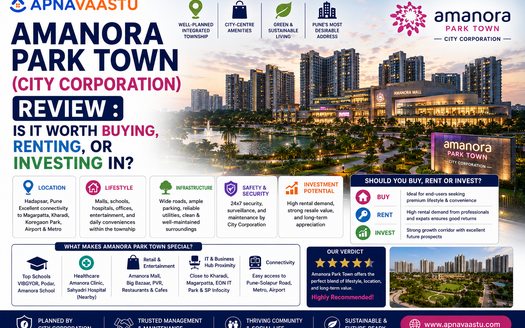
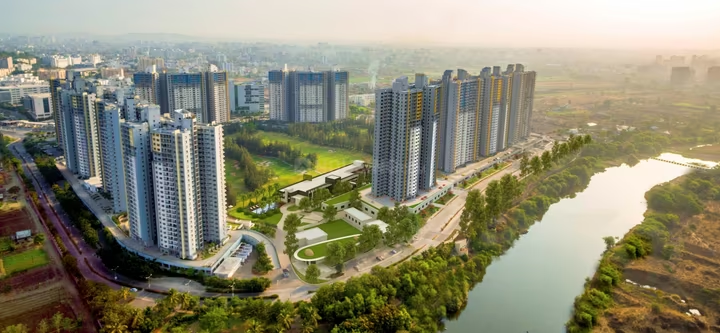
Pune’s supply mix has been visibly shifting toward large-scale integrated townships (following the Magarpatta/Amanora model) that combine residential, retail, educational, and green space within a single planned development, rather than standalone residential towers dependent entirely on surrounding, sometimes unplanned, infrastructure.
Why this matters for the future of the market: integrated townships tend to offer more predictable long-term livability and resale value because their infrastructure (roads, utilities, amenities) is planned for the eventual density from the outset, rather than retrofitted reactively as an area organically densifies. For buyers with a genuinely long-term horizon, this structural difference is likely to matter more over a 5–10 year hold than the specific unit-level features of any individual flat — a standalone tower in an area with weak surrounding infrastructure planning carries a different long-term risk profile than an equivalent unit within a well-planned township, even at a similar price point today.
Trend 4: Buyer Preferences Are Shifting Toward Flexibility and Hybrid-Work-Compatible Design
The lasting effect of hybrid and flexible work arrangements on housing preference hasn’t fully played out, but the direction is clear: dedicated home-office space, better natural light and ventilation, and proximity to quality co-working infrastructure are increasingly weighted more heavily by buyers than they were in a purely commute-driven housing decision framework.
This has a specific implication for Pune’s IT-corridor-adjacent markets: locations that remain highly commute-optimized but offer relatively poor in-home living quality (compact layouts, limited natural light, minimal amenity space) may see relatively softer demand growth compared to slightly further-out locations offering meaningfully better living quality, as the pure “minimize commute at all costs” calculation becomes somewhat less dominant for a growing share of buyers with more workplace flexibility.
Trend 5: Rental Market Professionalization
Pune’s rental market — historically dominated by informal, individually-managed listings — is showing early signs of professionalization: managed rental platforms, more standardized lease documentation, and a growing co-living segment specifically targeting students and young professionals in university-adjacent and IT-corridor-adjacent locations.
What this means for investors: the rental yield calculation is likely to become somewhat more transparent and benchmarkable over time as more standardized rental data becomes available, reducing (though not eliminating) the current information gap between what landlords informally claim as “market rent” and what’s actually achievable. Investors buying with a rental-yield thesis should increasingly expect and demand comparable, documented rental data rather than relying solely on broker-provided estimates.
Trend 6: Regulatory Maturity Continuing to Raise the Floor on Developer Accountability
RERA compliance culture in Pune has matured significantly since the regulation’s introduction, and the trend toward stricter enforcement, more transparent project disclosure, and reduced tolerance for chronic delivery delays is likely to continue. This doesn’t eliminate risk — delivery delays and disputes still occur — but the trajectory favors buyers over time, with better documentation standards and more accessible grievance mechanisms than existed a decade ago.
Practical implication: buyers evaluating projects should increasingly expect and demand the level of transparency RERA is designed to provide (registered completion dates, escrow-linked fund utilization, standardized agreements) as a baseline, and should treat any project or builder resistant to this transparency as a meaningfully higher-risk signal than it might have been treated in a less mature regulatory environment.
Trend 7: Diversifying Employment Drivers Beyond Pure IT Services
Pune’s employment base is structurally diversifying — continued growth in manufacturing and industrial activity (particularly around the Chakan-Talegaon corridor), a growing presence of global capability centers (GCCs) beyond traditional IT services outsourcing, and continued strength in education and research. This diversification is a genuinely important structural trend for real estate specifically, because it means Pune’s housing demand is becoming somewhat less correlated with IT-sector-specific hiring cycles than it was a decade ago, which historically made IT-dependent corridors more vulnerable to sector-specific slowdowns.
Segment-Wise Outlook: How Different Price Bands Are Likely to Behave Differently
Most “future of real estate” articles treat the market as a single undifferentiated block. A more useful framing separates expectations by price segment, since these segments respond to different demand drivers:
| Segment | Primary Demand Driver | Likely Trajectory Through the Rest of the Decade |
| Affordable (compact, peripheral) | First-time buyers, price-sensitive investors | Continued volume growth, but appreciation more dependent on specific infrastructure execution than segment-wide momentum |
| Mid-segment (established IT-corridor 2BHK/3BHK) | Upgrading end-users, rental-yield investors | Steadier, more moderate appreciation; strongest liquidity segment overall |
| Premium/luxury (integrated townships, branded developments) | High-net-worth end-users, lifestyle-driven buyers | Continued demand resilience, less price-sensitive to broader market cycles, but a smaller, more selective buyer pool |
| Redevelopment/older society stock (central, established localities) | Investors and end-users seeking central location with modernization potential | Growing segment as more societies reach redevelopment eligibility age; distinct risk/return profile requiring specific redevelopment-process due diligence |
What Could Disrupt These Trends: Risk Factors Worth Watching
A credible future-outlook piece should name genuine risks rather than presenting only upside:
- Interest rate volatility — a meaningful rate increase cycle would affect affordability and financing-dependent demand more than it would affect cash-heavy premium segment demand, making the mid and affordable segments more sensitive to this risk.
- Infrastructure execution risk — several of the trends above (integrated townships, connectivity-driven appreciation) depend on infrastructure projects completing on reasonably close to their stated timelines; Pune’s historical pattern of phased delays on major projects is a real risk to factor into any forward-looking thesis, not a hypothetical one.
- Oversupply in specific segments/corridors — rapid launch activity in certain peripheral corridors could outpace genuine demand growth, suppressing appreciation even where the broader structural trends above hold true citywide.
- Water and utility infrastructure strain — as Pune’s periphery continues to densify, utility infrastructure (water supply specifically) keeping pace with residential growth is a genuine structural risk factor, not just a project-level due-diligence item, as referenced in the sustainability trend above.
How to Actually Use These Trends When Making a 2026 Buying or Investment Decision
Rather than treating these as abstract observations, here’s how each trend should concretely inform a decision:
- Weight sustainability and water infrastructure genuinely into your project shortlist, not just amenity checklists — this is increasingly a resale-value factor, not just a lifestyle preference.
- Favor integrated townships or well-planned developments over standalone towers when your holding horizon is genuinely long-term (5+ years), given the structural livability and resale-value advantage explained above.
- Treat RERA transparency and documentation quality as a baseline requirement, and be skeptical of any project or builder resistant to providing it.
- If investing for rental yield, increasingly demand documented, comparable rental data rather than relying solely on broker-provided estimates, as the market’s data quality continues improving.
- Diversify your locational thesis across Pune’s diversifying employment base rather than concentrating purely on IT-corridor exposure, if building a multi-property investment portfolio over time.
- Build genuine infrastructure-delay buffers into any appreciation timeline tied to specific projects (metro extensions, road widening), rather than assuming official timelines will hold exactly as announced.
Frequently Asked Questions
Is Pune’s real estate market expected to grow through the rest of the decade? The structural drivers underlying Pune’s market — diversifying employment, continued infrastructure investment, and a maturing regulatory environment — support continued growth, though growth is increasingly likely to be uneven across specific corridors and price segments rather than uniform citywide, making location- and segment-specific due diligence more important than a blanket city-wide growth assumption.
Will Pune property prices keep rising as fast as they have in recent years? Appreciation is likely to become more differentiated by corridor and segment rather than broadly uniform, as some previously high-growth areas have already captured much of their appreciation while others remain earlier in their growth cycle. Blanket predictions of continued uniform rapid appreciation across the whole city should be treated skeptically.
What type of property is likely to hold value best over the coming years? Units within well-planned integrated townships, in corridors with genuinely funded and actively progressing infrastructure, from developers with strong RERA compliance and delivery track records, are structurally better positioned than standalone developments in less-planned surroundings — though specific project and locality due diligence remains essential regardless of these broader trends.
Is now a good time to buy in Pune given these trends? Timing depends more on your specific objective (end-use versus investment, yield versus appreciation focus) and the specific project/locality’s position within these broader trends than on a single citywide “good time” or “bad time” answer — a more useful question than market timing is whether the specific opportunity aligns with the structural trends outlined above.
Final Takeaway
The future of Pune’s real estate market isn’t best understood through a single price prediction — it’s better understood through the structural shifts already underway: a move toward planned, sustainable, technology-integrated development; a maturing, more transparent regulatory and rental environment; and an increasingly diversified employment base reducing single-sector dependency. Buyers and investors who align their decisions with these structural trends — favoring well-planned developments, genuine infrastructure progress over announcements, and documented transparency over broker assurances — are positioned to benefit from Pune’s continued growth more reliably than those chasing any single locality or price prediction in isolation.