What is EOI in Real Estate? Full Form, Meaning, and Refund Rules
Table of Contents
1. What Does EOI Stand For?
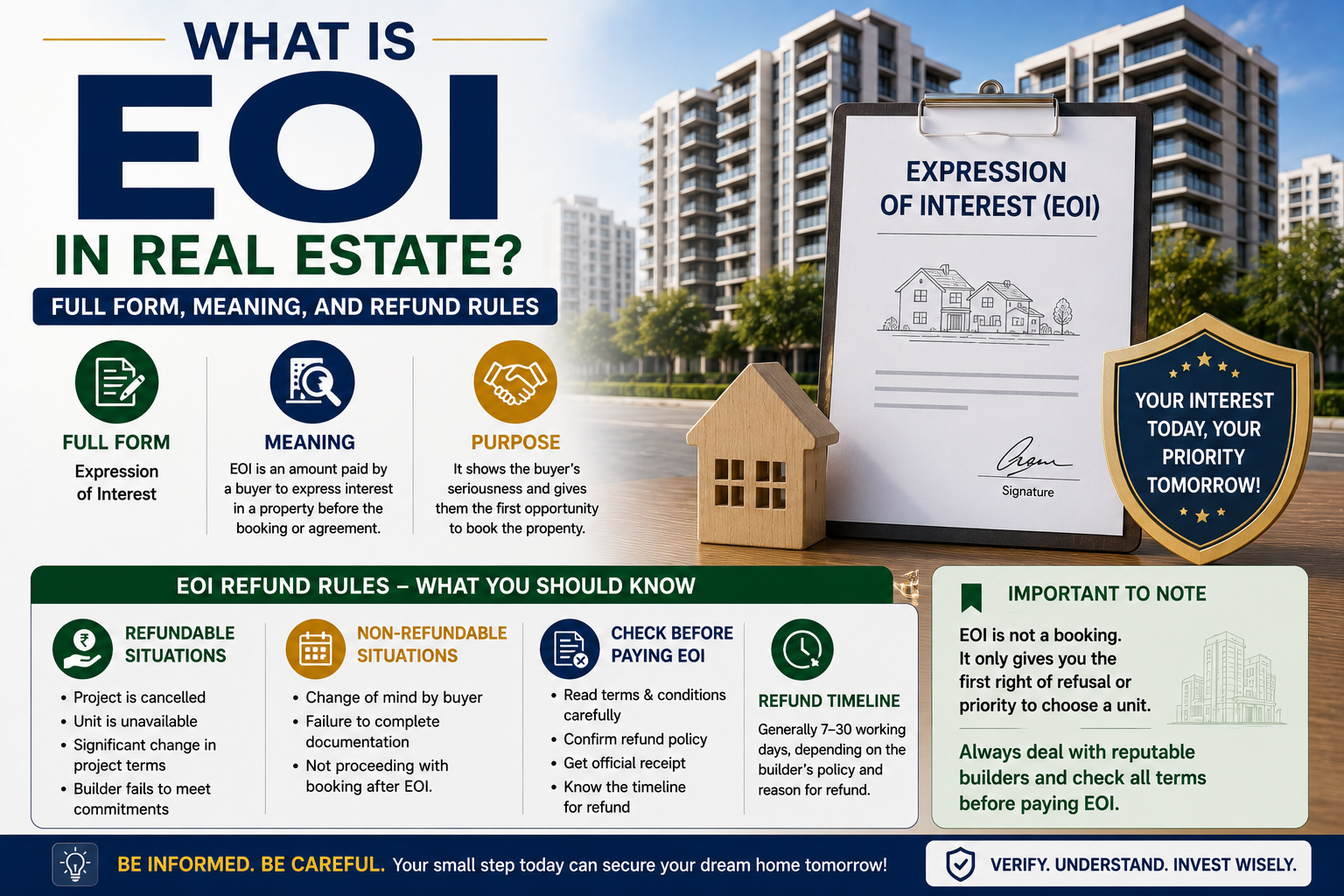
EOI = Expression of Interest. In the real estate context, it’s sometimes also referred to informally as:
- Interest registration
- Pre-booking registration
- Priority registration (in pre-launch marketing)
All of these describe the same core mechanism: a buyer formally signals intent before a project is fully launched or before a resale deal is formalized.
2. What Is EOI in Real Estate Explained in Detail
An Expression of Interest (EOI) is a formal, written, and typically non-binding submission made by a prospective buyer or investor to a developer, seller, or their sales representative, indicating serious intent to purchase a specific property or unit within a project.
It’s most commonly used in:
- Pre-launch phases of new residential or commercial developments, where a project isn’t officially open for sale yet
- High-demand or limited-inventory launches, where developers want to gauge demand before finalizing pricing or unit allocation
- Luxury and premium residential projects, where developers prefer to filter serious buyers from casual enquirers
- Commercial real estate and off-market deals, where sellers use EOIs to assess buyer seriousness before opening private negotiations
- Occasionally, in resale transactions for high-value or off-market properties
The key legal and practical characteristic of an EOI is that it is not a contract of sale. It doesn’t transfer any rights in the property, doesn’t fix a final price in most cases, and doesn’t obligate the developer to allot a unit to the person submitting it.
“The Expression of Interest is a valuable early step in the property-buying journey, offering flexibility for homebuyers and clarity for developers,” a description that captures why EOI has become a standard pre-launch tool across major Indian developers.
3. How the EOI Process Works, Step by Step
- Developer opens pre-launch registrations. Before a project is officially listed for sale, the developer (directly or via channel partners) invites prospective buyers to submit EOIs, sharing a project overview, indicative pricing, and location highlights. RERA registration may still be in process at this stage.
- Buyer submits the EOI. This typically includes buyer details, unit/configuration preference, and a token EOI amount paid to the developer’s official account, with a receipt issued.
- Developer collects and reviews EOIs. The volume and profile of EOIs received help the developer gauge genuine market demand, fine-tune final pricing, and plan the unit allocation or launch strategy.
- Developer finalizes pricing and inventory. Based on demand signals from EOIs, the developer sets final prices and opens formal bookings, sometimes giving EOI holders early or priority access.
- Buyer decides whether to convert or withdraw. At official launch, the buyer can proceed to a formal booking (usually by paying a booking amount and, if satisfied, signing the sale agreement) or choose to withdraw and request a refund of the EOI amount, subject to the developer’s stated terms.
- Refund or conversion is processed. If the buyer withdraws, the developer refunds the EOI amount per the agreed policy. If the buyer proceeds, the EOI amount is typically adjusted against the booking amount or total property cost.
4. EOI vs Token Amount vs Booking Amount vs LOI (Comparison Table)
This is one of the most-searched points of confusion around EOI, and most existing articles cover only one or two of these comparisons. Here’s the fuller picture.
| Stage | What It Means | Binding? | Typical Refundability | When Used |
| EOI (Expression of Interest) | Earliest signal of buyer interest, usually pre-launch | No | Usually fully refundable, per developer policy | Pre-launch, high-demand projects, off-market deals |
| Token Amount | A mid-step payment to temporarily hold a specific unit | Weak/limited | Often refundable, sometimes with a small deduction | After EOI, once a specific unit is identified |
| Booking Amount | Formal reservation of a unit, closer to a real commitment | Stronger | Usually non-refundable or refundable only with cancellation charges | At official launch/booking stage |
| LOI (Letter of Intent) | A more detailed statement of intent, sometimes used in resale or commercial deals to outline proposed terms | Can carry more weight if it specifies binding clauses | Varies, depends on drafted terms | Resale transactions, commercial negotiations |
| Sale Agreement | The formal, legally binding contract | Yes, fully binding | Governed by contract and RERA cancellation rules | After booking is confirmed |
Key distinction: EOI is about raising your hand; a booking amount is about reserving the seat; the sale agreement is buying the ticket. LOIs sit closer to resale and commercial contexts, whereas EOIs are more associated with developer-led project launches.
5. Is an EOI Legally Binding? What RERA Says
No, an EOI is not a legally binding contract under Indian law. It does not obligate the buyer to complete the purchase, nor does it obligate the developer to guarantee allocation of a specific unit or honor an indicative price quoted at the EOI stage. Final pricing and terms are typically confirmed only at the booking or agreement stage.
That said, EOI-stage payments don’t exist in a regulatory vacuum:
- Section 13 of the RERA Act, 2016 caps the amount a developer can collect as an advance or application fee before a formal, registered Sale Agreement is signed, generally at 10% of the property’s cost. While this provision is most directly associated with booking and advance payments, it’s a useful benchmark buyers should be aware of if an EOI amount starts creeping toward a large percentage of the total price.
- Developers are expected to disclose refund and cancellation terms transparently; non-disclosure or misleading terms around refunds can potentially fall under unfair trade practice provisions of consumer protection law.
- If a project is not yet RERA-registered at the EOI stage, that’s not automatically disqualifying (pre-launch marketing sometimes precedes registration), but buyers should treat it as a signal to ask more questions, not fewer, before paying any amount.
Practical takeaway: an EOI protects your option to buy, not your right to buy at a specific price or unit. Always get the refund and conversion terms in writing before paying.
6. Is EOI Refundable? Conditions, Timelines, and Rules
Whether your EOI amount comes back to you depends entirely on the developer’s stated policy. There is no single universal rule, but common patterns include:
Typically refundable when:
- You are not shortlisted or allotted a unit by the developer
- You withdraw your interest before converting to a formal booking
- The project itself gets delayed or cancelled by the developer
- The project is RERA-registered with proper approvals and refund terms are documented in writing
Typically not refundable, or only partially refundable, when:
- You proceed to the booking stage and later back out (subject to the developer’s cancellation policy)
- The developer’s terms explicitly state the EOI amount is non-refundable or subject to a processing/retention fee
- You fail to meet a stated deadline to convert your EOI into a booking
Typical refund timelines: many developers state a refund window of roughly 30 to 45 days from the date of withdrawal or non-allotment, but this is developer-specific and should always be confirmed in writing before payment, not assumed.
Important caution: not every developer follows a refundable model. Some project terms explicitly state that the EOI payment is non-refundable and will stand appropriated once submitted, with any refund left entirely to the developer’s discretion. This is precisely why reading the specific EOI terms and conditions, not just general industry norms, is essential before paying anything.
7. How Much Is a Typical EOI Amount?
EOI amounts vary significantly by project category and market positioning:
| Project Category | Typical EOI Amount Range |
| Mid-range residential developments | ₹50,000 – ₹2,00,000 |
| Premium residential projects | ₹2,00,000 – ₹5,00,000 |
| Ultra-luxury residential projects | ₹5,00,000 and above |
| Commercial/high-value off-market deals | Negotiated case by case, often a fixed percentage of deal value |
Always confirm the exact amount and refund terms directly with the developer’s official sales team rather than relying on general ranges. EOI amounts are set at the project’s discretion and can differ even within the same city or developer’s portfolio.
8. Why Developers Use EOI (Pre-Launch Demand Gauge)
For developers, EOI serves several strategic purposes:
- Demand validation: Gauging genuine buyer interest before committing to final pricing or launch timelines
- Buyer profiling: Understanding which unit types, floors, or configurations are in highest demand
- Sales pipeline building: Creating a warm, pre-qualified list of serious buyers ahead of a public launch
- Reduced launch-day uncertainty: Entering the formal sales phase with data-backed confidence rather than guesswork
- Marketing and pricing strategy: Adjusting final pricing based on the volume and profile of EOIs received
9. Why Buyers Submit an EOI: Real Benefits
- Early access: A chance to secure preferred units, floors, or configurations before public launch
- Potential price advantage: Some developers offer “early bird” or pre-launch pricing to EOI holders, though this isn’t guaranteed or binding
- Low financial risk: A comparatively small, often-refundable amount compared to a full booking commitment
- Negotiation leverage: In resale or off-market deals, an EOI signals seriousness and can open the door to private negotiation
- Time to complete due diligence: Buyers can use the EOI window to verify RERA registration, project approvals, and loan eligibility before committing further
10. Risks and Red Flags to Watch For
- Non-refundable clauses buried in fine print: always read the actual EOI terms, not just what the sales team verbally promises
- Paying EOI amounts in cash or to personal accounts instead of the developer’s official account, with no receipt
- Assuming EOI guarantees unit allocation; it does not; demand can exceed supply, and allocation is discretionary
- Vague or undocumented refund timelines:s insist on written terms, not verbal assurances. EOIs I collected for a project with no RERA registration or application in progress;s treat this as a reason for deeper scrutiny
- Pressure tactics (“only a few units left,” “price will double after launch”) used to rush EOI payment without due diligence
11. Questions to Ask Before Paying an EOI Amount
Before handing over any token EOI payment, get clear answers directly from the developer’s official sales team:
- Has the project been registered with RERA, or has the application at least been submitted?
- Is the EOI amount fully refundable, and is the refund timeline documented in writing?
- What is the indicative price range, and can it change between now and the official launch?
- Does submitting an EOI guarantee a specific unit type, floor, or orientation, or just a place in the queue?
- What payment structure applies after booking construction-linked or time-linked?
- Where exactly is the EOI amount being paid official company account, with a proper receipt?
- What happens if the project is delayed or cancelled altogether?
12. What a Standard EOI Document Contains
While formats vary by developer, a typical EOI form/letter includes:
- Full name and contact details of the prospective buyer
- Property/project name and preferred unit type or configuration
- Indicative price range or budget
- EOI/token amount paid, along with payment mode and receipt reference
- Refund and cancellation terms
- Validity period of the EOI (how long it remains active before lapsing or requiring renewal)
- Any conditions under which the EOI converts automatically to a booking
13. EOI in Other Real Estate Contexts: Auctions, Insolvency Sales, and Commercial Deals
Most searches for “EOI in real estate” relate to the developer pre-launch scenario above, but the term also appears in a few other real estate-adjacent contexts worth knowing, since the underlying mechanism differs meaningfully:
- Bank auctions and distressed asset sales (SARFAESI Act): When banks or Asset Reconstruction Companies (ARCs) auction mortgaged properties from defaulting borrowers, interested bidders are sometimes required to submit an EOI along with an Earnest Money Deposit (EMD) and execute a Non-Disclosure Agreement (NDA) before accessing detailed property/loan data. Here, EOI functions more like a formal bidder-registration step than a soft pre-launch interest signal.
- Insolvency and NCLT-driven asset sales: Under the Insolvency and Bankruptcy Code (IBC), Resolution Professionals inviting bids for a corporate debtor’s real estate or business assets often use a formal EOI stage as part of a structured, regulated bidding process — again a more procedural, higher-stakes use of the term than a residential pre-launch EOI.
- Commercial real estate and institutional deals: In large commercial transactions, an EOI can resemble a preliminary term sheet, outlining proposed price, timelines, and conditions before deeper due diligence and a formal offer.
Why this matters for buyers: if you encounter “EOI” in the context of a bank auction listing or an NCLT/insolvency sale notice, treat it as a more procedural, rule-bound step than the pre-launch residential EOI described above the refund conditions, deposit forfeiture rules, and legal consequences are typically stricter and governed by specific statutory processes (SARFAESI Rules, IBC regulations) rather than a developer’s internal policy.
14. Common Mistakes Buyers Make with EOI
- Assuming payment of an EOI guarantees the exact unit they want
- Not verifying the developer’s RERA registration status before paying
- Failing to get refund and cancellation terms in writing
- Paying through unofficial channels without a proper receipt
- Not researching the developer’s track record and project delivery history
- Confusing a residential pre-launch EOI with the stricter, auction/insolvency-style EOI used in bank or NCLT sales
15. Pre-EOI Checklist for Buyers
- Confirm the project’s RERA registration number (or application status, if pre-registration)
- Get the refund policy and timeline in writing, not just verbally
- Confirm the exact EOI amount and payment account details
- Ask whether the EOI guarantees a specific unit or just priority consideration
- Request a detailed cost sheet (base price, GST, parking, amenities charges)
- Research the developer’s delivery track record on past projects
- Keep all receipts and written communication for future reference
- Assess your loan eligibility and financial readiness before committing further
16. Frequently Asked Questions
1. What does EOI stand for in real estate? EOI stands for Expression of Interest, a non-binding formal declaration of a buyer’s intent to purchase a property, typically used before a project’s official launch or before a resale deal is finalized.
2. Is EOI the same as a booking amount? No. EOI is an earlier, generally more flexible and refundable step, while a booking amount is a stronger commitment that reserves a specific unit and is often non-refundable or subject to cancellation charges.
3. Is the EOI amount refundable? In most cases, yes, but this depends entirely on the developer’s specific terms. Some projects explicitly state EOI amounts are non-refundable, so always confirm in writing before paying.
4. Does paying an EOI guarantee me a unit? No. An EOI signals interest and may give priority consideration, but it does not guarantee allocation of a specific unit, especially in high-demand launches where demand can exceed supply.
5. Is EOI legally binding? No, an EOI is not a legally binding contract under Indian law. The binding, enforceable stage is the formal, registered Sale Agreement.
6. How much is typically paid as an EOI amount? It varies by project category, commonly ₹50,000 to ₹2,00,000 for mid-range residential projects, and up to ₹5,00,000 or more for premium and luxury developments.
7. What’s the difference between EOI and LOI (Letter of Intent) in real estate? EOI is more common in developer-led pre-launch scenarios, while LOI is more often used in resale transactions or commercial deals to outline more detailed proposed terms.
8. Can I back out after submitting an EOI? Yes, since it’s non-binding, you can typically withdraw before converting to a formal booking, subject to the developer’s specific refund terms.
9. Do I need to check RERA registration before paying an EOI amount? Yes. While a project may be in pre-launch and RERA registration could still be in process, it’s important to know the registration status or application progress before paying anything.
10. Is EOI used only for residential real estate? No, it’s also used in commercial real estate, off-market deals, and in a more procedural form in bank auctions (SARFAESI) and insolvency/NCLT-driven asset sales, though the rules and stakes differ significantly in those contexts.
11. What happens if the project I submitted an EOI for gets delayed or cancelled? In most cases, buyers are entitled to a refund of their EOI amount if the developer delays or cancels the project, though this should be confirmed against the specific terms provided at the time of payment.
12. Should I pay the EOI amount in cash? No,o always pay through official, traceable channels (bank transfer, cheque, or the developer’s official payment portal) directly to the developer’s registered account, and insist on a proper receipt.
17. Key Takeaways
- EOI = Expression of Interest:t a non-binding, early-stage signal of a buyer’s intent, not a purchase commitment.
- It sits before the token amount and booking amount in the typical property-buying sequence, and well before the legally binding Sale Agreement.
- Refundability depends entirely on the developer’s specific terms get this in writing before paying, since some projects explicitly state EOI amounts are non-refundable.
- EOI does not guarantee unit allocation or locked-in pricing; always verify current terms before assuming anything from earlier marketing communication.
- Beyond residential pre-launches, EOI also appears in bankauctionsn (SARFAESI) and insolvency/NCLT asset sales, a more procedural, stricter use of the same term that buyers shouldn’t confuse with the flexible pre-launch version.
- Always verify RERA registration status, get refund terms in writing, and pay only through official, traceable channels.