Is a Completion Certificate Required for Home Loan Approval?
Table of Contents
Purchasing a home and taking a home loan are significant achievements. Still, the documentation part can be so lengthy that it can be very tiring. One of the papers that most confuses the buyers is the Completion Certificate (CC).
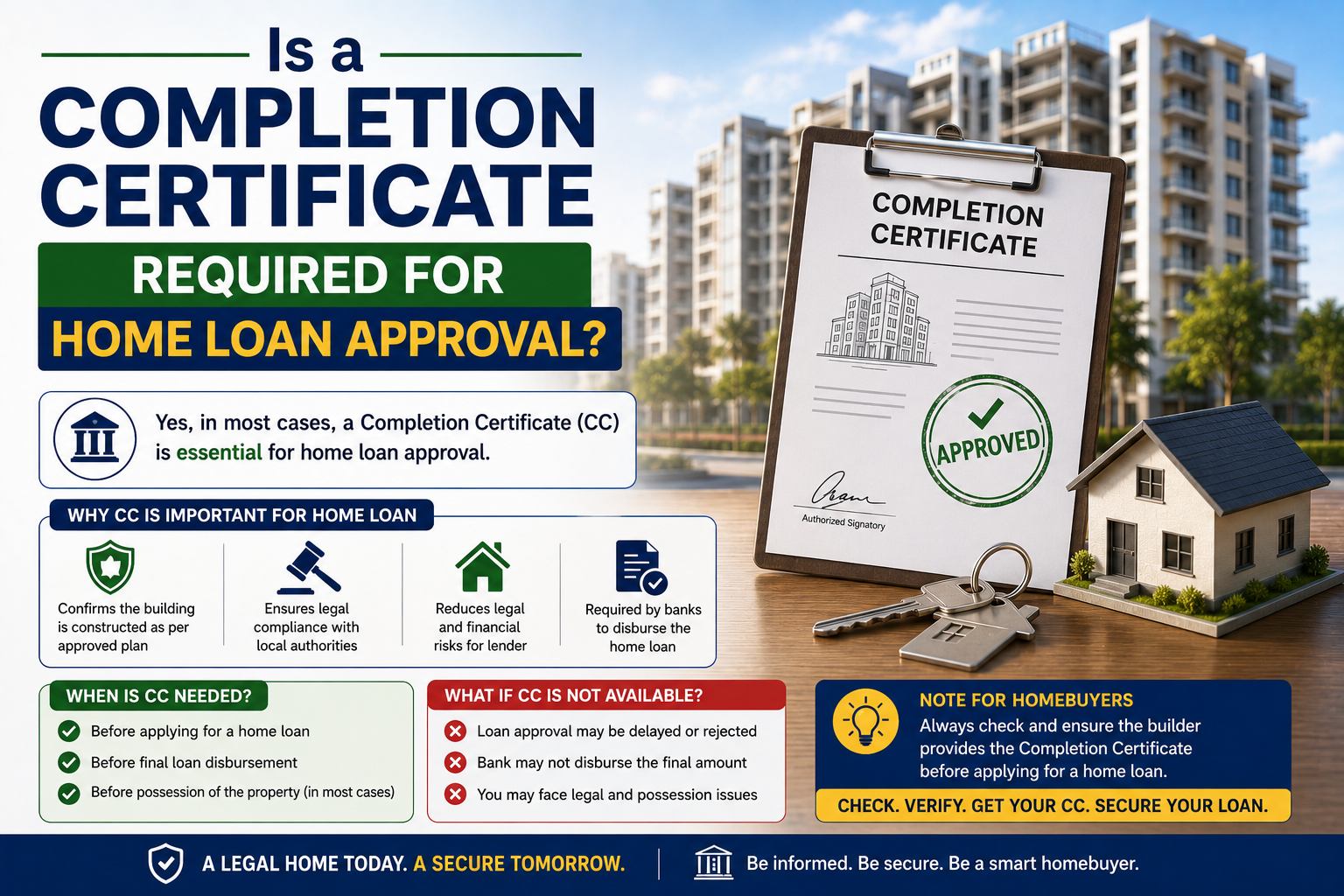
Are you thinking, “Without a completion certificate, can I still get a home loan approval?” to simply say: Yes, for most ready-to-move-in properties, it is non-negotiable. But the guidelines change whether your home is still under construction or finished.
This detailed guide will help us understand why the CC is the “go-ahead” for banks, the difference between a Completion Certificate (CC) and an Occupancy Certificate (OC), and also, what the options are if your developer hasn’t issued one to you.
What is a Completion Certificate (CC)?
A Completion Certificate is an official document given by local municipal bodies like DDA in Delhi, BMC in Mumbai, BBMP in Bangalore, etc. It is provided after the building construction is completed.
It is official proof that the building was constructed per the approved building plan and is also in compliance with all the safety codes, FAR limits, and other regulations of the area. In the absence of this, a building will be considered unauthorized, as per the law.
Is a Completion Certificate Required for Home Loan Approval?
The need for CC depends totally on the state of the property:
- Ready-to-Move-In Property
In case you intend to purchase a ready flat, banks will strictly demand the Completion Certificate.
Reason: Banks need to make sure that the assets they are giving loans against are legitimate. In case of any property without a CC, there might be possibilities of a demolition notice being served by the government on such properties. Since the asset in this case is collateral security for you, the bank will not risk itself in such matters.
- Under-Construction Properties
For properties that are not yet completed, one may qualify for a home loan without a CC.
- The Process: This involves getting approval from the bank using the Commencement Certificate that allows commencement of construction and RERA registration of the property.
- The Catch: The home loan shall be disbursed in installments corresponding to the various phases of construction. The last installment may sometimes be withheld until issuance of the CC/OC certificate.
- Resale Properties
When purchasing an old flat from a previous owner, the bank will carry out a “legal technical verification”. In case the CC was not issued for the building, a majority of Tier-1 banks will not approve the loan application.
Can I Get a Home Loan Without a Completion Certificate?
Technically, getting a home loan for a property that is under construction is possible without a completion certificate, but it is almost impossible for a finished building to get a loan from reputable lenders.
As per the Real Estate (Regulation and Development) Act, 2016 (RERA), developers have to secure a Completion Certificate and an Occupancy Certificate before they can hand over possession (IncorpX, 2026). If a builder is requesting you to move in without these documents, that means you are stepping into a “gray zone” where the property may not even legally have access to water and electricity connections.
CC vs. OC: What’s the Difference?
Many buyers use these terms interchangeably, but they are different steps in the legal process:
| Feature | Completion Certification (CC) | Occupancy Certification (OC) |
| Purpose | Certifies that the building is finished as per the plan. | Certifies the building is fit for human habitation. |
| Utilities | Does not guarantee water/power | Mandatory for permanent water, power, and sewage. |
| Loan Status | Needed for the final loan closure. | Crucial for the final disbursement and title transfer. |
Documents Needed for a Home Loan in India (2026 Checklist)
If you are applying for a home loan this year, then make sure that you have all the following documents ready to facilitate faster processing of your application:
- Property Documents
- Allotment letter or signed sale agreement.
- Chain of title deeds (only for resale property).
- Approved Building Plan copy.
- Commencement certificate (for construction ongoing property).
- Latest Tax Receipts and Encumbrance Certificate (EC).
- KYC & Financial Documents
- Proof of Identity: Aadhaar Card, PAN Card, or Passport.
- Proof of Address: Voter ID, Utility Bills, or Driving License.
- Income Proof for Salaried Individuals: Last three months’ salary slips, Form 16, and six months’ bank statements.
- Income Proof for Self-Employed: Previous two years’ income tax return (ITR), Profit & Loss Statement, and business registration.
What Happens if You Buy a Property Without a CC?
Purchasing real estate without the completion certificate is a risky proposition. Here is what you can expect:
- Eviction Order: The government may deem the structure “illegal,” compelling you to vacate.
- Utility Bill: Since the building will not be certified for domestic usage, you will need to bear commercial prices for water and electricity.
- Resale Issue: It would be very tough to sell your real estate because the next buyer will also struggle to obtain a housing loan.
- Higher Property Taxation: You could face higher penalties for staying at the uncertified property.
Final Verdict: Don’t Skip the CC
A Completion Certificate (CC) is not just a document; it’s your legal safeguard. You may initiate a home loan for an under-construction flat even without the CC, but you should never agree to a ready-to-move-in flat without inspecting the original CC and OC.
If you are planning to invest in a house, the first thing you should do is verify the project’s RERA registration status. As per the 2016 RERA law, developers are obligated to furnish these certificates to buyers, or else they are subjected to heavy fines (IncorpX, 2026).